Chemistry · Ch 1 — Solutions
Elevation of Boiling Point
Elevation of Boiling Point
A liquid boils at the temperature where its vapour pressure becomes equal to the surrounding atmospheric pressure. Water, for instance, boils at 373.15 K (100 °C) because at that temperature its vapour pressure reaches 1.013 bar (1 atmosphere).
Why the boiling point rises
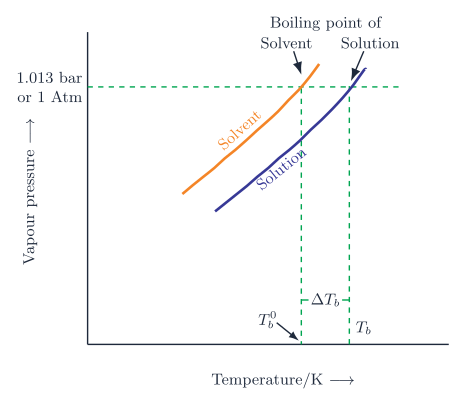
Adding a non-volatile solute lowers the vapour pressure of the solvent at every temperature. So at the pure solvent's normal boiling point, the solution's vapour pressure is still below atmospheric pressure — it is not yet boiling. To push its vapour pressure back up to 1.013 bar, the solution must be heated to a higher temperature. Hence a solution always boils at a temperature above the boiling point of the pure solvent.
Drawn by us to help you understand the concept clearly, and verified to make sure it's accurate. For exams, practice from your textbook's own diagram.
The figure plots vapour pressure on the vertical axis against temperature (in Kelvin) on the horizontal axis. Two upward-sloping curves are shown:
- The upper curve is for the pure solvent.
- The lower curve is for the solution (solvent + non-volatile solute).
A horizontal dashed line is drawn at 1.013 bar (standard atmospheric pressure). This line cuts both curves. From each intersection point, a vertical dashed line drops down to the temperature axis:
- The left vertical line meets the axis at , the boiling point of the pure solvent.
- The right vertical line meets the axis at , the boiling point of the solution.
The horizontal gap between these two temperatures on the x-axis is labelled — the elevation of boiling point.
Physical idea
At any given temperature, the vapour pressure of the solution is lower than that of the pure solvent (Raoult’s law). To make the solution boil — i.e., to raise its vapour pressure up to the external pressure of 1.013 bar — a higher temperature is needed. Hence the solution’s boiling point is higher than the solvent’s boiling point. The figure makes this shift visible: the solution curve must be followed further to the right before it reaches the 1.013 bar line.
Key formula developed from this figure
For dilute solutions, the elevation is directly proportional to the molality of the solute:
where:
- is the boiling point elevation (in K),
- is the molality of the solution (in mol kg),
- is the molal boiling point elevation constant (or ebullioscopic constant) of the solvent, with units K kg mol.
If grams of solute of molar mass are dissolved in grams of solvent, then
Substituting into gives the working formula:
…
Like the lowering of vapour pressure, this elevation depends on the number of solute particles, not their nature.
Defining the elevation
Let be the boiling point of the pure solvent and the boiling point of the solution. The elevation of boiling point is their difference:
The elevation is proportional to molality
Experiments on dilute solutions show that is directly proportional to the molal concentration of the solute:
where is the molality (moles of solute per kilogram of solvent) and is the constant of proportionality.
is the Boiling Point Elevation Constant or Molal Elevation Constant (also called the ebullioscopic constant). Its unit is . Its value depends only on the solvent; values for common solvents are tabulated separately.
Building the molar-mass formula
If gram of a solute of molar mass is dissolved in gram of solvent, the molality is
Substituting this into : …