Q.If two liquids A and B form minimum boiling azeotrope at some specific composition then _______________.
🔒You're viewing a preview — the full solution, concept, methods & PYQ mapping are locked.
🔒 Start your 14-day free trial to unlock the full solution →Concept understanding — Henrys Law
Henry's Law: The Physics of "Fizz"
Imagine you open a cold bottle of soda. You hear that familiar psshhht sound. Bubbles rush out. Now think: why were those bubbles inside the bottle in the first place? The liquid wasn't boiling. The answer is Henry's Law.
The Intuition: Gas Wants to Dissolve
Gases are just molecules flying around. When a gas touches a liquid, some of those molecules get "trapped" inside the liquid — they dissolve. But here's the key: the more you push on the gas, the more of it gets forced into the liquid.
Think of a crowded bus. If you push more people toward the door (higher pressure), more people get squeezed inside. If you let the pressure off (open the bottle), people rush out. That's exactly what happens with gas and liquid.
In the soda bottle, carbon dioxide gas is pumped in at high pressure. That pressure forces a huge amount of CO₂ to dissolve into the liquid. When you open the bottle, the pressure above the liquid drops to normal air pressure. Suddenly, the liquid can't hold all that CO₂ anymore — so it escapes as bubbles. That's the fizz.
The Precise Statement
Henry's Law says:
C=kH⋅P
Where:
- C = concentration of the dissolved gas in the liquid (usually mol/L or g/L)
- P = partial pressure of that gas above the liquid (usually atm or kPa)
- kH = Henry's law constant — a number that depends on the specific gas, the liquid, and the temperature
In words: At a constant temperature, the amount of gas that dissolves in a liquid is directly proportional to the partial pressure of that gas above the liquid.
What the Constant kH Tells You
kH is not universal. It's different for every gas-liquid pair. For example:
- CO₂ in water has a certain kH
- O₂ in water has a different kH (smaller — oxygen doesn't dissolve as easily)
Temperature matters too. Higher temperature means lower kH — gases become less soluble in hot liquids. That's why a warm soda goes flat faster than a cold one.
Henry's Law works only for dilute solutions and non-reacting gases. If the gas reacts chemically with the liquid (like HCl gas dissolving in water to form hydrochloric acid), Henry's Law does not apply — the concentration will be much higher than predicted.
Real-Life Examples
| Situation | What Henry's Law explains |
|---|---|
| Soda fizz | High pressure forces CO₂ in; releasing pressure lets it out |
Why this formula?
Henry's Law: Why the Formula Holds
Henry's Law describes the solubility of a gas in a liquid at a constant temperature. The key formula is:
P=kH⋅x
Where:
- P = partial pressure of the gas above the liquid
- x = mole fraction of the gas dissolved in the liquid
- kH = Henry's constant (depends on gas, liquid, and temperature)
Why This Linear Relationship Exists
1. Dynamic Equilibrium at the Interface
Imagine a gas above a liquid. At the molecular level:
- Gas molecules constantly strike the liquid surface and dissolve
- Dissolved molecules constantly escape back into the gas phase
At equilibrium, the rate of dissolution equals the rate of escape. This is a dynamic balance, not a static one.
2. The Driving Force for Dissolution
The rate at which gas molecules enter the liquid depends on:
- How many gas molecules hit the surface — this is proportional to the partial pressure P of the gas
- How easily they dissolve — this is captured by kH
So:
Ratedissolve∝P
3. The Driving Force for Escape
The rate at which dissolved molecules leave the liquid depends on:
- How many dissolved molecules are near the surface — this is proportional to the mole fraction x of the gas in the liquid
- How easily they escape — also captured by kH
So:
Rateescape∝x
4. Equating the Two Rates
At equilibrium:
Ratedissolve=Rateescape
Therefore:
P∝x
Introducing the proportionality constant kH:
P=kH⋅x
Why It's Linear (Not Exponential or Logarithmic)
The linearity arises because:
- No saturation effects at low concentrations — the molecules don't "crowd" each other
- Ideal behavior is assumed — gas molecules don't interact strongly with each other or with the solvent
- Temperature is constant — kH doesn't change …
Concept: Azeotropes and deviations from Raoult's law
A minimum boiling azeotrope forms when the solution exhibits positive deviation from Raoult's law. This happens when the intermolecular forces between unlike molecules (A–B) are weaker than those between like molecules (A–A and B–B).
When A–B interactions are weaker, molecules escape more easily from the solution than they would in an ideal mixture. The total vapor pressure of the solution becomes higher than predicted by Raoult's law. A higher vapor pressure means the solution boils at a lower temperature than either pure component — hence "minimum boiling."
At the azeotropic composition, this positive deviation reaches a maximum, creating a vapor pressure maximum (boiling point minimum). Both components vaporize in the same ratio as the liquid, so distillation cannot separate them further. …
A minimum-boiling azeotrope forms when A–B interactions are weaker than A–A or B–B interactions, causing positive deviation from Raoult's law and higher vapour pressure. The answer is (iv).
An azeotrope is a mixture that boils at a constant temperature and has the same composition in both liquid and vapour phases—you can't separate it further by simple distillation. The key to understanding why a minimum-boiling azeotrope forms lies in how the intermolecular forces between unlike molecules compare to those between like molecules.
Raoult's law tells us that for an ideal solution, the vapour pressure is simply the weighted average of the pure-component vapour pressures. But real solutions deviate when the A–B interactions differ in strength from the A–A and B–B interactions. This deviation directly affects the escaping tendency of molecules.
When A–B interactions are weaker than A–A or B–B, each component finds it easier to escape the solution than it would from its pure state. The molecules are less "held back" by their unlike neighbours. This leads to positive deviation from Raoult's law: the total vapour pressure of the mixture exceeds what you'd predict ideally.
A higher vapour pressure means a lower boiling point (since boiling occurs when vapour pressure equals atmospheric pressure). At some particular composition, this effect is maximized—the mixture boils at a temperature lower than either pure component. That's your minimum-boiling azeotrope.
Let's trace through the logic step by step:
-
Identify the molecular-level cause.
In a minimum-boiling azeotrope, the unlike interactions (A–B) are weaker than the like interactions (A–A and B–B). Molecules of A and B would rather escape into the vapour than stay surrounded by each other in the liquid.
-
Connect to vapour pressure.
Weaker A–B attractions mean both A and B molecules escape more readily. The solution exhibits positive deviation: its total vapour pressure Ptotal>Pideal, where
Pideal=xAPA∘+xBPB∘.
More molecules of both liquids enter the vapour phase than Raoult's law predicts.
-
Relate vapour pressure to boiling point.
Boiling occurs when Ptotal=Patm. A higher vapour pressure at a given temperature means the mixture reaches atmospheric pressure at a lower temperature—hence a minimum in the boiling-point curve.
-
Evaluate the options. …
Concept: Minimum Boiling Azeotropes
A minimum boiling azeotrope is a mixture that boils at a lower temperature than either of its pure components. This happens because the solution shows positive deviation from Raoult's law.
Method: Cause-Effect Reasoning for Azeotropes
Step 1 — Identify the deviation type
For a minimum boiling azeotrope, the total vapour pressure of the solution is higher than expected from Raoult's law. This is called positive deviation.
Step 2 — Link deviation to intermolecular forces
Positive deviation occurs when:
- A–B interactions are weaker than A–A and B–B interactions.
- Molecules of A and B tend to escape more easily from the solution, increasing vapour pressure.
Step 3 — Eliminate incorrect options
- (i) says A–B interactions are stronger — this would cause negative deviation (maximum boiling azeotrope). ✗ …
Common Mistakes & How to Avoid Them
Mistake 1: Confusing Minimum vs. Maximum Boiling Azeotropes
The error: Students often mix up the interaction strengths. For a minimum boiling azeotrope, the boiling point is lower than either pure component — this happens when A-B interactions are weaker than A-A or B-B interactions. Many students incorrectly pick option (i), which describes a maximum boiling azeotrope.
How to avoid: Remember the logic chain:
- Weaker A-B interactions → molecules escape more easily → higher vapour pressure → lower boiling point (minimum boiling azeotrope)
- Stronger A-B interactions → molecules held more tightly → lower vapour pressure → higher boiling point (maximum boiling azeotrope)
Key fact: For a minimum boiling azeotrope, the correct answer is (iv) — A-B interactions are weaker.
Mistake 2: Misinterpreting Vapour Pressure Changes
The error: Option (ii) says "vapour pressure increases because more molecules can escape" — this sounds plausible but is incomplete and misleading. The increase in vapour pressure is due to weaker interactions, not simply "more molecules escaping."
How to avoid: Focus on the cause, not just the effect:
- Weaker A-B interactions mean less attraction between unlike molecules
- This makes it easier for molecules to escape into vapour phase
- The result is higher vapour pressure than ideal (positive deviation from Raoult's law)
Mistake 3: Choosing Option (iii) — "Less number of molecules of only one liquid escape"
The error: This option is factually wrong. In a minimum boiling azeotrope, both liquids escape more easily, not just one. The phrase "only one of the liquids" is a trap. …
Showing the 12 most recent of 33 on this concept.
- TG EAPCET 2026Set eng-2026-05-09-AN1 markMCQQ.The difference in bond angles between SO2 and H2O is (A) 12.5∘ (B) 17.5∘ (C) 15.0∘ (D) 13.0∘
›Reveal solutionSolution
The bond angle in SO₂ is about 119∘ (due to VSEPR: trigonal planar with one lone pair), and in H₂O it is about 104.5∘ (tetrahedral with two lone pairs). The difference is 119∘−104.5∘=14.5∘, which rounds to 15.0∘, so the correct option is (C).
The key to this question is understanding how molecular geometry and lone pairs affect bond angles. Both SO₂ and H₂O are bent molecules, but their central atoms have different numbers of lone pairs, which changes the repulsion pattern and the angle.
In VSEPR theory, lone pairs repel more strongly than bonding pairs. The more lone pairs you have, the more the bonding pairs are squeezed together, reducing the bond angle. Let’s apply this to each molecule.
-
SO₂ (sulfur dioxide)
Sulfur has 6 valence electrons. In SO₂, it forms two double bonds with oxygen atoms (using 4 electrons) and retains one lone pair. That gives a steric number of 3 (two bonds + one lone pair). The electron geometry is trigonal planar, with ideal angles of 120∘. But the lone pair repels the bonding pairs more than they repel each other, so the O–S–O bond angle is slightly less than 120∘ — experimentally, it is 119∘.
-
H₂O (water) …
-
- TG EAPCET 2026Set eng-2026-05-09-FN1 markMCQQ.2.9 g of a gas (molar mass 40gmol−1) at T(K) occupied the same volume as 0.184 g of dihydrogen at 17∘C at the same pressure. The value of T(K) is (A) 568 (B) 368 (C) 468 (D) 268
›Reveal solutionSolution
Using the ideal gas law under identical pressure and volume, the number of moles of each gas must be equal; solving gives T=368K, which corresponds to option (B).
Concept & Intuition
The problem gives two gases at the same pressure and occupying the same volume. The ideal gas law, PV=nRT, tells us that when P and V are fixed, the product nT is constant. But here the gases are different, so we must compare their moles. Since P and V are identical for both, the number of moles of each gas must be the same. That’s the key: equal P and V implies equal n (because R is universal). So we can set the moles of the unknown gas equal to the moles of dihydrogen (H2) and solve for the unknown temperature.
Step-by-step solution
- Find moles of dihydrogen (H2) Mass of H2=0.184g. Molar mass of H2=2.0gmol−1.
nH2=2.00.184=0.092mol
- Find moles of the unknown gas Mass = 2.9g, molar mass = 40gmol−1.
ngas=402.9=0.0725mol
- Apply the condition of equal pressure and volume For the unknown gas at temperature T: PV=ngasRT For H2 at 17∘C (which is 17+273=290K): PV=nH2R(290) Since P and V are the same, the right-hand sides are equal:
ngasRT=nH2R(290)
Cancel R:
ngasT=nH2×290
- Solve for T
- TG EAPCET 2026Set eng-2026-05-10-AN1 markMCQQ.Which of the following is not correctly matched with the example mentioned in brackets? (A) Solid dispersed in gas (Smoke) (B) Solid dispersed in liquid (Paint) (C) Liquid dispersed in solid (Butter) (D) Gas dispersed in liquid (Cloud)
›Reveal solutionSolution
The question asks which colloid type is mismatched with its example. The key is to classify each example by the physical state of the dispersed phase and the dispersion medium. The mismatched pair is Cloud — it is a liquid-in-gas colloid, not gas-in-liquid. The correct option is (D).
The concept here is colloidal classification by phase. A colloid is a mixture where one substance (the dispersed phase) is finely distributed throughout another (the dispersion medium). The trick is to identify the state of matter of each part — solid, liquid, or gas — and then match it to the given example.
Let’s check each option step by step:
-
Option (A): Solid dispersed in gas (Smoke)
- Smoke consists of tiny solid particles (e.g., carbon or ash) suspended in air (a gas).
- Dispersed phase: solid; dispersion medium: gas.
- This matches perfectly. ✓
-
Option (B): Solid dispersed in liquid (Paint)
- Paint is a mixture of solid pigment particles dispersed in a liquid binder (like oil or water).
- Dispersed phase: solid; dispersion medium: liquid.
- Correct match. ✓
-
Option (C): Liquid dispersed in solid (Butter)
- Butter is a water-in-oil emulsion where tiny droplets of water (liquid) are trapped in a solid fat matrix.
- Dispersed phase: liquid; dispersion medium: solid.
- This is correct. ✓
-
Option (D): Gas dispersed in liquid (Cloud)
- A cloud is made of tiny water droplets (liquid) suspended in air (gas).
- So the dispersed phase is liquid, and the dispersion medium is gas. …
-
- TG EAPCET 2026Set eng-2026-05-10-FN1 markMCQQ.The following graph is obtained by taking partial pressure of HCl(g) on y-axis and mole fraction of HCl(g) in cyclohexane on x-axis. The slope (m) of the graph is [FIGURE] (A) Henry constant (KH) of cyclohexane (B) KH of HCl(g) (C) Square root of KH of HCl(g) (D) KH(HCl)1
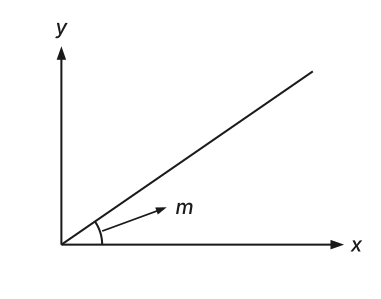
›Reveal solutionSolution
The graph plots partial pressure of HCl (y-axis) vs. mole fraction of HCl in cyclohexane (x-axis). According to Henry’s law, the slope equals Henry’s constant for HCl in cyclohexane, so the correct option is (B).
The key here is Henry’s law, which describes the solubility of a gas in a liquid. For a dilute solution, the partial pressure of the gas above the liquid is directly proportional to its mole fraction in the liquid:
PHCl=KH⋅xHCl
where KH is the Henry’s law constant. The constant is specific to the gas–solvent pair. In this graph, the y-axis is PHCl and the x-axis is xHCl, so the slope m is exactly KH.
Now, which substance does this KH belong to? The graph is for HCl gas dissolved in cyclohexane. The constant describes how much HCl partitions between the gas phase and the liquid phase. That is the Henry’s constant of HCl in cyclohexane — not of cyclohexane itself.
Let’s walk through the reasoning step by step.
- Identify the axes and the law The y-axis is partial pressure of HCl gas, PHCl. The x-axis is mole fraction of HCl in the liquid, xHCl. Henry’s law states:
PHCl=KH⋅xHCl
This is a linear relation through the origin (for dilute solutions). The slope is KH.
-
Interpret the slope
The slope m=ΔxHClΔPHCl. Since the graph is a straight line through the origin, the slope is constant and equals the proportionality constant in Henry’s law.
-
Assign the constant to the correct species …
- TG EAPCET 2026Set eng-2026-05-11-FN1 markMCQQ.Identify the correct statements from the following I. Hydrogen bonding is present in liquid water and solid water (ice) II. Hydrogenation of vegetable oils give a fat called vanaspati III. Water present in BaCl2.2H2O belongs to the type "interstitial water" (A) I, III only (B) I, II, III (C) I, II only (D) II, III only
›Reveal solutionSolution
All three statements are correct: hydrogen bonding is present in both liquid and solid water, hydrogenation of vegetable oils produces vanaspati, and the water in BaCl2.2H2O is interstitial. The correct option is (B).
Let's analyze each statement to determine its correctness.
Concept and Intuition
This question tests your understanding of fundamental concepts in chemistry:
- Hydrogen Bonding: A strong intermolecular force crucial for the properties of water.
- Hydrogenation: A chemical reaction used to modify the properties of fats and oils.
- Water of Crystallization: The different ways water molecules can be incorporated into crystal structures.
We will evaluate each statement based on these principles.
Step-by-Step Evaluation
1. Statement I: Hydrogen bonding is present in liquid water and solid water (ice)
- Reasoning: Hydrogen bonding is a special type of dipole-dipole interaction that occurs when a hydrogen atom covalently bonded to a highly electronegative atom (like oxygen, nitrogen, or fluorine) is attracted to another highly electronegative atom in a different molecule.
- In water (H2O), oxygen is highly electronegative and forms covalent bonds with two hydrogen atoms. This creates a strong partial positive charge on the hydrogen atoms and a strong partial negative charge on the oxygen atom.
- Liquid Water: In liquid water, molecules are constantly moving, but they form a dynamic network of hydrogen bonds. Each water molecule can form up to four hydrogen bonds with neighboring water molecules (two through its hydrogen atoms and two through the lone pairs on its oxygen atom). These bonds are continuously breaking and reforming.
- Solid Water (Ice): In ice, water molecules arrange themselves into a highly ordered, open, hexagonal crystalline structure. Each water molecule is tetrahedrally hydrogen-bonded to four other water molecules. This rigid, extensive network of hydrogen bonds is responsible for ice being less dense than liquid water.
- Conclusion: Statement I is correct.
2. Statement II: Hydrogenation of vegetable oils give a fat called vanaspati
- Reasoning: Vegetable oils are typically unsaturated fats, meaning their fatty acid chains contain one or more carbon-carbon double bonds (C=C). These double bonds give them a bent structure, preventing close packing and making them liquid at room temperature.
- Hydrogenation is a chemical process where hydrogen gas (H2) is added across these carbon-carbon double bonds in the presence of a catalyst (commonly nickel, palladium, or platinum). This converts the unsaturated fatty acids into saturated fatty acids (containing only C−C single bonds).
- Product: The resulting saturated fats have straighter chains, allowing them to pack more closely. This changes their physical state from liquid oil to a solid or semi-solid fat at room temperature. This product is commonly known as vanaspati ghee (or hydrogenated vegetable oil), which is used as a cooking medium and in the production of margarine.
- Conclusion: Statement II is correct.
3. Statement III: Water present in BaCl2.2H2O belongs to the type "interstitial water" …
- TG EAPCET 2026Set eng-2026-05-11-AN1 markMCQQ.At T(K), the pressure of two ideal gases A and B is in 2:5 ratio (pA:pB=2:5). At this temperature, their density is same. Molar mass ratio (MA:MB) is (A) 5:2 (B) 1:2 (C) 5:1 (D) 25:4
›Reveal solutionSolution
Using the ideal gas law in density form pM=ρRT, with equal densities and given pressure ratio, the molar mass ratio is the inverse of the pressure ratio, giving MA:MB=5:2.
The key concept is the density form of the ideal gas law. For an ideal gas, pV=nRT. Since n=Mm (mass over molar mass), we can write pV=MmRT. Rearranging gives pM=VmRT=ρRT, where ρ is density. This form directly links pressure, molar mass, and density at a fixed temperature — perfect for comparing two gases when density is the same.
-
Write the relation for each gas.
For gas A: pAMA=ρART
For gas B: pBMB=ρBRT
Since the temperature T and the gas constant R are identical, and the problem states ρA=ρB, we can set the right-hand sides equal.
-
Equate the two expressions.
Because ρART=ρBRT, we have:
pAMA=pBMB
- Use the given pressure ratio. The ratio pA:pB=2:5 means pBpA=52. From pAMA=pBMB, we get:
MBMA=pApB=25
So MA:MB=5:2. …
-
- TG EAPCET 2026Set eng-2026-05-11-AN1 markMCQQ.If two liquids A and B have PA∘:PB∘=1:2 and have mole fraction in solution as 1:2, then mole fraction of B in vapour phase is (A) 0.2 (B) 0.8 (C) 0.4 (D) 0.6
›Reveal solutionSolution
Using Raoult’s law and Dalton’s law, the mole fraction of B in the vapour phase is found to be 0.8, so the correct option is (B).
Concept & Intuition
This problem is about the relationship between the composition of a liquid mixture and the composition of the vapour above it. The key idea: in an ideal solution, the partial pressure of each component in the vapour is given by Raoult’s law (Pi=xiPi∘), and the total pressure is the sum of these partial pressures. The mole fraction of a component in the vapour phase is then the ratio of its partial pressure to the total pressure. So we just need to compute these pressures from the given ratios.
Step-by-step solution
-
Assign variables from the given ratios
The ratio of pure vapour pressures is PA∘:PB∘=1:2. Let PA∘=p and PB∘=2p for some p.
The mole fraction ratio in the liquid is xA:xB=1:2. Since xA+xB=1, we have xA=31 and xB=32.
-
Apply Raoult’s law to find partial pressures
Raoult’s law: PA=xAPA∘ and PB=xBPB∘.
So
PA=31⋅p=3p,PB=32⋅2p=34p.
- Find total vapour pressure Total pressure Ptotal=PA+PB=3p+34p=35p. …
-
- TG EAPCET 2025Set eng-2025-05-02-FN1 markMCQQ.A substance has a density of 2 g cm−3. It crystallizes in the fcc crystal with an edge length of 600 pm. The molar mass of the substance (in g mol−1) is (NA=6×10²³ mol−1) (A) 54.8 (B) 64.8 (C) 74.8 (D) 84.7
›Reveal solutionSolution
Using the density formula for a crystal, we relate density, number of atoms per unit cell, molar mass, and edge length. For fcc, Z=4; solving gives molar mass ≈ 64.8 g mol⁻¹, matching option (B).
The key idea is that the density of a crystalline solid is given by
ρ=NA⋅a3Z⋅M
where Z is the number of atoms per unit cell, M is the molar mass, NA is Avogadro’s number, and a is the edge length. For an fcc lattice, Z=4. We are given ρ=2 gcm−3, a=600 pm, and NA=6×10²³ mol−1. We solve for M.
- Convert edge length to cm The edge length is 600 pm. Since 1 pm=10−12 m and 1 m=100 cm, we have
a=600×10−12 m=600×10−10 cm=6×10⁻⁸ cm.
- Write the density formula
ρ=NA⋅a3Z⋅M
Rearranging for M:
M=Zρ⋅NA⋅a3.
-
Substitute the known values
- ρ=2 gcm−3
- NA=6×10²³ mol−1
- a=6×10⁻⁸ cm → a3=(6×10⁻⁸)3=216×10−24=2.16×10⁻²² cm3
- Z=4 (fcc)
So
M=42×(6×1023)×(2.16×10−22).
- Simplify step by step First, multiply the numerator:
- TG EAPCET 2025Set eng-2025-05-03-AN1 markMCQQ.Diborane on hydrolysis gives a compound X. The correct statements about X are I. It is a tribasic acid II. It is a weak monobasic acid III. It has a layer structure IV. It is highly soluble in water (A) I & III (B) II & III (C) II & IV (D) I & IV
›Reveal solutionSolution
Diborane hydrolysis yields boric acid (H₃BO₃), which is a weak monobasic acid (not tribasic) and has a layered crystal structure; thus the correct statements are II and III, corresponding to option (B).
Concept & Intuition
Diborane (B₂H₆) reacts violently with water to give boric acid (H₃BO₃) and hydrogen gas. The key is understanding the actual acidic behavior of boric acid: despite having three hydroxyl groups, it does not donate three protons. Instead, it acts as a Lewis acid, accepting an OH⁻ from water to form [B(OH)₄]⁻, releasing only one H⁺. That makes it a weak monobasic acid, not a tribasic one. Also, boric acid crystallizes in a layered structure held together by hydrogen bonds, which explains its slippery feel and certain physical properties.
- Hydrolysis reaction Diborane reacts with water:
B2H6+6H2O→2H3BO3+6H2
So compound X is boric acid, H3BO3.
- Acidic nature – why it’s monobasic, not tribasic Boric acid does not ionize by losing H⁺ from its O–H bonds. Instead, it accepts a hydroxide ion from water:
B(OH)3+H2O⇌[B(OH)4]−+H+
Only one H⁺ is produced per molecule. Hence it is a weak monobasic acid (statement II is true, statement I is false).
Watch outA common mistake is to count the three OH groups and assume three acidic protons. But boron’s electron deficiency makes it a Lewis acid, not a Brønsted acid. …
- TG EAPCET 2025Set eng-2025-05-03-AN1 markMCQQ.Two liquids ‘A’ and ‘B’ form an ideal solution. At 300 K, the vapour pressure of a solution containing 1 mole of ‘A’ and 3 moles of ‘B’ is 550 mm Hg. At the same temperature, if one more mole of ‘B’ is added to the solution, the vapour pressure of solution increases to 560 mm Hg. Then the ratio of vapour pressures of A and B in their pure state is (A) 1 : 3 (B) 3 : 1 (C) 2 : 3 (D) 3 : 2
›Reveal solutionSolution
Solving the two Raoult's-law equations gives PA0=400 and PB0=600 mm Hg, so PA0:PB0=2:3 — option (C).
Concept
For an ideal solution, the total vapour pressure is the mole-fraction-weighted sum of the pure vapour pressures:
P=xAPA0+xBPB0
Two different compositions give two equations in the two unknowns.
Solution
First solution — 1 mol A, 3 mol B, so xA=41, xB=43:
41PA0+43PB0=550⇒PA0+3PB0=2200(1)
Second solution — add 1 mol B: 1 mol A, 4 mol B, so xA=51, xB=54: …
- TG EAPCET 2025Set eng-2025-05-03-AN1 markMCQQ.Noble gas ‘X’ is used as a diluent for oxygen in modern diving apparatus and noble gas ‘Y’ is used mainly to provide an inert atmosphere in high temperature metallurgical processes. ‘Y’ and ‘X’ are respectively? (A) He, Ar (B) Ar, He (C) He, Kr (D) Ar, Kr
›Reveal solutionSolution
The key is matching each noble gas to its specific industrial use: helium (He) is the diluent for oxygen in diving, and argon (Ar) provides the inert atmosphere in high‑temperature metallurgy. Thus the pair is Ar, He — option (B).
Concept & Intuition
Noble gases are prized for their chemical inertness, but each has unique physical properties that suit particular applications.
- Helium (He) is extremely light (low density) and has very low solubility in blood. This makes it ideal as a diluent for oxygen in deep‑sea diving, replacing nitrogen to avoid decompression sickness (“the bends”) and reducing breathing resistance.
- Argon (Ar) is denser than air, cheap, and readily available. It is the most common inert gas used in welding and high‑temperature metallurgy (e.g., arc welding of aluminium, titanium processing) because it forms a protective blanket that prevents oxidation without reacting with molten metals.
Now let’s confirm step by step.
-
Identify noble gas ‘X’ (diluent for oxygen in diving)
- In standard compressed air, nitrogen dissolves under pressure and can cause narcosis and decompression sickness.
- Helium is used to replace nitrogen because it is much less soluble in blood and diffuses quickly, reducing these risks.
- Neon and krypton are too expensive or have undesirable properties; argon is denser than air and would increase breathing resistance.
- Therefore, X = He.
-
Identify noble gas ‘Y’ (inert atmosphere in high‑temperature metallurgy)
- Argon is the most widely used shielding gas in arc welding, casting, and heat treatment of reactive metals (titanium, zirconium).
- Helium is also used in welding but is less common for metallurgy because it is lighter and escapes more easily; argon’s higher density provides a better blanket. …
- TG EAPCET 2025Set eng-2025-05-03-FN1 markMCQQ.Which of the following is a lung irritant that can lead to an acute respiratory disease in children? (A) CO (B) SO2 (C) CO2 (D) NO2
›Reveal solutionSolution
NO2 is the textbook lung irritant that can cause acute respiratory disease in children — option (D).
Concept. Oxides of nitrogen, especially NO2, are key air pollutants formed in high-temperature combustion and in photochemical smog. NO2 is a reddish-brown, highly reactive gas that attacks respiratory tissue.
Reasoning through the options.
- CO (A): toxic because it binds haemoglobin to form carboxyhaemoglobin, impairing oxygen transport — a blood-level poison, not primarily a lung irritant.
- SO2 (B): irritates eyes and the respiratory tract and aggravates asthma, but the specific textbook statement about acute respiratory disease in children is attached to NO2.
- CO2 (C): not a lung irritant at ambient levels; its concern is the greenhouse effect. …
🎓Unlock everything free for 14 days
- ✓Full step-by-step solutions
- ✓Concept-first explanations
- ✓Methods, shortcuts & mistakes
- ✓PYQ mapping + timed mock tests
Full access for 14 days. No credit card required.