Q.How many mL of 0.1 M HCl are required to react completely with 1 g mixture of Na2CO3 and NaHCO3 containing equimolar amounts of both?
🔒You're viewing a preview — the full solution, concept, methods & PYQ mapping are locked.
🔒 Start your 14-day free trial to unlock the full solution →Concept understanding — Reaction Rate Stoichiometry
Reaction Rate Stoichiometry – From Intuition to Precision
Imagine you are watching a simple reaction:
2NO2→2NO+O2
As NO₂ disappears, NO appears twice as fast as O₂ appears. Why? Because the balanced equation says: for every 2 molecules of NO₂ that break apart, you get 2 molecules of NO and 1 molecule of O₂. The numbers in front of the species — the stoichiometric coefficients — tell you the relative speeds at which reactants vanish and products appear.
That is the core idea: reaction rate stoichiometry is the relationship between the rates of change of different species in a chemical reaction, dictated by their coefficients in the balanced equation.
The Intuitive Picture
Think of a factory assembly line. The balanced equation is like a recipe:
- 2 units of raw material A → 2 units of product B + 1 unit of byproduct C
If the line runs steadily, every time 2 units of A are consumed, 2 units of B are produced and 1 unit of C is produced. So the rate at which A disappears must be twice the rate at which C appears. The rate at which B appears equals the rate at which A disappears (both have coefficient 2).
The stoichiometric coefficients are not speeds themselves — they are scaling factors that connect the speeds of different species.
The Precise Statement
For a general reaction:
aA+bB→cC+dD
The rate of reaction (often called the rate of the process, r) is defined as:
r=−a1dtd[A]=−b1dtd[B]=c1dtd[C]=d1dtd[D]
Here:
- dtd[X] is the instantaneous rate of change of concentration of species X (in mol L⁻¹ s⁻¹).
- The minus sign is used for reactants (their concentration decreases with time).
- The plus sign is used for products (their concentration increases with time).
- Dividing by the coefficient normalises the rate — so r is the same number for every species.
r=−a1dtd[A]=c1dtd[C]
This single value r is the intrinsic rate of the reaction, independent of which species you measure.
How to Use It (Step by Step)
Suppose you are given:
2H2+O2→2H2O
And you measure that dtd[H2]=−0.040 M/s (negative because H₂ is being consumed).
Step 1: Write the rate relation:
r=−21dtd[H2]=−11dtd[O2]=21dtd[H2O]
Step 2: Plug in the known value:
r=−21(−0.040)=+0.020 M/s
Step 3: Find the rate for O₂:
−dtd[O2]=r⇒dtd[O2]=−0.020 M/s
Step 4: Find the rate for H₂O:
21dtd[H2O]=r⇒dtd[H2O]=2r=0.040 M/s …
Why this formula?
Reaction Rate Stoichiometry: Why the Formula Holds
Let’s start with the core idea: In a chemical reaction, the rate at which reactants disappear and products appear is not arbitrary — it is tied directly to the stoichiometric coefficients in the balanced equation.
The Key Formula
For a general reaction:
aA+bB→cC+dD
The rate of reaction (R) is defined as:
R=−a1dtd[A]=−b1dtd[B]=c1dtd[C]=d1dtd[D]
Where:
- [A],[B],[C],[D] are concentrations (in mol/L)
- t is time
- a,b,c,d are stoichiometric coefficients
Why This Formula Holds: The Reasoning
1. The Physical Meaning of Stoichiometric Coefficients
The coefficients tell us the mole ratio in which substances react or are produced. For example:
2H2+O2→2H2O
- 2 moles of H2 react with 1 mole of O2 to produce 2 moles of H2O.
- This means: for every 2 molecules of H2 that disappear, only 1 molecule of O2 disappears, and 2 molecules of H2O appear.
Key insight: The number of moles changing per unit time is different for each substance, but the reaction event is the same.
2. The Problem with Raw Rates
If we simply wrote:
Rate=−dtd[H2]
This would be twice the rate of disappearance of O2 (since H2 disappears twice as fast). That’s inconsistent — the same reaction shouldn’t have two different numerical rates.
We need a single, unique rate that describes the reaction itself, not just one substance.
3. The Solution: Normalize by Stoichiometric Coefficients
To get a reaction rate that is the same regardless of which substance we track, we divide each substance’s rate of change by its stoichiometric coefficient.
Why division works:
- If A disappears at rate −dtd[A], and a moles of A are consumed per reaction event, then the number of reaction events per unit time is:
Reaction events per second=a−dtd[A]
- Similarly, for product C appearing at rate +dtd[C], with c moles produced per event:
Reaction events per second=c+dtd[C]
Since the same reaction is happening, these must be equal. Hence:
−a1dtd[A]=c1dtd[C]
4. The Sign Convention
- Reactants decrease over time → dtd[reactant]<0 → we add a negative sign to make the rate positive.
- Products increase over time → dtd[product]>0 → we use a positive sign. …
The key idea is reaction rate stoichiometry: each mole of base consumes a fixed number of moles of HCl, determined by the balanced equations.
Step 1 – Write the reactions
Na2CO3+2HCl→2NaCl+H2O+CO2
NaHCO3+HCl→NaCl+H2O+CO2
Step 2 – Find moles of each in 1 g mixture
Let moles of each = x. Molar masses: Na2CO3=106, NaHCO3=84.
Total mass: 106x+84x=190x=1⟹x=1901 mol.
Step 3 – Total moles of HCl needed …
The key is to treat the two reactions separately — HCl reacts with Na2CO3 in a 2:1 mole ratio and with NaHCO3 in a 1:1 ratio. For an equimolar mixture of 1 g total, the required volume of 0.1 M HCl is 157.9 mL.
Why this approach works
When you mix a strong acid like HCl with a carbonate/bicarbonate mixture, two distinct neutralisation reactions occur. The stoichiometry is not the same for both — each mole of Na2CO3 consumes 2 moles of HCl (because it first forms HCO3−, then H2CO3), while each mole of NaHCO3 consumes only 1 mole of HCl. If you miss this difference, you'll get the wrong volume.
The problem gives a total mass of 1 g, but the two compounds are present in equimolar amounts — equal number of moles, not equal mass. That's the crucial starting point.
Step-by-step solution
1. Write the balanced reactions
For Na2CO3:
Na2CO3+2HCl→2NaCl+H2O+CO2
For NaHCO3:
NaHCO3+HCl→NaCl+H2O+CO2
A common mistake is to use a 1:1 ratio for Na2CO3 as well. Remember: carbonate is dibasic — it takes two protons to fully neutralise it.
2. Define the unknown
Let the number of moles of Na2CO3 = number of moles of NaHCO3 = x (since equimolar).
Molar masses:
- Na2CO3: 2(23)+12+3(16)=106 g/mol
- NaHCO3: 23+1+12+3(16)=84 g/mol
Total mass of mixture:
106x+84x=190x=1 g
So:
x=1901 mol
3. Calculate moles of HCl required
From Na2CO3: 2x moles of HCl
From NaHCO3: x moles of HCl
Total HCl needed:
2x+x=3x=3×1901=1903 mol …
Method: Acid-Base Stoichiometry for a Carbonate/Bicarbonate Mixture
This is a titration stoichiometry problem -- HCl reacts with Na2CO3 and NaHCO3 in different mole ratios, so each component's contribution must be tracked separately before adding up the total HCl required.
Step 1 -- Write the balanced reactions
Na2CO3+2HCl→2NaCl+H2O+CO2
NaHCO3+HCl→NaCl+H2O+CO2
Notice Na2CO3 needs 2 mol HCl per mole (it is dibasic), while NaHCO3 needs only 1 mol HCl per mole.
Step 2 -- Set up the equimolar mixture
Let moles of Na2CO3 = moles of NaHCO3 = x (given: equimolar).
Molar masses: Na2CO3=106 g/mol, NaHCO3=84 g/mol.
Total mass of the 1 g mixture:
106x+84x=190x=1⟹x=1901 mol
Step 3 -- Total moles of HCl required …
Here are the most common mistakes students make on this stoichiometry problem, along with the conceptual fix for each.
1. Writing the Wrong Balanced Chemical Equations
The Mistake: Students often write only one generic reaction (e.g., “Na2CO3+HCl→NaCl+CO2+H2O”) and forget that NaHCO3 reacts differently. They also frequently forget to balance the equations correctly.
Why it happens: Rushing through the problem without checking the acid-base nature of each salt.
How to Avoid:
- Write two separate, balanced reactions.
- For Na2CO3 (a carbonate), the reaction with HCl is:
Na2CO3+2HCl→2NaCl+CO2+H2O
Note: 1 mole of Na2CO3 requires 2 moles of HCl.
- For NaHCO3 (a bicarbonate), the reaction is:
NaHCO3+HCl→NaCl+CO2+H2O
Note: 1 mole of NaHCO3 requires 1 mole of HCl.
2. Misinterpreting “Equimolar Amounts”
The Mistake: Students assume “equimolar” means equal mass (e.g., 0.5 g each). This leads to incorrect mole calculations.
Why it happens: Confusing “molar” (moles) with “mass” (grams).
How to Avoid:
- “Equimolar” means equal number of moles, not equal mass.
- Let the number of moles of Na2CO3 = number of moles of NaHCO3 = x.
- Total mass of mixture = x×MNa2CO3+x×MNaHCO3=1 g.
- Molar masses:
- MNa2CO3=106 g/mol
- MNaHCO3=84 g/mol
- So: 106x+84x=190x=1⟹x=1901 mol.
3. Forgetting to Multiply Moles by the Stoichiometric Coefficient
The Mistake: After finding x, students directly use x as the total moles of HCl needed, ignoring that Na2CO3 consumes 2 moles of HCl per mole.
Why it happens: Not checking the balanced equation for each reactant.
How to Avoid:
- Moles of HCl for Na2CO3 = 2×x=2×1901=1902 mol.
- Moles of HCl for NaHCO3 = 1×x=1901 mol.
- Total moles of HCl required = 1902+1901=1903 mol.
4. Incorrect Volume Calculation from Molarity
The Mistake: Using the formula M=Vn but plugging in volume in mL without converting, or using V=n×M instead of V=Mn. …
Showing the 12 most recent of 31 on this concept.
- TG EAPCET 2026Set eng-2026-05-09-AN1 markMCQQ.Given below are two statements Statement-I: Rate of a first order reaction (A → p) decreases with time Statement-II: Rate of a zero-order reaction (B → p) decreases with time The correct answer is (A) Both statements I and II are correct (B) Both statements I and II are not correct (C) Statement I is correct, but statement II is not correct (D) Statement I is not correct, but statement II is correct
›Reveal solutionSolution
For a first‑order reaction, the rate is proportional to the concentration of reactant, which falls exponentially, so the rate decreases with time. For a zero‑order reaction, the rate is constant (independent of concentration) until the reactant is exhausted, so the rate does not decrease with time. Therefore Statement I is correct, Statement II is not correct.
Concept & Intuition
The rate of a reaction tells us how fast the concentration of reactant (or product) changes per unit time. The key is how that rate depends on the remaining concentration of the reactant.
- In a first‑order reaction, rate = k[A]. As the reaction proceeds, [A] drops, so the rate drops proportionally.
- In a zero‑order reaction, rate = k (a constant). The rate does not depend on how much reactant is left; it stays the same until the reactant is suddenly gone.
Thus the behaviour of the rate over time is fundamentally different for these two orders.
Step‑by‑step reasoning
- Statement I: First‑order reaction For A→p, the rate law is
rate=−dtd[A]=k[A]
The integrated form gives [A]=[A]0e−kt. Substituting back:
rate=k[A]0e−kt
Since e−kt decreases as t increases, the rate clearly decreases with time. So Statement I is correct.
- Statement II: Zero‑order reaction For B→p, the rate law is rate=−dtd[B]=k …
- TG EAPCET 2026Set eng-2026-05-09-FN1 markMCQQ.In leaching alumina, concentrated solution of 'X' and in leaching gold, dilute solution of 'Y' are used as leaching agents. X and Y respectively are (A) KCN, NaOH (B) NaOH, KCN (C) Ca(OH)2, NaCN (D) NaCl, KCN
›Reveal solutionSolution
The key idea is that alumina is leached with a concentrated base (NaOH) via the Bayer process, while gold is leached with a dilute cyanide solution (KCN or NaCN) via the MacArthur-Forrest process. The correct pair is NaOH for X and KCN for Y, which corresponds to option (B).
The question tests your knowledge of two classic industrial leaching processes: the Bayer process for purifying bauxite (alumina ore) and the cyanidation process for extracting gold from its ores. The trick is remembering that the concentration of the leaching agent is opposite in each case — concentrated for alumina, dilute for gold — and that the specific chemicals are a strong base and a cyanide salt.
- Identify the process for alumina (X). Alumina (Al₂O₃) is extracted from bauxite ore using the Bayer process. The leaching agent is a concentrated solution of sodium hydroxide (NaOH). Hot, concentrated NaOH reacts with amphoteric alumina to form soluble sodium aluminate:
Al2O3+2NaOH+3H2O→2NaAl(OH)4
Impurities like iron oxides remain insoluble and are filtered off. So X must be NaOH.
- Identify the process for gold (Y). Gold is extracted from its ores using the cyanidation process (MacArthur-Forrest process). The leaching agent is a dilute solution of sodium cyanide (NaCN) or potassium cyanide (KCN). Gold is oxidized and forms a soluble complex:
4Au+8NaCN+O2+2H2O→4Na[Au(CN)2]+4NaOH
The solution is kept dilute (typically 0.1–0.2% NaCN) to avoid excessive consumption of cyanide and to maintain safety. So Y is a cyanide salt — either NaCN or KCN.
- Match with the options.
- (A) KCN, NaOH → Wrong order (X would be KCN, Y would be NaOH). …
- TG EAPCET 2026Set eng-2026-05-10-AN1 markMCQQ.At 27 ∘C, the ratio of RMS velocity and most probable velocity of SO2 is (A) 3:2 (B) 2:3 (C) 3:5 (D) 5:3
›Reveal solutionSolution
The ratio of RMS velocity to most probable velocity for any ideal gas is a fixed constant, independent of temperature and molar mass, equal to 3:2.
The key idea is that both RMS velocity and most probable velocity are derived from the Maxwell–Boltzmann distribution of molecular speeds. Their ratio depends only on the mathematical form of these averages, not on the gas identity or temperature. So for SO₂ at 27 °C, the ratio is the same as for any ideal gas.
-
Recall the formulas
For an ideal gas at temperature T and molar mass M:
- RMS velocity: vrms=M3RT
- Most probable velocity: vmp=M2RT
-
Form the ratio
vmpvrms=M2RTM3RT=23
The RT/M cancels completely.
- Interpret the ratio This gives vrms:vmp=3:2. Notice that temperature (27 °C) and the gas (SO₂) are irrelevant — the ratio is universal. …
-
- TG EAPCET 2026Set eng-2026-05-10-FN1 markMCQQ.The sulphide ore of zinc is X and carbonate ore of zinc is Y. X and Y are respectively (A) Kaolinite, siderite (B) Siderite, calamine (C) Calamine, sphalerite (D) Sphalerite, calamine
›Reveal solutionSolution
The sulphide ore of zinc is Sphalerite (ZnS) and the carbonate ore of zinc is Calamine (ZnCO3). Therefore, option (D) is the correct choice.
Concept and Intuition
Ores are naturally occurring rocks or minerals from which a metal can be extracted profitably. Different metals are found in various chemical forms within these ores. For zinc, two common types of ores are sulphide ores and carbonate ores.
- Sulphide ores are minerals where the metal is chemically bonded with sulphur. These ores are typically processed by roasting (heating in air) to convert the sulphide to an oxide, which can then be reduced to the metal.
- Carbonate ores are minerals where the metal is chemically bonded with the carbonate ion (CO32−). These ores are typically processed by calcination (heating in the absence of air) to convert the carbonate to an oxide, which can then be reduced.
To solve this problem, we need to recall the common names and chemical compositions of zinc's sulphide and carbonate ores.
Step-by-Step Solution
-
Identify common zinc ores:
Zinc is primarily extracted from a few key minerals. The most important ones are:
- Sphalerite (also known as Zinc blende)
- Calamine (also known as Smithsonite)
- Zincite
-
Determine the sulphide ore of zinc (X):
The most common sulphide ore of zinc is Sphalerite.
The chemical formula for Sphalerite is ZnS.
Therefore, X is Sphalerite.
-
Determine the carbonate ore of zinc (Y):
The most common carbonate ore of zinc is Calamine.
The chemical formula for Calamine is ZnCO3.
Therefore, Y is Calamine.
-
Match X and Y with the given options:
We have identified X as Sphalerite and Y as Calamine. Let's check the options: …
- TG EAPCET 2026Set eng-2026-05-11-AN1 markMCQQ.At T(K), the following data is obtained for the decomposition of A(g), which follows first order kinetics A(g) → B(g) + C(g)
[!FORMULA] Time (sec)0100xTotal pressure (atm)0.50.60.65
What is x (in sec)? (log1.25=0.097;log1.4285=0.1549) (A) 180 (B) 160 (C) 140 (D) 200›Reveal solutionSolution
The key idea is to relate total pressure to the concentration of reactant A using stoichiometry, then apply the first‑order integrated rate law. The missing time x is found to be 160 seconds, corresponding to option (B).
We are told the decomposition of A(g) follows first‑order kinetics. For a first‑order reaction, the rate depends only on the concentration (or partial pressure) of A. The integrated law is:
ln[A]t[A]0=kt
But the data gives total pressure, not the partial pressure of A. So we must first convert total pressure into the partial pressure of A at each time.
1. Relate total pressure to partial pressure of A
The reaction is:
A(g)→B(g)+C(g)
Initially, only A is present. Let the initial pressure of A be P0=0.5 atm.
At any time t, let the decrease in pressure of A be p atm. Then:
- Pressure of A remaining: PA=P0−p
- Pressure of B formed: p
- Pressure of C formed: p
Total pressure at time t:
Ptotal=(P0−p)+p+p=P0+p
So:
p=Ptotal−P0
And therefore:
PA=P0−p=P0−(Ptotal−P0)=2P0−Ptotal
This is the key relation: the partial pressure of A at any time is twice the initial pressure minus the total pressure.
2. Find the rate constant k using the data at t=100 sec
At t=0: PA(0)=0.5 atm
At t=100 sec: Ptotal=0.6 atm
PA(100)=2(0.5)−0.6=1.0−0.6=0.4 atm
For a first‑order reaction (using pressures instead of concentrations, since P∝n at constant T and V):
k=t1lnPA(t)PA(0)
k=1001ln0.40.5=1001ln(1.25)
Given log1.25=0.097, we convert to natural log: ln(1.25)=2.303×0.097
k=1002.303×0.097=1000.223391=0.00223391 s−1
We can keep it symbolic for now: k=100ln(1.25).
3. Use the same relation to find x when total pressure is 0.65 atm …
- TG EAPCET 2026Set ap-2026-05-04-FN1 markMCQQ.Compared to cane sugar, artificial sweetener (X) has maximum sweetness value and (Y) has minimum sweetness value. X and Y respectively are (A) Alitame, Saccharin (B) Alitame, Aspartame (C) Aspartame, Sucralose (D) Saccharin, Sucralose
›Reveal solutionSolution
The question asks for the artificial sweetener with the maximum sweetness value and the one with the minimum sweetness value among common options. The correct pair is Alitame (maximum) and Saccharin (minimum), which corresponds to option (A).
The key here is understanding the relative sweetness of artificial sweeteners compared to cane sugar (sucrose). Sweetness is measured on a scale where sucrose is assigned a value of 1. Artificial sweeteners are many times sweeter, so a higher number means you need less of it to achieve the same sweetness.
Let’s recall the approximate sweetness values of the common artificial sweeteners mentioned:
- Saccharin – about 300–500 times sweeter than sucrose. It’s one of the oldest, but not the most potent.
- Aspartame – about 200 times sweeter than sucrose. It’s less sweet than saccharin.
- Sucralose – about 600 times sweeter than sucrose. This is quite high.
- Alitame – about 2000 times sweeter than sucrose. This is among the most potent artificial sweeteners known.
Now, the question asks for the one with maximum sweetness value and the one with minimum sweetness value among the given options. From the list above, Alitame has the highest (2000×), and Saccharin (300–500×) is lower than Sucralose (600×) and Aspartame (200×). Wait — check carefully: Aspartame is 200×, which is actually lower than Saccharin’s 300–500×. So the minimum among these four is Aspartame, not Saccharin.
But the options pair X (max) and Y (min). Let’s examine each: …
- TG EAPCET 2026Set ap-2026-05-05-FN1 markMCQQ.At 300 K, the diffusion rate of one mole of an ideal gas is 0.082 L s−1. What is the pressure (in atm) of this gas which can diffuse in 100 s? (R = 0.082 L atm mol−1 K−1) (A) 1 (B) 3 (C) 5 (D) 2
›Reveal solutionSolution
Volume diffused in 100 s is 8.2 L; then P=VnRT=8.21×0.082×300=3 atm.
The diffusion rate is 0.082 Ls−1, so the volume of gas that diffuses in 100 s is
V=0.082 Ls−1×100 s=8.2 L. …
- TG EAPCET 2024Set ap-2024-05-08-FN1 markMCQQ.What is the correct equation that relates kinetic energy (Eke) and pressure (P) of one mole of an ideal gas? (V = Volume) (A) P=3V2Eke (B) P=2Eke3V (C) P=2Eke3V2 (D) P=3V2(Eke)2
›Reveal solutionSolution
The pressure of an ideal gas arises from the collisions of its molecules with the container walls, and this pressure is directly related to the total translational kinetic energy of the gas molecules. For one mole of an ideal gas, the correct relationship is P=3V2Eke.
The relationship between the macroscopic properties of a gas, like pressure and volume, and the microscopic properties of its constituent molecules, like their kinetic energy, is established by the kinetic theory of gases. This theory provides a model for how gas molecules behave and how their motion translates into observable phenomena.
The core idea is that gas molecules are in constant, random motion. When these molecules collide with the walls of their container, they exert a force. The sum of these forces over the area of the walls gives rise to the pressure of the gas. The faster and more massive the molecules, and the more frequently they collide, the greater the pressure.
Simultaneously, the kinetic energy of these molecules is directly related to the temperature of the gas. For an ideal gas, the total internal energy is purely translational kinetic energy. By linking the microscopic definition of pressure to the total kinetic energy, we can derive the required relationship.
Here's the step-by-step derivation:
- Pressure from Kinetic Theory: According to the kinetic theory of gases, the pressure (P) exerted by an ideal gas in a container of volume (V) is given by the formula:
P=31VNmv2
where:
*   $N$ is the total number of gas molecules.
*   $m$ is the mass of a single gas molecule.
*   $\overline{v^2}$ is the mean square speed of the gas molecules.
2. Total Kinetic Energy of the Gas:
The translational kinetic energy of a single molecule is 21mv2. Therefore, the average translational kinetic energy of a single molecule is 21mv2.
The total translational kinetic energy (Eke) of all N molecules in the gas is the sum of the kinetic energies of individual molecules.
Eke=N×(21mv2)
Eke=21Nmv2
- Relating Pressure and Total Kinetic Energy: From the expression for total kinetic energy, we can isolate the term Nmv2: …
- TG EAPCET 2024Set eng-2024-05-09-FN1 markMCQQ.For a first order reaction, a plot of lnk (y-axis) and T1 (x-axis) gave the straight line with slope equal to −103k and intercept equal to 2.303 (on y-axis). What is the activation energy (Ea in kJ mol−1) of the reaction? (Given R = 8.314 J mol−1K−1) (A) 8.314 (B) 2.303 (C) 2303 (D) 83.14
›Reveal solutionSolution
The Arrhenius equation gives lnk=lnA−REa⋅T1, so the slope of the lnk vs 1/T plot is −REa. Equating this to the given slope −103 yields Ea=8.314 kJ mol−1, which corresponds to option (A).
The key idea is the Arrhenius equation in its linearized form. For a first-order reaction (or any reaction), the temperature dependence of the rate constant k is given by:
k=Ae−Ea/(RT)
Taking natural logs:
lnk=lnA−REa⋅T1
This is a straight line: y=c+mx, where y=lnk, x=1/T, intercept c=lnA, and slope m=−REa.
So the slope directly gives the activation energy. No need to involve the intercept except to check consistency.
- Identify the slope from the problem The problem states: the slope equals −103k. Wait — careful: the notation says “slope equal to −103k”. Here k is not the rate constant; it’s likely a typographical shorthand for “103” meaning 1000. In many textbooks, they write 103 as 103 (i.e., 1000). So the slope is −1000 (units: K, because 1/T has units K−1, and lnk is dimensionless). So:
slope=−1000 K
- Relate slope to activation energy From the Arrhenius plot:
slope=−REa
Therefore:
−REa=−1000
Cancel the negatives:
REa=1000
- Solve for Ea Given R=8.314 J mol−1K−1:
Ea=1000×8.314=8314 J mol−1
Convert to kJ mol−1:
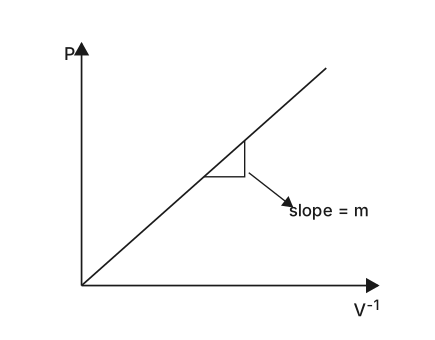
- TG EAPCET 2024Set ap-2024-05-07-FN1 markMCQQ.At 400 K, the following graph is obtained for x moles of an ideal gas. x is equal to (R = gas constant, P = pressure, V = volume) (A) 400Rm (B) m400R (C) 400mR (D) 400mR1
›Reveal solutionSolution
A plot of P against 1/V at constant T is a straight line through the origin whose slope is xRT. With slope =m and T=400 K, x=m/(400R) — option (A).
The concept first
Boyle's law says P∝1/V at constant temperature — but plotted as P vs V that is a hyperbola, which is useless for extracting a number by eye. The standard trick in physical chemistry is to linearise: choose the axes so that the law becomes a straight line, because a straight line has just two readable parameters, a slope and an intercept, and each of them is a physical quantity.
Here the axes chosen are P (vertical) against V−1 (horizontal). Start from the ideal gas equation for x moles:
PV=xRT
and solve for P:
P=xRT(V1)
Compare with y=m′x′+c:
- y≡P,
- x′≡1/V,
- slope m′≡xRT,
- intercept c=0 — which is why the line in the figure passes through the origin. (That zero intercept is itself a check that the gas is ideal.)
The key realisation: at a fixed temperature, R and T are constants, so the slope is proportional to the amount of gas. Double the moles and the line gets twice as steep.
Step-by-step
- Write the ideal gas equation for x moles:
PV=xRT
- Cast it in the form of the plotted variables (P on the y-axis, V−1 on the x-axis):
P=(xRT)⋅V−1
- Identify the slope. Comparing with y=(slope)x′: slope=xRT …
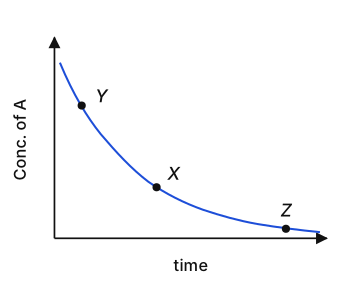
- TG EAPCET 2024Set ap-2024-05-07-FN1 markMCQQ.A → P is a first order reaction. The change in concentration of A with time is shown below. The instantaneous rate at points X, Y and Z is RX, RY, and RZ respectively. What is the correct order of RX, RY and RZ? [FIGURE] (A) RY>RX>RZ (B) RY>RZ>RX (C) RX>RY>RZ (D) RZ>RX>RY
›Reveal solutionSolution
A first-order rate is k[A], so the rate simply tracks the concentration. Y has the highest [A] (steepest part), then X, then Z on the flat tail: RY>RX>RZ — option (A).
The concept first
Two ideas meet in this question, and seeing that they are the same idea is the whole point.
Idea 1 — the rate law. For A→P obeying first-order kinetics,
R=−dtd[A]=k[A]
The rate is proportional to how much A is still there. Early on, plenty of A ⇒ fast; late on, little A ⇒ slow. This self-limiting behaviour is what generates the characteristic exponential decay
[A]t=[A]0e−kt
which is exactly the curve drawn: steep at first, then flattening asymptotically towards the time axis.
Idea 2 — the graph. The instantaneous rate at a point is the magnitude of the slope of the tangent to the [A] vs t curve at that point. On a decaying curve, the steepest tangent is at the top-left and the tangent becomes almost horizontal on the tail.
Put the two together: −dtd[A]=k[A] says the steepness of the curve is proportional to the height of the curve. So you can answer either by reading heights or by reading slopes — they must agree, and that agreement is first-order kinetics.
Step-by-step
- Locate the three points on the curve. Moving along the curve from the top-left downwards: Y is on the steep upper part (earliest time), X is on the middle, less-steep part, and Z is far out on the flat tail (latest time).
- Read off the concentrations. Because the curve falls monotonically, [A]Y>[A]X>[A]Z …
- TG EAPCET 2024Set ap-2024-05-07-FN1 markMCQQ.The number average molecular weight (Mn) of a polymer is 1500. In this polymer, 800 molecules of molar mass 1000, 100 molecules of molar mass 2000 and x molecules of molar mass 5000 are present. What is the value of x? (A) 200 (B) 400 (C) 100 (D) 50
›Reveal solutionSolution
The number‑average molecular weight is the total mass of all molecules divided by the total number of molecules. Setting up that ratio equal to 1500 and solving for the unknown count x gives x=100, which corresponds to option (C).
The key idea is that number‑average molecular weight Mn is defined as
Mn=∑Ni∑NiMi
where Ni is the number of molecules of molar mass Mi.
We are given Mn=1500, three groups of molecules with known counts and masses, and one unknown count x. We simply plug into the definition and solve.
- Write the total number of molecules There are 800 molecules of mass 1000, 100 molecules of mass 2000, and x molecules of mass 5000.
Total number=800+100+x=900+x
- Write the total mass of the polymer sample
Total mass=(800×1000)+(100×2000)+(x×5000)
Compute the known parts:
800×1000=800000,100×2000=200000
So total mass = 800000+200000+5000x=1000000+5000x.
- Set up the number‑average equation
Mn=Total numberTotal mass=900+x1000000+5000x=1500
- Solve for x Multiply both sides by (900+x):
1000000+5000x=1500(900+x)
Expand the right side:
1000000+5000x=1350000+1500x
Subtract 1500x from both sides:
1000000+3500x=1350000
Subtract 1000000:
🎓Unlock everything free for 14 days
- ✓Full step-by-step solutions
- ✓Concept-first explanations
- ✓Methods, shortcuts & mistakes
- ✓PYQ mapping + timed mock tests
Full access for 14 days. No credit card required.