Q.Find the area enclosed by the ellipse a2x2+b2y2=1
🔒You're viewing a preview — the full solution, concept, methods & PYQ mapping are locked.
🔒 Start your 14-day free trial to unlock the full solution →Concept understanding — Area of Ellipse
Area of an Ellipse
A circle of radius r has area πr2. An ellipse is a circle that has been stretched by different amounts along two perpendicular directions, so it is natural to expect its area to be a stretched version of πr2. The standard ellipse centred at the origin is
a2x2+b2y2=1,
where a is the semi-major (or semi-minor) axis along x and b is the semi-axis along y. The result we want is beautifully simple:
Area of ellipse=πab
Notice that when a=b=r the ellipse becomes a circle and πab collapses to πr2 — a good sanity check.
Finding it by integration
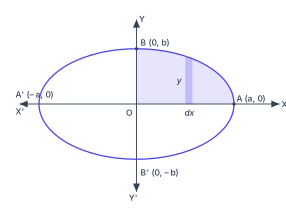
Because the ellipse is symmetric about both axes, we compute the area of the piece in the first quadrant and multiply by 4. Solving the equation for the upper half gives
y=b1−a2x2=aba2−x2.
As x runs from 0 to a this traces the first-quadrant arc, so
Area=4∫0aaba2−x2dx.
The integral ∫0aa2−x2dx is the area of a quarter-circle of radius a, which equals 4πa2. (You may also get it from the standard result ∫a2−x2dx=2xa2−x2+2a2sin−1ax+C.) Therefore
Area=a4b⋅4πa2=πab.
The intuition
The factor ab in front is exactly the vertical stretch that turns a circle of radius a into this ellipse: it scales every height by b/a, and scaling all heights scales the area by the same ratio. Multiplying the circle's area πa2 by b/a gives πab. …
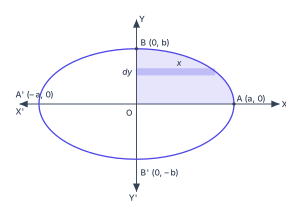
Concept: Area of Ellipse — The ellipse is a scaled circle, so its area is π times the product of its semi-axes.
Reasoning:
-
The ellipse a2x2+b2y2=1 is symmetric about both axes. The area in the first quadrant is ∫0aydx, where y=b1−x2/a2.
-
Total area A=4∫0ab1−a2x2dx. Substitute x=asinθ, so dx=acosθdθ, and when x=0, θ=0; when x=a, θ=π/2. …
The area of an ellipse is found by integrating the upper half of the ellipse from −a to a and doubling it. The result is πab.
The formula for the area of a circle is πr2. An ellipse is like a stretched circle — stretched by a factor of a along the x-axis and b along the y-axis. So intuitively, the area should be πab, the product of the semi-axes times π. But let's derive it properly.
- Set up the integral for area. The ellipse is symmetric about both axes. So the total area is twice the area of the upper half (where y≥0). From the equation a2x2+b2y2=1, solve for y in the upper half:
y=b1−a2x2
This is valid for x from −a to a.
- Write the area as an integral. The area of the upper half is ∫−aaydx. So the total area A is:
A=2∫−aab1−a2x2dx
- Simplify using symmetry. The integrand is even (symmetric about x=0), so we can integrate from 0 to a and double:
A=4b∫0a1−a2x2dx
- Substitute to get a standard form. Let x=asinθ. Then dx=acosθdθ. When x=0, θ=0; when x=a, θ=2π. The square root becomes:
1−a2x2=1−sin2θ=cosθ
(since cosθ≥0 in [0,π/2]).
The integral transforms to:
A=4b∫0π/2(cosθ)⋅(acosθ)dθ=4ab∫0π/2cos2θdθ
- Evaluate the cos2θ integral. Use the identity cos2θ=21+cos2θ: …
Method: Area of an ellipse from first principles (quarter + symmetry)
Use this to derive πab for a general ellipse a2x2+b2y2=1 by integration, rather than quoting the formula.
Steps
Step 1: Exploit symmetry.
The ellipse is symmetric about both axes, so total area =4× the first-quadrant area.
Step 2: Solve for y and set up the integral.
Upper-half: y=b1−a2x2, so
Area=4∫0ab1−a2x2dx.
Step 3: Substitute x=asinθ. …
Common Mistakes
Mistake 1: Forgetting the factor of 4 (or 2) for symmetry.
Why it's wrong: ∫0ab1−a2x2dx is only the first-quadrant area; the full ellipse needs ×4. Correct approach: Area=4∫0ab1−a2x2dx=πab.
Mistake 2: Losing the ab or the cos2 average. …
- TG EAPCET 2021Set eng-2021-08-04-FN1 markMCQQ.The area (in square units) of the quadrilateral formed by joining the focii of the two ellipses 9x2+5y2=1 and 5x2+9y2=1 is (A) 4 (B) 2 (C) 6 (D) 8
›Reveal solutionSolution
The four foci are (±2,0) and (0,±2); they form a square of area 8 — option (D).
Step 1 — Foci of the first ellipse. 9x2+5y2=1 has a2=9, b2=5, major axis along x, so c2=a2−b2=4, c=2. Foci: (±2,0).
Step 2 — Foci of the second ellipse. 5x2+9y2=1 has larger denominator under y2, so major axis along y, c2=9−5=4, c=2. Foci: (0,±2). …
- TG EAPCET 2023Set eng-2023-05-12-AN1 markMCQQ.Tangents are drawn to the ellipse 9x2+5y2=1 at all the ends of its latus recta. The area of the quadrilateral so formed (in sq. units) is (A) 27 (B) 36 (C) 42 (D) 45
›Reveal solutionSolution
The tangents at the four ends of the latus recta of an ellipse form a rhombus whose diagonals are the axes; the area is half the product of the intercepts, giving 27 square units.
Concept & Intuition
The latus rectum of an ellipse is a chord through a focus perpendicular to the major axis. Its endpoints are symmetric about both axes. Tangents at these four points will be symmetric as well, so the quadrilateral they form is actually a rhombus centered at the origin, with its diagonals along the coordinate axes. The area of such a rhombus is simply half the product of the lengths of its diagonals — which here are the intercepts cut off on the x‑axis and y‑axis by the four tangents. So we just need the equations of the tangents at one latus‑rectum endpoint, find where they hit the axes, and double appropriately.
Step‑by‑step solution
-
Identify the ellipse parameters
The ellipse is 9x2+5y2=1.
So a2=9⇒a=3, b2=5⇒b=5.
Eccentricity: e=1−a2b2=1−95=94=32.
Foci are at (±ae,0)=(±2,0).
-
Endpoints of the latus recta
For the right focus (2,0), the latus rectum is the vertical line x=2.
Substitute into the ellipse: 94+5y2=1⇒5y2=95⇒y2=925⇒y=±35.
So the four endpoints are:
(2,35),(2,−35),(−2,35),(−2,−35).
- Equation of the tangent at one endpoint For an ellipse a2x2+b2y2=1, the tangent at (x1,y1) is
a2xx1+b2yy1=1.
Take (x1,y1)=(2,35). Then
9x⋅2+5y⋅35=1⇒92x+3y=1.
Multiply by 9: 2x+3y=9.
So the tangent line is 2x+3y=9.
-
Find the intercepts of this tangent
- x‑intercept (set y=0): 2x=9⇒x=29.
- y‑intercept (set x=0): 3y=9⇒y=3.
By symmetry, the tangent at (2,−35) will be 2x−3y=9, giving x‑intercept 29 and y‑intercept −3.
The tangents at the left‑side endpoints (−2,±35) will be −2x±3y=9, giving x‑intercept −29 and y‑intercepts ±3.
-
Shape of the quadrilateral
The four tangents are:
2x+3y=9,2x−3y=9,−2x+3y=9,−2x−3y=9. …
-
- TG EAPCET 2021Set eng-2021-08-05-AN1 markMCQQ.If a circle (x−1)2+y2=r2 touches the ellipse x2+4y2=16 internally, then r= (A) 311 (B) 311 (C) 215 (D) 2
›Reveal solutionSolution
The circle is centred at (1,0) and must lie entirely inside the ellipse, touching it at exactly one point. The condition for internal tangency is that the distance from the circle’s centre to the ellipse, along the line joining their centres, equals r. Solving gives r=311, which is option (A).
The key idea: a circle touching an ellipse internally means the circle lies completely inside the ellipse and meets it at exactly one point. For a circle centred at (1,0), the ellipse is centred at (0,0) with semi-axes 4 (along x) and 2 (along y). Since the circle’s centre is on the x-axis, the point of tangency will also lie on the x-axis — the line joining the centres is the natural direction for the shortest distance from the centre to the ellipse.
-
Write the ellipse in standard form.
x2+4y2=16 becomes 16x2+4y2=1. So a=4, b=2.
-
Identify the geometry of internal tangency.
The circle (x−1)2+y2=r2 has centre C=(1,0). For internal tangency, the circle must be inside the ellipse, so the distance from C to the ellipse along the x-axis (the line through both centres) must equal r. The ellipse extends from x=−4 to x=4 on the x-axis. Since C is at x=1, the nearest point on the ellipse to the right is at x=4 — but that’s too far. Actually, the point of tangency will be somewhere between C and the ellipse’s boundary on the same side.
Because the circle’s centre is inside the ellipse (check: 12+0<16), the circle can expand until it just touches the ellipse from inside. The tangency point lies on the line joining the centres — here the x-axis — so let the point be (x0,0) on the ellipse. Then x02=16, so x0=4 or x0=−4. But C is at x=1, so the nearer boundary is x=4. That would give r=4−1=3, which is not among the options. So the tangency is not at the vertex — it occurs at some other point where the circle’s curvature matches the ellipse’s curvature? No, that’s for osculating circles. For simple tangency, the condition is that the circle and ellipse share a common tangent at the point of contact.
-
Set up the tangency condition.
Let the point of contact be (x1,y1) on the ellipse. Then:
- It lies on the ellipse: x12+4y12=16.
- It lies on the circle: (x1−1)2+y12=r2.
- The gradients (slopes of tangents) are equal at that point.
For the ellipse x2+4y2=16, differentiate implicitly: 2x+8yy′=0⇒y′=−4yx.
For the circle (x−1)2+y2=r2, differentiate: 2(x−1)+2yy′=0⇒y′=−yx−1.
Equate slopes at (x1,y1):
−4y1x1=−y1x1−1
Assuming y1=0, multiply both sides by −y1:
4x1=x1−1
Multiply by 4: x1=4x1−4⇒3x1=4⇒x1=34.
- Find y1 from the ellipse. …
-
- TG EAPCET 2024Set eng-2024-05-09-AN1 markMCQQ.The equations of the directrices of the ellipse 9x2+4y2−18x−16y−11=0 are (A) y=2±59 (B) x=1±56 (C) x=2±59 (D) y=1±56
›Reveal solutionSolution
The ellipse is vertical, centered at (1,2), with semi-major axis a=3 and semi-minor axis b=2. The directrices are horizontal lines y=2±ea=2±59, so the correct option is (A).
We start with the given equation:
9x2+4y2−18x−16y−11=0
This is a quadratic in x and y with both squared terms positive, so it’s an ellipse. The key is to rewrite it in standard form by completing the square — that reveals the center, orientation, and lengths of axes, which then give the directrices.
1. Complete the square for x and y.
Group the x terms and y terms:
(9x2−18x)+(4y2−16y)=11
Factor out the coefficients of the squares:
9(x2−2x)+4(y2−4y)=11
Complete each square:
- For x2−2x: add and subtract 1 → (x−1)2−1
- For y2−4y: add and subtract 4 → (y−2)2−4
Substitute:
9[(x−1)2−1]+4[(y−2)2−4]=11
9(x−1)2−9+4(y−2)2−16=11
9(x−1)2+4(y−2)2=36
Divide through by 36:
4(x−1)2+9(y−2)2=1
2. Identify the orientation and parameters.
The standard form is b2(x−h)2+a2(y−k)2=1 with a>b for a vertical major axis.
Here:
- Center: (h,k)=(1,2)
- a2=9 → a=3 (semi-major axis, along y-direction)
- b2=4 → b=2 (semi-minor axis, along x-direction)
Since the larger denominator is under the y-term, the major axis is vertical.
3. Find the eccentricity e.
For an ellipse, e=1−a2b2:
e=1−94=95=35
4. Determine the directrices.
For a vertical ellipse, the directrices are horizontal lines given by:
- TG EAPCET 2025Set eng-2025-05-03-FN1 markMCQQ.If the perpendicular distance from the focus of an ellipse 9x2+b2y2=1 (b<3) to its corresponding directrix is 54, then the slope of the tangent to this ellipse drawn at (23,2b) is (A) −23 (B) 32 (C) 23 (D) −32
›Reveal solutionSolution
The focus–directrix distance ea−ae=54 with a=3 forces e=35 and hence b=2. Differentiating 9x2+4y2=1 at (23,2) gives slope −32 — option (D).
The concept first
For a2x2+b2y2=1 with b<a, the foci sit at (±ae,0) and the corresponding directrices at x=±ea (the directrix on the same side as its focus). So the perpendicular distance from a focus to its own directrix is
ea−ae=ea(1−e2)=aeb2.
That single relation contains everything the question hides: it pins down e, and e pins down b.
Step-by-step
Step 1 — set up the focus–directrix equation. Here a2=9⇒a=3:
e3−3e=54.
Multiply through by 5e:
35−35e2=4e⟹35e2+4e−35=0.
Step 2 — solve for e.
e=2⋅35−4±16+4⋅35⋅35=65−4±16+180=65−4±14.
Eccentricity is positive, so e=6510=355=35.
Step 3 — get b.
b2=a2(1−e2)=9(1−95)=4⟹b=2,
and indeed b=2<3, the condition stated in the question. The ellipse is
9x2+4y2=1.
Step 4 — check the point lies on it. The point is (23,2b)=(23,22): …
- TG EAPCET 2021Set eng-2021-08-04-AN1 markMCQQ.P is a point on the conic a2x2+b2y2=a2(a2+b2−y2) and S is a focus of that conic. M is the foot of the perpendicular from P on to a directrix of that conic nearer to S. If PM = KSP, then K = (A) a2+b2b (B) ba2+b2 (C) a2+b2a (D) aa2+b2
›Reveal solutionSolution
The given equation simplifies to an ellipse. Using the ellipse’s focus-directrix property, the ratio SP/PM equals the eccentricity e, so K=1/e. The eccentricity is b/a2+b2, hence K=a2+b2/b.
First, we need to identify the conic. The equation is
a2x2+b2y2=a2(a2+b2−y2).
Expand the right-hand side:
a2x2+b2y2=a4+a2b2−a2y2.
Bring all terms to one side:
a2x2+b2y2+a2y2=a4+a2b2.
Factor y2:
a2x2+(b2+a2)y2=a2(a2+b2).
Divide through by a2(a2+b2):
a2+b2x2+a2y2=1.
This is an ellipse centred at the origin, with semi-major axis along the x-axis of length a2+b2 and semi-minor axis along the y-axis of length a.
Watch outDon’t confuse the roles of a and b here — the standard ellipse form is A2x2+B2y2=1 with A>B. Here A=a2+b2 and B=a, so A>B as long as b=0.
Now, for an ellipse A2x2+B2y2=1 with A>B, the eccentricity is
e=1−A2B2=1−a2+b2a2=a2+b2b2=a2+b2b.
The foci are at (±Ae,0)=(±a2+b2⋅a2+b2b,0)=(±b,0).
The directrices are the lines x=±eA=±b/a2+b2a2+b2=±ba2+b2.
The focus S is one of (±b,0); the nearer directrix to S is the one on the same side of the centre. For S=(b,0), the nearer directrix is x=ba2+b2. …
- TG EAPCET 2022Set eng-2022-07-20-FN1 markMCQQ.Let e1 be the eccentricity of a hyperbola for which distance between its focii is 2 times the distance between its directrices and e2 be the eccentricity of another hyperbola for which the length of its transverse axis is twice the length of its the conjugate axis. Then e1e2= (A) 1 (B) 210 (C) 5 (D) 25
›Reveal solutionSolution
The problem gives two separate hyperbolas with different conditions. For the first, the relation between foci and directrices yields e1=2. For the second, the transverse axis being twice the conjugate axis gives e2=5/2. Their product is 10/2, which is option (B).
The key here is to recall the standard definitions and parameters of a hyperbola. Every hyperbola has a transverse axis (length 2a), a conjugate axis (length 2b), foci at distance c from the centre, and directrices at distance a/e from the centre. The eccentricity e is defined by c=ae, and the relation c2=a2+b2 always holds. The distance between the two foci is 2c, and the distance between the two directrices is 2a/e.
Once you translate each condition into an equation involving a, b, c, and e, the eccentricities come out cleanly.
- First hyperbola: The distance between its foci is 2c. The distance between its directrices is 2a/e1. The condition says 2c=2×(2a/e1), i.e. c=2a/e1. But we also know c=ae1. Equate:
ae1=e12a
Cancel a (non-zero) and multiply: e12=2, so e1=2 (eccentricity is positive). …
🎓Unlock everything free for 14 days
- ✓Full step-by-step solutions
- ✓Concept-first explanations
- ✓Methods, shortcuts & mistakes
- ✓PYQ mapping + timed mock tests
Full access for 14 days. No credit card required.