Mathematics · Ch 6 — Binomial Theorem
Binomial Theorem for Positive Integral Indices
Binomial Theorem for Positive Integral Indices
Observing Patterns in Binomial Expansions
We begin by recalling expansions we already know for small powers of :
Three clear patterns emerge from these expansions.
Pattern (i): The number of terms in the expansion is always one more than the index (the exponent). For , the index is 2 and there are 3 terms. For , the index is 3 and there are 4 terms. In general, the expansion of will have terms.
Pattern (ii): In successive terms, the power of the first quantity decreases by 1 each time, while the power of the second quantity increases by 1 each time. The first term has and the last term has .
Pattern (iii): In every term, the sum of the exponents of and is constant — it equals the index of the binomial. For example, in , the terms are , , , — in each term the exponents add to 3.
Pascal's Triangle
If we write only the coefficients from these expansions in rows, we get a striking triangular pattern:
Index 0:           1
Index 1:         1   1
Index 2:       1   2   1
Index 3:     1   3   3   1
Index 4:   1   4   6   4   1
This array is called Pascal's triangle (known in ancient India as Meru Prastara by Pingala). Each row begins and ends with 1. Every other number is obtained by adding the two numbers directly above it from the previous row. For instance, in the row for index 2 we have 1, 2, 1. Adding the 1 and 2 gives 3, and adding the 2 and 1 gives the other 3 — these become the middle entries of the row for index 3.
To build the next row, write 1 at each end. For each interior position, add the two numbers above it from the previous row. This works for any index.
Expanding Using Pascal's Triangle
Suppose we want . First we need the row for index 5. We can extend Pascal's triangle row by row:
Index 0:            1
Index 1:          1   1
Index 2:        1   2   1
Index 3:      1   3   3   1
Index 4:    1   4   6   4   1
Index 5:  1   5  10  10   5   1
Using this row of coefficients and the three patterns we observed:
- The first term is
- The powers of decrease by 1 each term; powers of increase by 1 each term
- The sum of exponents in each term is 5
When expanding a binomial like , remember to raise both the coefficient and the variable to the required power. A common mistake is to write instead of .
The Limitation of Pascal's Triangle
For small indices, Pascal's triangle is convenient. But imagine trying to expand . You would need to construct all rows from index 0 up to index 12 — a tedious and error-prone process. For even larger powers, this method becomes impractical.
We need a rule that gives us the coefficients directly, without building the entire triangle.
Rewriting Pascal's Triangle Using Combinations
Recall the notation for combinations (or binomial coefficients):
where is a non-negative integer. Two important facts:
Now observe that the numbers in Pascal's triangle can be expressed using these combination symbols:
Index 0:              C(0,0)
Index 1:          C(1,0)   C(1,1)
Index 2:       C(2,0)  C(2,1)  C(2,2)
Index 3:    C(3,0) C(3,1) C(3,2) C(3,3)
Index 4: C(4,0) C(4,1) C(4,2) C(4,3) C(4,4)
Check that this matches: , , , , and so on.
The row for index in Pascal's triangle is simply:
This is the key insight. Instead of building the triangle row by row, we can compute any coefficient directly using the combination formula.
Example: Row for Index 7
For index 7, the row is:
Computing these:
So the row is: 1, 7, 21, 35, 35, 21, 7, 1.
Expanding Using Combinations
Using this row and our three patterns: …
Drawn by us to help you understand the concept clearly, and verified to make sure it's accurate. For exams, practice from your textbook's own diagram.
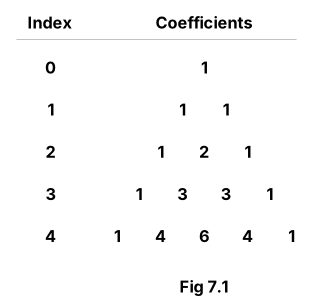
Fig. 7.1 is a triangular arrangement of numbers that shows the coefficients from the expansions of for through . The figure is the first step toward building Pascal’s triangle.
The top of the triangle is the single coefficient for : the number 1 (from ). The next row, for , has two numbers: 1 and 1 (from ). The row for has three numbers: 1, 2, 1 (from ). The row for has four numbers: 1, 3, 3, 1 (from ). The bottom row shown, for , has five numbers: 1, 4, 6, 4, 1 (from ).
There are no axes or curves — this is a pure number array. Each row corresponds to a fixed exponent , and the entries in that row are the coefficients of the terms in the expansion of , read left to right. The leftmost and rightmost entries in every row are always 1. The figure is arranged so that each number (except the 1s on the edges) is the sum of the two numbers directly above it in the previous row. For example, the 2 in the row sits below the 1 and 1 of the row; the 3s in the row sit below the 1 and 2, and below the 2 and 1, respectively.
The physical idea the figure teaches is that binomial coefficients follow a simple additive pattern — each coefficient is the sum of the two coefficients above it from the previous expansion. This pattern lets you generate the coefficients for any without expanding the binomial each time.
The textbook uses this figure to introduce Pascal’s triangle, and then rewrites each entry using combination notation. The key formula that emerges is the binomial theorem for positive integral index :
…
Drawn by us to help you understand the concept clearly, and verified to make sure it's accurate. For exams, practice from your textbook's own diagram.
What Fig. 7.2 Shows
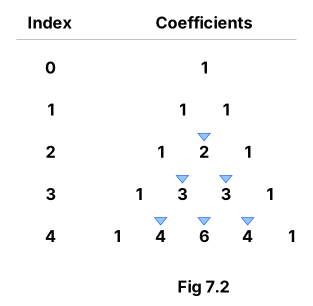
The figure is a triangular array of numbers, with the apex at the top and each row spreading wider as you go down. The topmost row contains a single entry: 1. The second row has two entries, both 1. The third row has three entries: 1, 2, 1. The fourth row: 1, 3, 3, 1. The fifth row: 1, 4, 6, 4, 1. And so on.
The caption tells you the key rule: every entry (except the 1's at the edges) is the sum of the two numbers directly above it — one to its left and one to its right in the row above. For example, the 2 in the third row comes from adding the two 1's above it. The 3's in the fourth row come from adding 1+2 and 2+1. The 6 in the fifth row comes from adding 3+3.
There are no axes or curves — this is not a graph. It is a pure number pattern, arranged as a triangle. The rows are labelled implicitly by the index of the binomial expansion : row 0 (just a single 1) corresponds to , row 1 (1, 1) to , row 2 (1, 2, 1) to , and so on. The numbers in row are the coefficients that appear when you expand .
The Physical Idea
The figure teaches a recursive rule for generating binomial coefficients without having to compute factorials or combinations each time. If you know one complete row, you can build the next row by simple addition — no multiplication, no division. This is the heart of Pascal's triangle.
The textbook uses this pattern to show that the coefficients in are not arbitrary; they follow a predictable structure. Once you see that each coefficient is the sum of two from the previous row, you can extend the triangle as far as you need. For small (like ), this is faster than using the combination formula.
The triangle only gives coefficients for positive integer exponents. For negative or fractional exponents, the pattern breaks down — you need the general binomial theorem (not in Class 11).
The Key Formula the Figure Develops
The figure leads directly to the binomial theorem for positive integral index :
where (read "n choose r") is the binomial coefficient, defined as:
Each is exactly the -th entry in row of Pascal's triangle. For example, row 5 is:
The figure also teaches three structural observations that the formula captures:
- The expansion has terms (one more than the index).
- Powers of decrease from to ; powers of increase from to .
- In every term, the sum of the exponents of and equals .
The textbook later rewrites Pascal's triangle using combination notation (Fig. 7.3), where row becomes . This connects the visual pattern to the algebraic formula, making it clear that the recursive addition rule is equivalent to the combinatorial identity .
Why This Matters for Exams
When expanding a binomial like , you can either:
- Write out Pascal's triangle up to row 5 (quick for small ), or …
Drawn by us to help you understand the concept clearly, and verified to make sure it's accurate. For exams, practice from your textbook's own diagram.
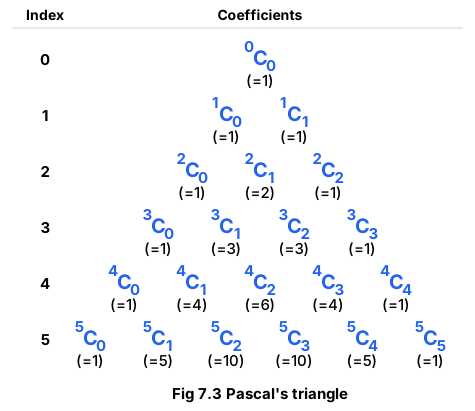
Fig 7.3 in the NCERT textbook is not a graph with axes or curves — it is a triangular array of numbers, Pascal’s triangle, rewritten using combination notation. The figure shows the same triangle as Fig 7.2, but each entry is now expressed as (also written ) instead of its numerical value.
The top vertex of the triangle corresponds to and contains . The next row () has and , both equal to 1. The third row () reads , , — which numerically are 1, 2, 1. Each subsequent row is built from the row above using the relation , which is exactly the addition rule that generates Pascal’s triangle.
The key idea the figure teaches is that the coefficients in the binomial expansion of are precisely the numbers . By writing the triangle in this form, the textbook shows that you can directly write the row for any index without constructing all previous rows — you simply list .
The central formula developed with this figure is the binomial theorem for positive integral index:
where , is a positive integer, and the sum runs from to .
The figure makes clear that the coefficients are symmetric: , which is why the triangle reads the same left-to-right and right-to-left. It also shows that the first and last entries in every row are 1, since .
The physical idea is simple: instead of memorising or building Pascal’s triangle row by row for large , you can compute any coefficient directly using the combination formula. This is what makes the binomial theorem practical for expansions like , where writing out 13 rows of the triangle would be tedious. …