Mathematics · Ch 8 — Conic Sections
Hyperbola
Hyperbola
The Hyperbola: Definition and Key Elements
A hyperbola is the set of all points in a plane for which the difference of the distances from two fixed points is constant. This is the defining property, analogous to the ellipse (where the sum of distances is constant) but with subtraction instead of addition.
The two fixed points are called the foci (singular: focus). The constant difference is always taken as the distance to the farther focus minus the distance to the nearer focus, so the difference is positive.
The definition uses difference, not sum. If is a point on the hyperbola and are the foci, then . The absolute value is needed because which focus is farther depends on which branch of the hyperbola lies on.
The midpoint of the line segment joining the foci is called the centre of the hyperbola. The line through the foci is called the transverse axis — this is the axis along which the hyperbola opens. The line through the centre perpendicular to the transverse axis is called the conjugate axis.
The points where the hyperbola intersects the transverse axis are called the vertices (singular: vertex). A hyperbola has two vertices, one on each branch.
Standard Notation and the Relationship Between a, b, and c
Let the distance between the two foci be . Let the distance between the two vertices (the length of the transverse axis) be . By definition, for a hyperbola (unlike an ellipse where ).
We define a quantity by the relation:
The length of the conjugate axis is .
For a hyperbola: . This is the Pythagorean relation, but note the plus sign — it is the opposite of the ellipse relation .
Determining the Constant Difference
To find the numerical value of the constant difference mentioned in the definition, we use a clever argument involving the vertices.
Consider the hyperbola with foci and , vertices and , and centre as shown in the textbook figure (Fig 10.28). Let and be the two vertices, with closer to and closer to .
Take the point at vertex . By the definition of the hyperbola:
Now take the point at vertex . Again by definition:
Since the constant is the same for every point on the hyperbola, these two expressions are equal:
Now observe from the figure that (since lies between and on the transverse axis). Similarly, (since lies between and ).
Substituting these into the equality:
Since (the distance between the two vertices), we can simplify:
…
Definition
A hyperbola is the set of all points in a plane such that the absolute difference of their distances from two fixed points (the foci) is constant.
The "difference" here means: distance to the farther focus minus distance to the closer focus. This difference is always the same positive number for every point on the hyperbola.
The constant difference is denoted by , where . The distance between the two foci is , with .
The midpoint of the line segment joining the foci is the centre of the hyperbola. The line through the foci is the transverse axis; the line through the centre perpendicular to it is the conjugate axis. The points where the hyperbola meets the transverse axis are its vertices.
Intuition
Think of a hyperbola as the opposite of a circle or ellipse. In a circle, distances from a fixed point are equal. In an ellipse, the sum of distances from two foci is constant. In a hyperbola, the difference of distances from two foci is constant — so the two branches "pull away" from each other, never closing.
Tiny Concrete Example
Take two foci at and . Let the constant difference be (so , ). Then a point on the hyperbola satisfies: …
Drawn by us to help you understand the concept clearly, and verified to make sure it's accurate. For exams, practice from your textbook's own diagram.
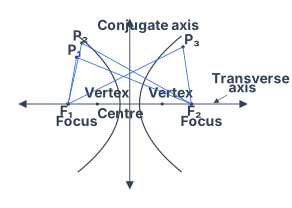
Fig. 10.27 is the first visual definition of a hyperbola in the NCERT text. It shows a two-branch curve opening left and right, drawn on a standard Cartesian plane. The horizontal line through the two foci is the transverse axis; the vertical line through the centre, perpendicular to the transverse axis, is the conjugate axis. The two fixed points labelled and are the foci, placed symmetrically on the transverse axis. Midway between them is the centre (labelled or simply marked as the origin). The hyperbola crosses the transverse axis at exactly two points — these are the vertices, one on each branch, closer to the centre than the foci are.
Three points are marked on the curve: , , . From each of these points, two blue line segments are drawn — one to and one to . The figure is designed to make you see that the difference of these two distances is the same for every point on the hyperbola. For a point on the right branch, the distance to the right focus () is smaller than the distance to the left focus (); for a point on the left branch, the opposite is true. The definition uses the absolute difference — the distance to the farther focus minus the distance to the nearer focus — and that constant difference is what defines the curve.
The figure does not show the constant difference as a number; it shows the geometric idea. The textbook then uses the vertices and (the two vertices) to calculate that this constant is exactly , where is half the distance between the vertices.
The key quantities introduced with this figure are:
- — the distance between the two foci and .
- — the distance between the two vertices (the length of the transverse axis).
- — defined by , so that is the length of the conjugate axis (shown in the next figure, Fig. 10.28).
The central formula that emerges from this figure is the definition of a hyperbola itself:
where is any point on the hyperbola, and are the foci, and is the constant difference. The absolute value ensures the definition works for both branches.
The textbook then uses the geometry of the figure to derive this constant. By taking at vertex (on the right branch) and at vertex (on the left branch), and applying the definition, it shows:
and after a short manipulation (using the fact that and lie on the transverse axis), this simplifies to . So the constant difference is exactly the distance between the two vertices. …
Drawn by us to help you understand the concept clearly, and verified to make sure it's accurate. For exams, practice from your textbook's own diagram.
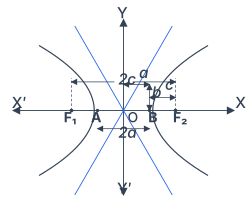
The figure shows a standard hyperbola drawn on an -coordinate plane. The curve has two separate, mirror-image branches: one opening to the right, the other to the left. The -axis runs horizontally through the centre, and the -axis vertically through the centre. The two foci are marked and , placed symmetrically on the -axis, one on each side of the centre. The two vertices are labelled and , also on the -axis, lying between the foci and the centre. The centre itself is the origin, the midpoint of both the segment and the segment .
The diagram labels three key distances. The distance from the centre to each focus is , so the full distance between the foci is — shown as a dashed horizontal span from to . The distance from the centre to each vertex is , so the distance between the two vertices (the length of the transverse axis) is — also shown as a dashed horizontal span from to . A vertical dashed line through the centre, of length , represents the conjugate axis; the label appears at the top of this vertical segment, indicating the distance from the centre to the point where the conjugate axis meets the dashed rectangle that helps sketch the asymptotes (though the rectangle itself is not mentioned in the description, the label is present).
The physical idea the figure teaches is the definition of a hyperbola: for any point on either branch, the absolute difference of its distances to the two foci is constant and equals . The textbook uses the figure to prove this constant. By placing at vertex (on the right branch) and then at vertex (on the left branch), and using the definition, it shows that . A short algebraic manipulation — adding and subtracting segment lengths along the transverse axis — yields that this common difference is exactly .
The symbols have these meanings:
- : the two foci, fixed points apart.
- : the two vertices, apart along the transverse axis.
- : distance from centre to each focus.
- : distance from centre to each vertex (semi-transverse axis).
- : defined by , the semi-conjugate axis length.
Do not confuse with the distance from centre to focus. For a hyperbola, , so is real but not directly a distance to any labelled point on the axes — it appears as the vertical half-length of the conjugate axis. …