Q.Describe the Excretory system of man giving the structure of a Nephron.
You're viewing a preview — the full solution, concept, methods & PYQ mapping are locked.
Start your 14-day free trial to unlock the full solution →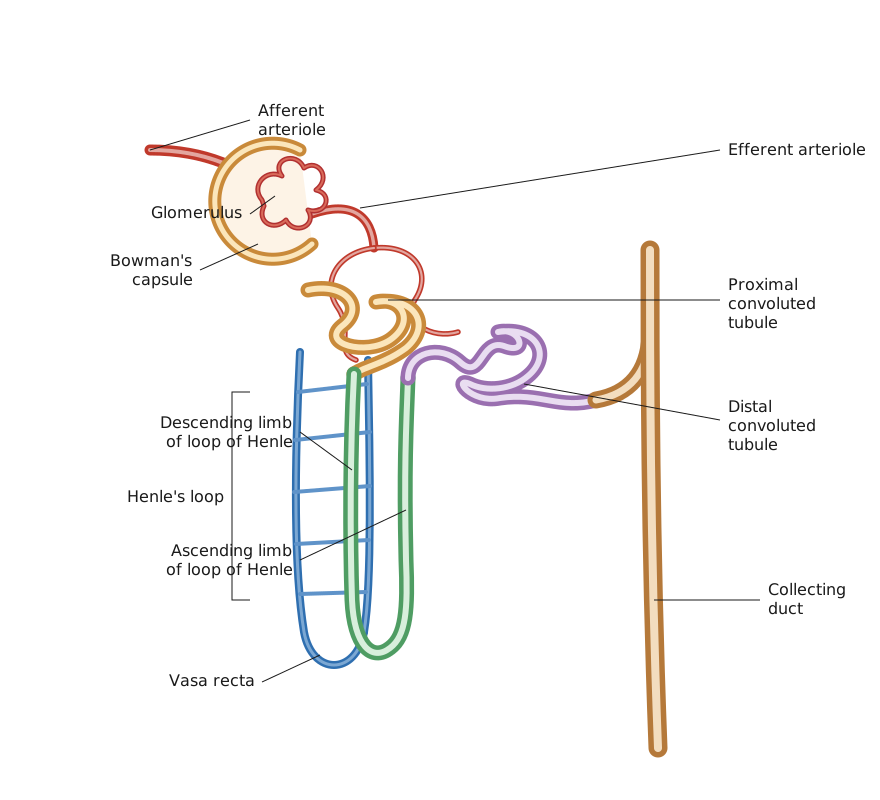
The human excretory system is made up of paired kidneys (containing millions of nephrons), ureters, a urinary bladder, and a urethra, and it removes nitrogenous wastes by forming urine through filtration, reabsorption and secretion in the nephron.
Excretory system of man:
The human excretory system consists of:
- A pair of kidneys - Bean-shaped, reddish-brown organs located on either side of the vertebral column in the abdominal cavity (retroperitoneal position), the main excretory organs.
- A pair of ureters - Muscular tubes that carry urine from each kidney down to the urinary bladder.
- Urinary bladder - A muscular sac that stores urine temporarily before it is voided.
- Urethra - The tube through which urine is expelled to the exterior during micturition.
Internal structure of the kidney:
Each kidney has a convex outer border and a concave inner border (hilum), through which the ureter, blood vessels and nerves enter/exit. Internally, the kidney is divided into an outer cortex and an inner medulla, the medulla organised into conical renal pyramids projecting into the calyces, which open into the funnel-shaped pelvis leading to the ureter.
Structure of the Nephron:
Each kidney contains about one million nephrons, which are the structural and functional units responsible for urine formation. A nephron has two main parts:
- Malpighian corpuscle (renal corpuscle):
- Glomerulus - A tuft of capillaries formed by the afferent arteriole, which then continues as the (narrower) efferent arteriole, creating high pressure for filtration.
- Bowman's capsule - A double-walled, cup-shaped structure that surrounds the glomerulus and collects the filtrate.
- Renal tubule:
- Proximal Convoluted Tubule (PCT) - Lined with microvilli-bearing cells, reabsorbs most of the useful substances (glucose, amino acids, ions, water) from the filtrate.
- Loop of Henle - A U-shaped structure with a descending limb (permeable to water) and an ascending limb (permeable to ions, impermeable to water), important in concentrating urine. …
Unlock everything free for 14 days
- Full step-by-step solutions
- Concept-first explanations
- Methods, shortcuts & mistakes
- PYQ mapping + timed mock tests
Full access for 14 days. No credit card required.