Q.Identify True/False statements. Correct each false statement to make it true.
🔒You're viewing a preview — the full solution, concept, methods & PYQ mapping are locked.
🔒 Start your 14-day free trial to unlock the full solution →Concept understanding — Reproductive System Functions
Reproductive System Functions – A First Look
Think about what every living thing does, without exception: it reproduces. A mango tree grows from a seed, flowers, and produces more mangoes. A cat gives birth to kittens. You yourself are here because two people, your parents, reproduced. Reproduction is the biological process by which organisms create new individuals of their own kind — it is the reason life continues across generations.
For a commerce or humanities student, the reproductive system is not about complicated diagrams or medical terms. It is about understanding the purpose and basic working of the system that ensures the survival of the human species. The NCERT textbook presents this as a fundamental life process, just like nutrition, respiration, or excretion.
What Does the Reproductive System Do?
The primary function of the reproductive system is to produce offspring. But that simple statement hides a lot of careful design. The system must:
- Produce gametes — the male sperm and the female egg (ovum).
- Transport these gametes so they can meet and fertilise.
- Provide a safe environment for the development of the fertilised egg into a baby.
- Nourish the newborn after birth (through milk production in females).
In humans, reproduction is sexual — it requires two parents, one male and one female. This is different from asexual reproduction (like a bacterium splitting into two), and it introduces genetic variation, which is why brothers and sisters are not identical copies of each other.
The reproductive system is the only organ system that is not essential for the survival of the individual — you can live without reproducing. But it is essential for the survival of the species. That is why it is considered a life process in biology.
The Male Reproductive System – Key Functions
The male system is designed to produce and deliver sperm. The NCERT textbook highlights these main parts and their roles:
- Testes (two oval organs): Produce sperm and the male hormone testosterone. Testosterone is responsible for changes during puberty — deeper voice, facial hair, muscle growth.
- Duct system (epididymis, vas deferens, urethra): Stores sperm and transports it out of the body.
- Accessory glands (seminal vesicles, prostate gland, bulbourethral glands): Add fluids to the sperm to form semen. These fluids nourish the sperm and help them swim.
The entire process is controlled by hormones from the brain (pituitary gland) and the testes themselves.
The Female Reproductive System – Key Functions
The female system is more complex because it must not only produce eggs but also support a growing baby. The NCERT textbook describes these main functions:
- Ovaries (two almond-shaped organs): Produce eggs (ova) and the female hormones oestrogen and progesterone. These hormones regulate the menstrual cycle and prepare the body for pregnancy.
- Fallopian tubes (oviducts): Carry the egg from the ovary to the uterus. Fertilisation (fusion of sperm and egg) usually happens here.
- Uterus (womb): A hollow, muscular organ where the fertilised egg implants and grows into a baby. Its lining thickens each month in preparation for pregnancy.
- Cervix and vagina: The cervix is the lower opening of the uterus; the vagina is the birth canal through which the baby is delivered. …
Let’s go through each statement one by one, exactly as the NCERT textbook presents the facts.
- False. Androgens are produced by Leydig cells, not by Sertoli cells. Correct statement: Androgens are produced by Leydig cells.
- True. Sertoli cells provide nutrition to the developing spermatozoa.
- False. Leydig cells are found in the testes, not in the ovary. Correct statement: Leydig cells are found in the testes.
- True. Leydig cells synthesise androgens (mainly testosterone).
- False. Oogenesis takes place in the ovary, specifically within the ovarian follicles. The corpus luteum forms after ovulation and secretes progesterone. Correct statement: Oogenesis takes place in the ovary. …
This answer evaluates each statement about the human reproductive system as True or False, correcting the false ones based strictly on NCERT Class 12 Biology.
Let’s go through each statement one by one, grounding every correction in what the NCERT textbook actually says. The reproductive system is a beautifully coordinated network of cells, hormones, and organs, and these statements touch on some of its most commonly misunderstood details.
- Androgens are produced by Sertoli cells. (True/False) This is False. The NCERT textbook clearly states that androgens — the male sex hormones, primarily testosterone — are produced by the Leydig cells (also called interstitial cells), which are present in the spaces between the seminiferous tubules of the testes. Sertoli cells, on the other hand, are found inside the seminiferous tubules and have a completely different job: they provide nutrition to the developing spermatozoa and also secrete a hormone called inhibin. So the corrected statement would read: Androgens are produced by Leydig cells.
- Spermatozoa get nutrition from Sertoli cells. (True/False) This is True. NCERT explicitly mentions that Sertoli cells are responsible for nourishing the spermatozoa as they develop within the seminiferous tubules. Without these "nurse cells," the sperm cells would not get the nutrients they need to mature. So this statement is correct as given.
- Leydig cells are found in ovary. (True/False) This is False. Leydig cells are exclusive to the male reproductive system — specifically, they are located in the testes. In the female, the analogous hormone-producing cells are the theca interna cells of the ovarian follicle, which produce androgens that are then converted to oestrogen. But Leydig cells themselves are never found in the ovary. The corrected statement: Leydig cells are found in the testes.
- Leydig cells synthesise androgens. (True/False) This is True. As mentioned in part (a), the NCERT textbook confirms that Leydig cells synthesise androgens, particularly testosterone. This is a fundamental fact about male reproductive physiology. So this statement is correct.
- Oogenesis takes place in corpus luteum. (True/False) …
Showing the 12 most recent of 36 on this concept.
- TG EAPCET 2026Set ap-2026-05-04-AN1 markMCQQ.Match the following: List-1 List-2 A. Ligaments I. Dense irregular connective tissue B. Valves of heart II. Transitional epithelium C. Epiglottis III. Dense regular connective tissue D. Wall of urinary bladder IV. Vascular tissue V. Gristle The correct answer is (A) A – III, B – IV, C – I, D – V (B) A – I, B – II, C – III, D – IV (C) A – IV, B – I, C – V, D – III (D) A – III, B – I, C – V, D – II
›Reveal solutionSolution
Match each structure to its tissue type by understanding the functional demands: ligaments need parallel collagen for tensile strength (dense regular), heart valves need multidirectional strength (dense irregular), epiglottis needs flexible support (cartilage/gristle), and the bladder wall needs stretch accommodation (transitional epithelium). The correct answer is (D).
The key to matching anatomical structures with tissue types lies in understanding what each structure does and what tissue properties support that function.
Concept: Structure follows function in tissue organization
Dense regular connective tissue has collagen fibers arranged in parallel bundles, providing maximum tensile strength in one direction—perfect for structures that experience unidirectional pulling forces. Dense irregular connective tissue has collagen fibers arranged in multiple directions, resisting tension from various angles. Transitional epithelium is specialized stratified tissue that can stretch and recoil. Cartilage (gristle) provides firm yet flexible support.
Let's analyze each structure:
-
Ligaments (A) connect bone to bone across joints and must resist strong pulling forces along their length. The collagen fibers run parallel to the direction of stress, making this dense regular connective tissue (III). The organized, unidirectional arrangement maximizes tensile strength where it's needed.
-
Valves of the heart (B) are thin flaps that must withstand blood pressure from multiple directions as they open and close. They need strength in all directions within their plane, which requires dense irregular connective tissue (I). The randomly oriented collagen network prevents tearing regardless of pressure direction.
-
Epiglottis (C) is the flap of tissue that covers the trachea during swallowing. It must be firm enough to hold its shape yet flexible enough to move quickly. This is elastic cartilage, commonly called gristle (V). The cartilage matrix provides the perfect balance of rigidity and flexibility. …
-
- TG EAPCET 2026Set ap-2026-05-04-AN1 markMCQQ.Consider the following statements Statement I: Dryopithecus is a stage in human evolution and was more ape like Statement II: In human evolution Homo erectus was followed by Homo habilis The correct answer is (A) Both statement I and statement II are true (B) Both statement I and statement II are false (C) Statement I is true, but statement II is false (D) Statement I is false, but statement II is true
›Reveal solutionSolution
Dryopithecus was an ape-like ancestor in the lineage leading to humans and great apes, making Statement I true. However, Homo habilis appeared before Homo erectus in human evolution, making Statement II false. The correct option is (C).
The question asks us to evaluate two statements regarding human evolution. To do this, we need to recall the general timeline and characteristics of various hominid species. Understanding the sequence and key features of these stages is crucial for correctly assessing each statement.
-
Analyze Statement I: Dryopithecus is a stage in human evolution and was more ape like
- Dryopithecus is an extinct genus of hominoids that lived during the Miocene epoch, approximately 9 to 12 million years ago.
- Fossils of Dryopithecus have been found in Europe and Asia. They are considered to be among the earliest ancestors of both modern humans and great apes (chimpanzees, gorillas, orangutans).
- Their skeletal features, particularly their limb structure and dental characteristics, indicate that they were primarily arboreal (tree-dwelling) and exhibited many ape-like traits. For example, they had relatively long arms and short legs, and their molars had thin enamel, similar to modern apes.
- Therefore, Dryopithecus is indeed considered a significant stage in the broader evolutionary lineage that eventually led to humans, and it was distinctly more ape-like in its morphology and lifestyle.
- Conclusion for Statement I: Statement I is true.
-
Analyze Statement II: In human evolution Homo erectus was followed by Homo habilis
- Let's recall the general sequence of the genus Homo in human evolution:
- Homo habilis ("handy man") lived approximately 2.4 to 1.4 million years ago. They are known for being the first to make and use stone tools. …
- Let's recall the general sequence of the genus Homo in human evolution:
-
- TG EAPCET 2026Set ap-2026-05-04-FN1 markMCQQ.Consider the following statements Statement I: Barbiturates cause sleeplessness Statement II: Benzodiazepines are sleeping pills The correct answer is Options : (A) Both statement I and statement II are true (B) Both statement I and statement II are false (C) Statement I is true, but statement II is false (D) Statement I is false, but statement II is true
›Reveal solutionSolution
Barbiturates cause sleep, not sleeplessness (I false); benzodiazepines are sleeping pills (II true).
Barbiturates depress the central nervous system and are classic sedative-hypnotics — they promote sleep, so 'cause sleeplessness' is incorrect. Benzodiazepines (e.g. diazepam, nitrazepam) are widely prescribed as anti-anxiety an …
- TG EAPCET 2026Set ap-2026-05-04-FN1 markMCQQ.Accumulation of iron particles in tissues lead to (A) Asbestosis (B) Silicosis (C) Siderosis (D) Black lung disease
›Reveal solutionSolution
The accumulation of iron particles in tissues is medically termed siderosis. The correct option is (C).
The human body has mechanisms to clear foreign particles, especially in the respiratory system. However, prolonged or intense exposure to certain types of dust or particles can overwhelm these mechanisms, leading to the deposition and accumulation of these particles in tissues. This accumulation can trigger inflammatory responses, fibrosis, and impaired organ function, leading to specific diseases depending on the nature of the inhaled particle.
Let's examine the given options:
-
Siderosis: This term specifically refers to the accumulation of iron in tissues. When iron particles, such as iron dust or fumes, are inhaled over time, they can deposit in the lungs, leading to a condition called pulmonary siderosis. This is commonly observed in occupations involving iron exposure, like welding or iron mining. The iron particles themselves are relatively inert, but their presence can cause changes in lung tissue.
-
Asbestosis: This is a chronic lung disease caused by inhaling asbestos fibers. Asbestos is a group of naturally occurring fibrous minerals. When these fibers are inhaled, they can become lodged in the lungs, leading to inflammation and scarring (fibrosis) of the lung tissue. This results in symptoms like shortness of breath and a persistent cough, and it increases the risk of lung cancer and mesothelioma. …
-
- TG EAPCET 2026Set ap-2026-05-04-FN1 markMCQQ.Study the following and choose the correct statement I. Sickle cell anemia is due to replacement of glutamic acid in 6th position by valine II. Thalassemia is sex linked disorder due to recessive genes III. Down syndrome is an allosomal disorder IV. Phenylketonuria is due to mutation of the gene-PAH in chromosome 12 (A) I, IV (B) II, III (C) I, III (D) III, IV
›Reveal solutionSolution
The question tests your knowledge of specific genetic disorders and their causes. Only statements I and IV are correct, so the answer is option (A).
Let’s go through each statement one by one, understanding the biology behind it.
-
Statement I: Sickle cell anemia is due to replacement of glutamic acid in the 6th position by valine.
This is a classic point from molecular genetics. Sickle cell anemia results from a point mutation in the beta-globin gene on chromosome 11. The mutation changes the codon GAG to GUG, which substitutes valine (a hydrophobic amino acid) for glutamic acid (a hydrophilic one) at the 6th position of the beta chain. This alters hemoglobin’s shape, causing sickling of red blood cells. This statement is correct.
-
Statement II: Thalassemia is a sex-linked disorder due to recessive genes.
Thalassemia is actually an autosomal recessive disorder, not sex-linked. It involves reduced or absent synthesis of globin chains (alpha or beta) due to mutations in genes on chromosomes 16 (alpha) or 11 (beta). It is not linked to the X or Y chromosome. So this statement is incorrect.
-
Statement III: Down syndrome is an allosomal disorder.
“Allosomal” refers to sex chromosomes (X and Y). Down syndrome is caused by trisomy of chromosome 21, which is an autosome (non-sex chromosome). It is an autosomal aneuploidy, not an allosomal one. So this statement is incorrect. …
-
- TG EAPCET 2026Set ap-2026-05-05-FN1 markMCQQ.Identify the correct statements related to the class Phaeophyceae A. Asexual reproduction occurs usually by biflagellate zoospores B. Sexual reproduction is by oogamous method only C. Food is stored as simple carbohydrates in the form of mannitol or laminarin D. Major pigments are chlorophyll a, c, xanthophylls and carotenoids E. Cellulose cell wall has outer gelatinous coating of algin (A) A, B, C and D only (B) B, C, D and E only (C) A, D and E only (D) A, B, C and E only
›Reveal solutionSolution
Phaeophyceae (brown algae) have biflagellate zoospores, store food as mannitol/laminarin, contain chlorophyll a, c, xanthophylls, and carotenoids, and have a cellulose wall with algin coating — but sexual reproduction is not only oogamous; it can also be isogamous or anisogamous. The correct set is A, C, D, E, which matches option (C).
The question tests your knowledge of the brown algae class Phaeophyceae — a group you’ve likely studied under plant kingdom diversity. The trick is to recall that while many brown algae show oogamy (e.g., Fucus), the class as a whole includes all three types of sexual reproduction: isogamous, anisogamous, and oogamous. Statement B says “only oogamous” — that’s the trap.
Let’s go statement by statement.
-
Statement A: Asexual reproduction occurs usually by biflagellate zoospores
This is correct. In Phaeophyceae, asexual reproduction commonly happens through zoospores that are pear-shaped and have two flagella — one pointing forward (tinsel type) and one trailing (whiplash type). These are produced in sporangia.
-
Statement B: Sexual reproduction is by oogamous method only
This is false. While oogamy is present (e.g., in Fucus and Sargassum), many brown algae also reproduce by isogamy (e.g., Ectocarpus) or anisogamy (e.g., Dictyota). So “only” makes this statement incorrect.
-
Statement C: Food is stored as simple carbohydrates in the form of mannitol or laminarin
Correct. Brown algae do not store starch like green plants. Their reserve food is mannitol (a sugar alcohol) and laminarin (a β-glucan polymer). These are indeed simple carbohydrates.
-
Statement D: Major pigments are chlorophyll a, c, xanthophylls and carotenoids …
-
- TG EAPCET 2026Set ap-2026-05-05-FN1 markMCQQ.Consider the following statements Statement I: Cannabinoids are being abused by sports persons (doping) Statement II: Cocaine is involved in the transport of neurotransmitter dopamine The correct answer is (A) Both statement I and statement II are true (B) Both statement I and statement II are false (C) Statement I is true, but statement II is false (D) Statement I is false, but statement II is true
›Reveal solutionSolution
We need to verify two independent statements about drugs: cannabinoids in sports doping and cocaine's interaction with dopamine transport. Both statements are factually correct, making (A) the right answer.
Let me evaluate each statement based on established pharmacological and sports medicine facts.
Statement I: Cannabinoids are being abused by sports persons (doping)
Evaluating the claim:
Cannabinoids, particularly THC (tetrahydrocannabinol) from cannabis, are indeed on the World Anti-Doping Agency's (WADA) prohibited substances list. While the performance-enhancing effects are debated, cannabinoids are monitored and restricted in competitive sports for several reasons:
- They may reduce anxiety and pain perception
- They can affect reaction time and coordination
- WADA prohibits them in-competition
- Numerous athletes have faced sanctions for cannabinoid use
Conclusion for Statement I: This statement is TRUE. Cannabinoids are classified as substances of abuse in sports, and their use constitutes doping violations.
Statement II: Cocaine is involved in the transport of neurotransmitter dopamine
Evaluating the claim:
This requires understanding cocaine's mechanism of action at the neurochemical level:
-
Normal dopamine transport: After dopamine is released into the synaptic cleft, it's normally reabsorbed by the presynaptic neuron through dopamine transporter (DAT) proteins—a process called reuptake.
-
Cocaine's mechanism: Cocaine binds to and blocks dopamine transporters, preventing the reuptake of dopamine from the synapse. …
- TG EAPCET 2025Set ap-2025-04-29-AN1 markMCQQ.Study the lists I, II, III & IV given below and identify the mismatch.
List-1 (Type of inflorescence) List-2 (Family) List-3 (Example) List-4 (Character) I Verticellaster Lamiaceae Leucas Begin as a monochasial cyme II Cyathium Euphorbiaceae Euphorbia Bisexual flowers arranged in cymose fashion III Hypanthodium Moraceae Ficus Male, female and gall flowers are present (A) I & III (B) II & III (C) I & II (D) III only 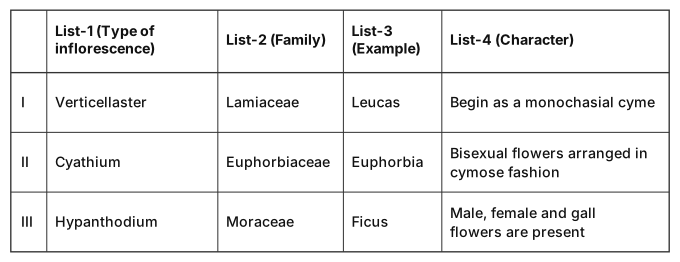
›Reveal solutionSolution
Row I is wrong because a verticillaster begins as a dichasial cyme (and only later becomes monochasial/scorpioid), and Row II is wrong because a cyathium contains unisexual flowers — many male flowers around one female — not bisexual ones. Row III (hypanthodium in Ficus, with male, female and gall flowers) is perfectly correct. The mismatches are I & II, i.e. option (C).
The concept first
"Special" inflorescences are the ones that don't fit the plain racemose/cymose scheme. Three of them are examination favourites, and each is defined by a precise developmental description. Learn the description, not just the family name, because that is exactly what the question tests.
Inflorescence Family Example The defining description Verticillaster Lamiaceae Leucas, Ocimum A condensed cluster in the axil of opposite leaves that starts as a dichasial (biparous) cyme and is continued by monochasial (scorpioid, uniparous) cymes Cyathium Euphorbiaceae Euphorbia, Poinsettia A cup-like involucre enclosing one central, stalked female flower (a naked pistil) surrounded by many male flowers, each reduced to a single stamen — all flowers unisexual Hypanthodium Moraceae Ficus A hollow, pear/flask-shaped fleshy receptacle with a small apical pore (ostiole), lined internally by male, female and gall flowers Step-by-step check of each printed row
Step 1 — Row I: Verticillaster / Lamiaceae / Leucas / "Begin as a monochasial cyme".
The family and example are right. But the character is not: a verticillaster begins as a dichasial cyme at the centre, and afterwards the lateral branches continue in the monochasial (scorpioid) manner. The printed statement reverses the order of development, so Row I is a mismatch.
Step 2 — Row II: Cyathium / Euphorbiaceae / Euphorbia / "Bisexual flowers arranged in cymose fashion". …
- TG EAPCET 2025Set ap-2025-04-30-FN1 markMCQQ.Karyotype of Turner's syndrome is (A) 45, X [AA + XO] (B) 47, XXY [AA + XXY] (C) 47, XX + 13 (D) 47, XX + 18
›Reveal solutionSolution
Turner's syndrome results from the loss of one X chromosome in females, giving a total of 45 chromosomes with the sex chromosome constitution XO. The correct karyotype notation is 45, X.
Turner's syndrome is a classic example of a sex chromosome aneuploidy — a condition where the number of sex chromosomes deviates from the normal pair. In humans, the normal female karyotype is 46, XX (22 pairs of autosomes + two X chromosomes). Turner's syndrome arises when one of the X chromosomes is completely or partially missing, leaving a single X. This is written as 45, X (or sometimes 45, XO), where "O" denotes the absence of a second sex chromosome.
The key idea is that the total chromosome count drops to 45 because one sex chromosome is absent, while all 44 autosomes (22 pairs) remain intact. The notation "45, X" is the standard way to express this: the number before the comma is the total chromosome count, and the symbols after the comma describe the sex chromosome constitution.
Let's examine each option:
-
Option (A): 45, X [AA + XO]
This correctly states the total as 45, with the sex chromosome constitution as X (or XO). The "AA" stands for the 44 autosomes (22 pairs). This matches Turner's syndrome exactly.
-
Option (B): 47, XXY [AA + XXY]
This describes Klinefelter's syndrome — a male with an extra X chromosome. The total is 47, and the sex chromosomes are XXY. Not Turner's.
-
Option (C): 47, XX + 13 …
-
- TG EAPCET 2024Set ap-2024-05-08-FN1 markMCQQ.Match the following List-1 List-2 A. Physical barrier I. Lysozyme B. Physiological barriers II. Interferons C. Cellular barriers III. Monocytes D. Cytokine barriers IV. Colostrum V. Mucus membrane The correct answer is (A) A-V, B-I, C-IV, D-II (B) A-V, B-I, C-III, D-II (C) A-III, B-II, C-I, D-V (D) A-I, B-V, C-II, D-III
›Reveal solutionSolution
This question tests your understanding of the different types of innate immune barriers in the human body. The correct match is A-V, B-I, C-III, D-II, which corresponds to option (B).
The immune system has multiple layers of defense. The first line of defense consists of physical and physiological barriers that prevent pathogen entry. The second line includes cellular and cytokine barriers that act if a pathogen does get in. This question asks you to correctly classify specific examples into these four categories.
Let’s go through each item in List-1 and match it with the correct example from List-2.
-
Physical barrier (A) — These are structures that physically block pathogens from entering the body. The mucus membrane (V) lines the respiratory, digestive, and urogenital tracts. Mucus traps microbes, and cilia sweep them out. This is a classic physical barrier. So A matches V.
-
Physiological barriers (B) — These are conditions or secretions that create an inhospitable environment for pathogens. Lysozyme (I) is an enzyme found in tears, saliva, and mucus that breaks down bacterial cell walls. It is a physiological barrier because it acts chemically, not physically. So B matches I.
-
Cellular barriers (C) — These are immune cells that directly attack pathogens. Monocytes (III) are a type of white blood cell that can differentiate into macrophages and engulf microbes. They are a cellular component of innate immunity. So C matches III. …
-
- TG EAPCET 2024Set ap-2024-05-08-FN1 markMCQQ.Statement I: Jean Baptiste de Lamarck stated that acquired characters are inherited to the next generations Statement II: August Weisman strongly supported the view of inheritance of acquired characters (A) Both statements I and II are correct (B) Both statements I and II are false (C) Statement I is true, but II is false (D) Statement I is false. But II is true
›Reveal solutionSolution
Lamarck proposed the inheritance of acquired characters; Weismann disproved it with his germ-plasm theory. Statement I is correct, Statement II is false.
The core of this question lies in the history of evolutionary thought — specifically, the clash between two major ideas about how traits are passed on. Lamarck’s theory, often summarized as “use and disuse,” claimed that changes an organism acquires during its lifetime (like a giraffe stretching its neck) could be inherited by its offspring. Weismann, on the other hand, is famous for refuting this idea through his germ-plasm theory, which showed that only changes in the reproductive cells (germ cells) are heritable, not changes in the body cells (soma).
Let’s break down each statement.
- Statement I: Lamarck and acquired characters. Jean-Baptiste de Lamarck did indeed propose that acquired characteristics — features developed through an organism’s own efforts or environmental influences during its life — could be passed to the next generation. This was a cornerstone of his theory of evolution, published in Philosophie Zoologique (1809). For example, he argued that the long necks of giraffes resulted from generations of stretching to reach high leaves. So, Statement I is historically accurate. …
- TG EAPCET 2024Set ap-2024-05-07-AN1 markMCQQ.Identify the correct matching I Nerium = Verticillaster = Sunken stomata II Vallisnaria = Free floating hydrophyte = Epiphylophy III Tribulus = Ephemeral = Xerophyte IV Rhizophora = Halophyte = Vivipary (A) I and III (B) II and IV (C) I and II (D) III and IV
›Reveal solutionSolution
Vallisneria is rooted-submerged (not free-floating) and Nerium does not have a verticillaster, so I and II fail. Tribulus (an ephemeral xerophyte) and Rhizophora (a viviparous halophyte) are both correct — option (D).
The concept first — the ecological classification of plants
Plants are grouped by the water regime they live in:
- Xerophytes — dry habitats. Sub-types: ephemerals (drought escapers, e.g. Tribulus, Argemone), succulents (drought evaders, e.g. Opuntia) and true xerophytes (drought endurers, e.g. Nerium, Casuarina), which show sunken stomata, thick cuticle, multiple epidermis.
- Hydrophytes — water. Sub-types: free-floating (Pistia, Eichhornia, Wolffia), rooted-floating (Nelumbo, Nymphaea), rooted-submerged (Vallisneria, Hydrilla), suspended submerged (Ceratophyllum).
- Halophytes — saline/marshy soil (mangroves such as Rhizophora, Avicennia), showing pneumatophores and vivipary.
Now test each statement.
Step-by-step
- I. Nerium = Verticillaster = Sunken stomata. Nerium (oleander) is a classic true xerophyte with a thick cuticle, multilayered epidermis and stomata sunk in pits lined with hairs — that part is right. But its leaves are whorled (verticillate phyllotaxy), and a verticillaster is a cymose inflorescence characteristic of the Lamiaceae (Ocimum, Salvia). Nerium belongs to Apocynaceae and has a cymose inflorescence, not a verticillaster. → I is not a fully correct match. …
🎓Unlock everything free for 14 days
- ✓Full step-by-step solutions
- ✓Concept-first explanations
- ✓Methods, shortcuts & mistakes
- ✓PYQ mapping + timed mock tests
Full access for 14 days. No credit card required.