Zoology · Ch 10 — Principles of Inheritance and Variation
Pedigree Analysis
Pedigree Analysis
The idea that certain disorders run in families is very old, based on the observation that specific features are passed down through generations. After Mendel’s work was rediscovered, scientists began to systematically study how traits are inherited in humans. But unlike pea plants or fruit flies, humans cannot be subjected to controlled crosses. So the only practical way to study inheritance in our species is to examine the family history of a particular trait across several generations. This method is called pedigree analysis.
In pedigree analysis, the inheritance of a specific trait is represented in the form of a family tree. The tree shows how the trait appears in different individuals over multiple generations. For human genetics, this is a powerful tool — it allows researchers and doctors to trace the inheritance of a normal feature, an abnormality, or a disease.
To make the family tree clear and standardised, a set of symbols is used. The textbook provides these in Figure 4.13. The key symbols include:
- A square represents a male.
- A circle represents a female.
- A horizontal line connecting a square and a circle indicates a marriage (or mating).
- A vertical line descending from the marriage line leads to the couple’s children.
- Shaded (filled) symbols represent individuals who show the trait being studied.
- Unshaded (open) symbols represent individuals who do not show the trait. …
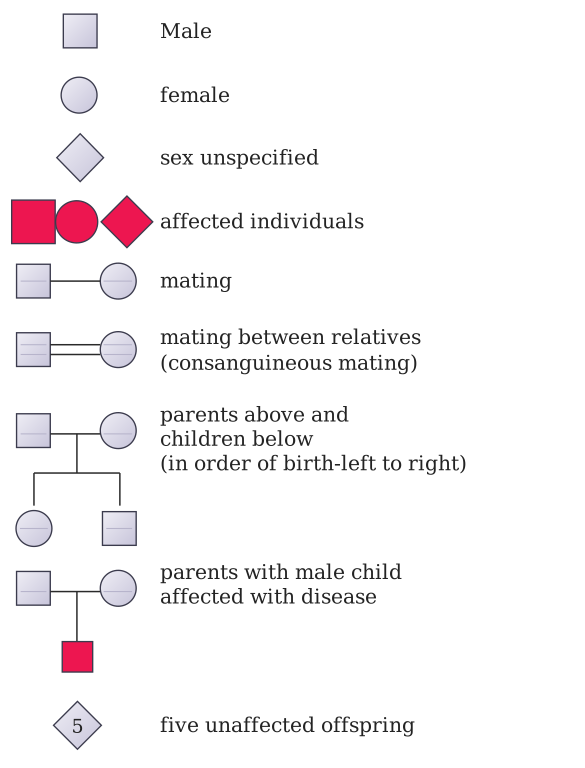
Drawn by us to help you understand the concept clearly, and verified to make sure it's accurate. For exams, practice from your textbook's own diagram.
The figure is a reference chart of the standard symbols used to draw a human pedigree. It does not show a specific family history or any disease; instead, it is a legend that defines the visual language of pedigree analysis.
The chart is arranged in a grid-like layout. Each row contains one symbol on the left and its meaning written in text on the right.
The first row shows a square, labelled "Male". The second row shows a circle, labelled "Female". The third row shows a diamond, labelled "Sex unspecified" — used when the sex of the individual in the pedigree is not known or not relevant.
The fourth row shows a shaded square, a shaded circle, and a shaded diamond together, labelled "Affected individuals" — a filled symbol (of any of the three shapes) marks an individual who expresses the trait or disorder being studied.
The fifth row shows a square and a circle joined by a single horizontal line, labelled "Mating" — this represents a couple. The sixth row shows the same square and circle joined instead by a double horizontal line, labelled "Mating between relatives (consanguineous mating)".
The seventh row shows a small family tree: a mating pair above, connected by a vertical line down to a horizontal sibship line, with two children hanging below it. This is labelled "Parents above and children below", with a note that children are arranged in order of birth, left to right.
The eighth row shows a similar mating pair above a single shaded (affected) square below, labelled "Parents with male child affected with disease". …