Economics · Ch 15 — Environment and Sustainable Development
Environment — Definition And Functions
Environment — Definition And Functions
The environment can be thought of as the entire planetary inheritance — the whole stock of resources handed down to us — together with everything that lives and does not live within it. It is made up of biotic elements (living things such as birds, animals, plants, forests and fisheries) and abiotic elements (non-living things such as air, water, land, rocks and sunlight). Studying the environment therefore means studying how these living and non-living parts constantly influence one another.
The four vital functions of the environment
- It supplies resources. These are of two kinds. Renewable resources can keep being used without running out, because they replenish themselves and stay continuously available — trees in a forest or fish in the ocean are examples. Non-renewable resources get used up as they are extracted and consumed; fossil fuels are the classic case.
- It absorbs and assimilates waste generated by human activity.
- It sustains life by supplying genetic material and biodiversity.
- It provides aesthetic services such as natural scenery.
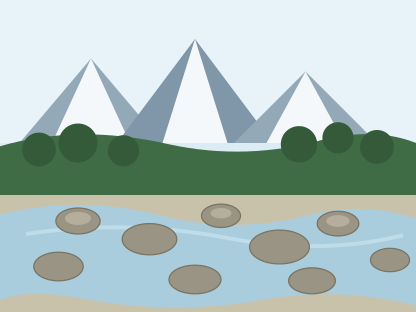
Drawn by us to help you understand the concept clearly, and verified to make sure it's accurate. For exams, practice from your textbook's own diagram.
Own-drawn recreation of NCERT Fig 7.1 (p.117) -- redrawn in our own style from the facts the real photograph shows (a small, rocky, snow-fed mountain stream against a sno …
Carrying capacity and the limits of these functions
The environment can go on performing all four functions indefinitely — as long as the demands placed on it stay within its carrying capacity. That means two things must hold together: resources should not be extracted faster than they can regenerate, and the waste dumped into nature should stay within its absorptive capacity, the environment's ability to soak up degradation. Once these limits are crossed, the environment can no longer sustain life properly, and the result is an environmental crisis — which is broadly the situation the world faces today.
Why the crisis has arrived
Two pressures are chiefly responsible. The rising population of developing countries, and the high consumption and production standards of the developed world, have together strained the environment's supply and waste-absorbing functions. Many resources have been driven towards exhaustion, and the volume of waste now exceeds what nature can absorb. As a consequence, past development has polluted and dried up rivers and aquifers, so that clean water — once free — has effectively become an economic good that has to be paid for.
Work These Out
- Why has water become an economic commodity? Discuss.
- Think about which common diseases and illnesses are typically caused by air pollution, water pollution and noise pollution -- for example, air pollution is linked to diseases such as asthma, and water pollution to diseases such as cholera. What other pollution-linked illnesses can you list under each of the three categories? Intensive extraction has depleted key renewable and non-renewable resources, forcing large spending on technology and research to find new ones. On top of this come the health costs of a degraded environment: with a large share of India's water polluted, respiratory and water-borne illnesses have risen, and so has health expenditure. Global problems such as global warming and ozone depletion add still further financial burdens on the government. In short, the opportunity costs of these negative environmental impacts are very high.
Global Warming
Global warming is the gradual rise in the average temperature of the earth's lower atmosphere, driven by the build-up of greenhouse gases since the Industrial Revolution. Much of the recent and projected warming is human-caused — the result of burning fossil fuels and clearing forests, which release carbon dioxide, methane and similar heat-trapping gases. Since around 1750, atmospheric carbon dioxide has risen by roughly 31 per cent and methane by about 149 per cent above pre-industrial levels; over the past century atmospheric temperature climbed by about 1.1°F (0.6°C) and sea level rose by several inches.
Contributing factors include the burning of coal and petroleum, deforestation, methane from animal waste, and expanded cattle production. Its longer-term consequences include melting polar ice and rising seas, coastal flooding, disruption of snow-fed drinking-water supplies, extinction of species, more frequent tropical storms and a greater spread of tropical diseases. A 1997 UN climate conference at Kyoto, Japan, produced an international agreement — requiring industrialised nations to cut greenhouse-gas emissions — to combat the problem.
Ozone Depletion
Ozone depletion is the thinning of the ozone in the stratosphere, caused by high levels of chlorine and bromine compounds there. These come from chlorofluorocarbons (CFCs), used as coolants in refrigerators and air-conditioners and as aerosol propellants, and from halons used in fire extinguishers.
As the ozone layer thins, more ultraviolet radiation reaches the earth's surface; this is linked to skin cancer in humans, reduces phytoplankton and harms other aquatic life, and can affect the growth of land plants. A reduction of roughly 5 per cent in the ozone layer was recorded between 1979 and 1990. Because the ozone layer normally blocks most harmful ultraviolet wavelengths, this decline caused worldwide alarm and led to the Montreal Protocol, which banned CFCs and other ozone-destroying chemicals such as carbon tetrachloride, methyl chloroform and halons.
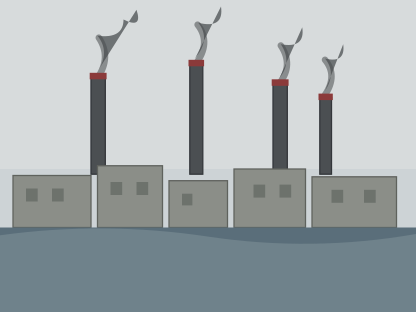
Drawn by us to help you understand the concept clearly, and verified to make sure it's accurate. For exams, practice from your textbook's own diagram.
Own-drawn recreation of NCERT Fig 7.2 ( …
Are environmental problems new? …