Biology · Ch 13 — Plant Growth and Development
Auxins
Auxins
Auxins (from the Greek word 'auxein', meaning 'to grow') were first isolated from human urine. The term auxin is applied to indole-3-acetic acid (IAA) and to other natural and synthetic compounds that have certain growth-regulating properties. Auxins are generally produced by the growing apices of the stems and roots, from where they migrate to the regions of their action.
- Auxins such as IAA and indole butyric acid (IBA) have been isolated from plants.
- NAA (naphthalene acetic acid) and 2,4-D (2,4-dichlorophenoxyacetic acid) are synthetic auxins.
- All these auxins have been used extensively in agricultural and horticultural practices.
Some important effects and uses of auxins are:
- They help to initiate rooting in stem cuttings, an application widely used in plant propagation.
- They promote flowering, for example in pineapples.
- They help to prevent fruit and leaf drop at early stages, but promote the abscission of older, mature leaves and fruits.
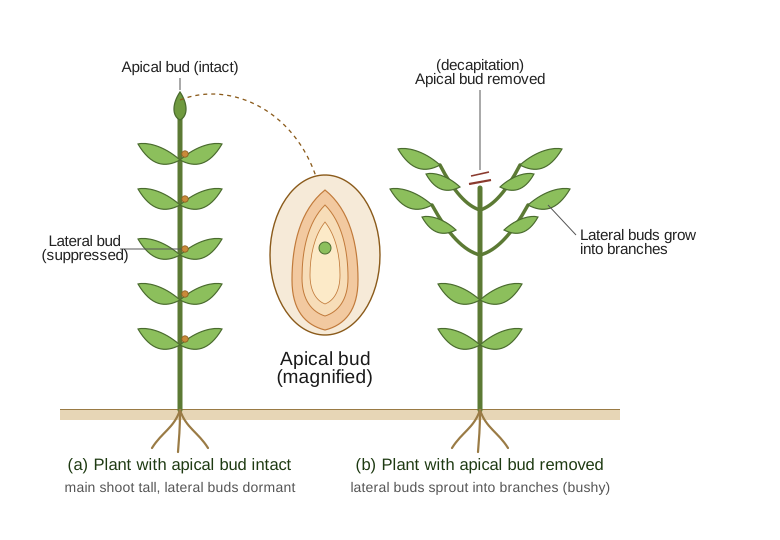
- In most higher plants the growing apical bud inhibits the growth of the lateral (axillary) buds — a phenomenon called apical dominance. Removal of the shoot tips (decapitation) usually results in the growth of the lateral buds; this is widely applied in tea plantations and hedge-making.
- Auxins induce parthenocarpy (the development of seedless fruit), for example in tomatoes. …
Drawn by us to help you understand the concept clearly, and verified to make sure it's accurate. For exams, practice from your textbook's own diagram.
This figure demonstrates apical dominance, the way in which a growing apical (terminal) bud suppresses the growth of the lateral (axillary) buds below it. In part (a), the plant has its apical bud intact: the main shoot grows tall while the lateral buds along the stem remain dormant and do not develop into branches. In part (b), the apical bud has been removed (decapitation): freed from the influence of the tip, the lateral buds now grow out into branches, making the plant bushier. The contrast between the two plants shows that the apical bud, through the auxin it produces, normally holds back the side buds. This principle is put to pr …