Chemistry · Ch 3 — Classification of Elements and Periodicity in Properties
(a) Atomic Radius
(a) Atomic Radius
(a) Atomic Radius
The Problem of Defining an Atom's Size
Measuring the size of an atom is not like measuring the radius of a ball. There are two fundamental difficulties. First, an atom is incredibly small — its radius is on the order of m (or 1.2 Å). Second, and more importantly, the electron cloud that surrounds the nucleus does not have a sharp, well-defined boundary. There is no "edge" to an atom. This means the size of an individual, isolated atom cannot be measured directly.
How We Estimate Atomic Size: Covalent and Metallic Radii
Since we cannot measure an isolated atom, we estimate its size by measuring the distance between two bonded atoms in a combined state. The approach depends on the type of element.
-
For non-metals: We use the covalent radius. This is defined as half the distance between the nuclei of two identical atoms joined by a single covalent bond. For example, in a chlorine molecule (), the distance between the two chlorine nuclei is 198 pm. Half of this distance, 99 pm, is taken as the atomic (covalent) radius of chlorine.
-
For metals: We use the metallic radius. This is defined as half the distance between the nuclei of two adjacent atoms in a metallic crystal. For example, in solid copper, the distance between two adjacent copper atoms is 256 pm. Therefore, the metallic radius of copper is 128 pm.
In this textbook, for simplicity, the term "atomic radius" is used to refer to either the covalent radius (for non-metals) or the metallic radius (for metals). These radii are determined experimentally using X-ray diffraction or other spectroscopic methods.
The Two Major Trends in Atomic Radius
The atomic radii of elements show two clear, opposite trends.
Trend 1: Atomic radius decreases across a period (from left to right).
Consider the second period elements: Li, Be, B, C, N, O, F. Their atomic radii (in pm) are:
| Atom | Li | Be | B | C | N | O | F |
|---|---|---|---|---|---|---|---|
| Atomic Radius (pm) | 152 | 111 | 88 | 77 | 74 | 66 | 64 |
The size decreases steadily from lithium to fluorine.
(a) Across the periods
| Atom (Period II) | Li | Be | B | C | N | O | F |
|---|---|---|---|---|---|---|---|
| Atomic radius | 152 | 111 | 88 | 77 | 74 | 66 | 64 |
| Atom (Period III) | Na | Mg | Al | Si | P | S | Cl |
Drawn by us to help you understand the concept clearly, and verified to make sure it's accurate. For exams, practice from your textbook's own diagram.
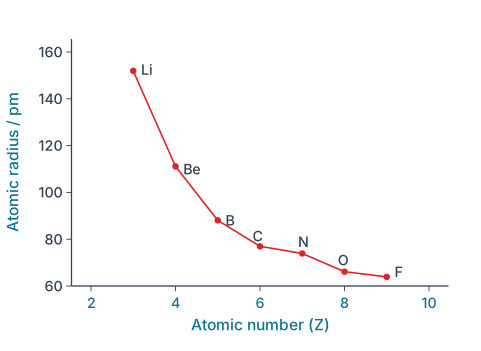
Fig. 3.4(a) plots atomic radius (in picometres) on the vertical axis (60 to 160 pm) against atomic number (2 to 10) for the second-period elements. A single falling curve runs through seven labelled points — Li (152 pm), Be (111), B (88), C (77), N (74), O (66) and F (64) — the values of Table 3.6(a).
Why the curve falls: across a period the added electrons enter the same valence shell while the nuclear charge grows one proton at a time; shielding by the unchanged inner core barely increases, so the effective nuclear charge (, with the shielding constant) rises steadily and pulls the valence shell inward. The steepest single drop is Li → Be (41 pm). …
Why? Across a period, the electrons being added are going into the same valence shell (the same principal quantum level, ). The nuclear charge (the number of protons) increases by one with each step. The inner core of electrons remains the same, so the shielding effect does not increase significantly. The result is that the effective nuclear charge — the net positive charge felt by the outermost electrons — increases. This stronger attraction pulls the valence electrons closer to the nucleus, making the atom smaller.
Trend 2: Atomic radius increases down a group (from top to bottom).
Consider Group 1 (alkali metals) and Group 17 (halogens):
| Group 1 Atom | Atomic Radius (pm) | Group 17 Atom | Atomic Radius (pm) |
|---|---|---|---|
| Li | 152 | F | 64 |
| Na | 186 | Cl | 99 |
| K | 231 | Br | 114 |
| Rb | 244 | I | 133 |
| Cs | 262 | At | 140 |
The size increases dramatically as you go down the group.
(b) Down a family
| Atom (Group 1) | Atomic Radius | Atom (Group 17) | Atomic Radius |
|---|---|---|---|
| Li | 152 | F | 64 |
| Na | 186 | Cl | 99 |
| K | 231 | Br | 114 |
Drawn by us to help you understand the concept clearly, and verified to make sure it's accurate. For exams, practice from your textbook's own diagram.
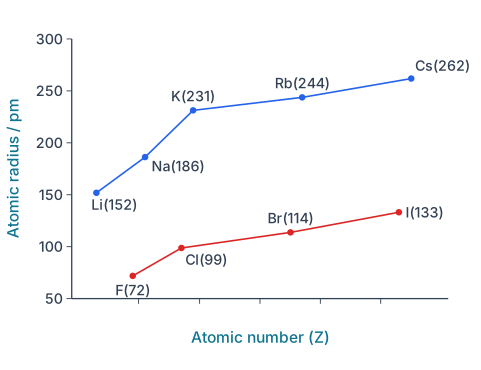
Fig. 3.4(b) shows two rising curves of atomic radius against atomic number, one for each family. The upper (alkali-metal) curve runs Li(152) → Na(186) → K(231) → Rb(244) → Cs(262); the lower (halogen) curve runs F(72) → Cl(99) → Br(114) → I(133) — values in parentheses exactly as the book's figure prints them. At every period the alkali metal is far larger than the halogen (Na 186 vs Cl 99).
Why both curves rise: each step down a group adds a whole new principal shell ( increases), and the added inner shells shield the valence electrons — atomic size grows despite the larger nuclear charge. Why the alkali curve sits above: within a period the alkali metal is the largest atom (lowest on its lone electron) and the halogen nearly the smallest. …
…