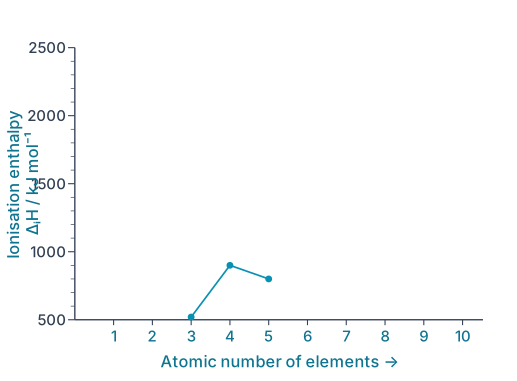
Q.Ionisation enthalpies of elements of second period are given below: Ionisation enthalpy/ k cal mol: 520, 899, 801, 1086, 1402, 1314, 1681, 2080. Match the correct enthalpy with the elements and complete the graph given in Fig. 3.1. Also write symbols of elements with their atomic number.
You're viewing a preview — the full solution, concept, methods & PYQ mapping are locked.
Start your 14-day free trial to unlock the full solution →Ionisation enthalpy increases across a period with predictable dips at boron (half-filled subshell starts) and oxygen (pairing begins in ). Matching gives: Li (3) = 520, Be (4) = 899, B (5) = 801, C (6) = 1086, N (7) = 1402, O (8) = 1314, F (9) = 1681, Ne (10) = 2080 kcal mol⁻¹.
The ionisation enthalpy measures how tightly an atom holds its outermost electron. Across a period, nuclear charge increases while shielding remains roughly constant, so the effective pull on the valence electrons grows stronger and ionisation enthalpy rises. But electronic configuration introduces two important exceptions: removing an electron becomes slightly easier when you break into a new subshell (boron) or when you relieve electron–electron repulsion in a paired orbital (oxygen).
Let me walk through the second period element by element, using electronic structure to predict where the trend breaks.
1. Lithium (Z = 3):
The single electron is far from the nucleus and poorly shielded by the two electrons. It comes off easily. Lithium must have the lowest ionisation enthalpy: 520 kcal mol⁻¹.
2. Beryllium (Z = 4):
The subshell is now full. Both electrons are closer to the nucleus than lithium's lone electron, and the increased nuclear charge () binds them more tightly. Ionisation enthalpy jumps. The next value up is 899 kcal mol⁻¹.
3. Boron (Z = 5):
Now we start filling the subshell. The orbital is slightly higher in energy and more diffuse than , so the single electron is easier to remove than a electron from beryllium, despite the higher nuclear charge. This is the first dip. Boron's ionisation enthalpy drops to 801 kcal mol⁻¹.
Students often expect a monotonic increase and miss the dip at boron. The key is recognising that electrons are less tightly bound than electrons in the same shell.
4. Carbon (Z = 6):
Two electrons, each in a separate orbital (Hund's rule). Nuclear charge has increased, and both electrons are unpaired, so repulsion is minimal. Ionisation enthalpy climbs again: 1086 kcal mol⁻¹.
5. Nitrogen (Z = 7):
The subshell is now half-filled, with one electron in each of the three orbitals. This is an exceptionally stable configuration (exchange energy is maximised). Removing an electron disrupts this symmetry, so nitrogen holds its electrons unusually tightly. Ionisation enthalpy jumps to 1402 kcal mol⁻¹.
6. Oxygen (Z = 8):
The fourth electron must pair up in one of the orbitals. Pairing introduces electron–electron repulsion in the same orbital, which slightly destabilises the configuration. Removing the paired electron actually relieves this repulsion, so ionisation enthalpy dips relative to nitrogen. This is the second dip: 1314 kcal mol⁻¹.
The oxygen dip is smaller than the boron dip because we're still within the same subshell — only pairing repulsion is at play, not a subshell jump.
7. Fluorine (Z = 9): …
Unlock everything free for 14 days
- Full step-by-step solutions
- Concept-first explanations
- Methods, shortcuts & mistakes
- PYQ mapping + timed mock tests
Full access for 14 days. No credit card required.