Chemistry · Ch 8 — Organic Chemistry – Some Basic Principles and Techniques
Halogens
Halogens
The estimation of halogens in an organic compound is carried out by the Carius method. This is a gravimetric method — you measure the mass of a solid product to work backwards to the percentage of the element in the original sample.
The principle is straightforward. A known mass of the organic compound is heated strongly with fuming nitric acid in the presence of silver nitrate. The nitric acid oxidises the carbon and hydrogen in the compound to carbon dioxide and water. The halogen, which was covalently bonded in the organic molecule, is converted into the free halide ion and immediately precipitated as the corresponding silver halide (AgX). The silver halide is insoluble in dilute nitric acid, so it can be filtered, washed, dried, and weighed.
The entire reaction is carried out in a thick-walled glass tube called a Carius tube, which is sealed and heated in a furnace. The tube is designed to withstand the high pressure generated inside.
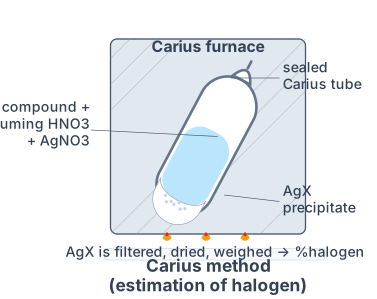
Drawn by us to help you understand the concept clearly, and verified to make sure it's accurate. For exams, practice from your textbook's own diagram.
The Carius method is a quantitative technique used to determine the percentage of halogen (chlorine, bromine, or iodine) in an organic compound. The figure in your textbook shows the essential setup: a thick-walled glass tube called a Carius tube, sealed at one end, containing the organic sample along with fuming nitric acid and a known excess of silver nitrate (). The tube is then sealed at the open end and placed inside a furnace, where it is heated to a high temperature.
The physical idea is simple but powerful. When the organic compound is heated strongly with fuming nitric acid, the carbon and hydrogen are oxidised to and , while any halogen present is converted into the corresponding halide ion (, , or ). The nitric acid also ensures that the halide ion remains in solution and does not get oxidised further. The silver nitrate already present in the tube then reacts with these halide ions to form a precipitate of silver halide (), which is insoluble in dilute nitric acid. After the tube is cooled and opened, the precipitate is filtered, washed, dried, and weighed.
The entire process is a gravimetric analysis — you are measuring the mass of a pure, known compound (the silver halide) to find out how much halogen was originally present in the sample.
A common mistake is to think the Carius tube is simply a test tube. It is a strong, sealed glass tube designed to withstand high pressure from the gases produced during heating. Never attempt this without proper equipment.
From the mass of the silver halide precipitate, you can calculate the mass of halogen in it using the atomic masses. The textbook gives the key formula for the percentage of halogen in the organic compound:
Let’s break down each symbol in this formula.
- Atomic mass of halogen: This is the atomic mass of the specific halogen you are estimating. For chlorine it is 35.5 u, for bromine 80 u, and for iodine 127 u.
- Molecular mass of AgX: This is the molecular mass of the silver halide formed. For silver chloride () it is u, for silver bromide () it is u, and for silver iodide () it is u.
- Mass of AgX precipitate: The actual mass of the dried silver halide you obtained from the experiment, measured in grams.
- Mass of organic compound taken: The mass of the original organic sample you weighed out at the start, also in grams.
The ratio is the fraction of the precipitate’s mass that is due to the halogen. Multiplying this by the mass of the precipitate gives the mass of halogen in the sample. Dividing by the original sample mass and multiplying by 100 gives the percentage. …
A common mistake is to think the silver halide is weighed directly from the reaction mixture. It must be washed free of excess silver nitrate and nitric acid, then dried to constant mass before weighing. Any contamination will give a falsely high mass of AgX and a wrong percentage of halogen.
The Calculation
Let the mass of the organic compound taken be grams.
Let the mass of the silver halide (AgX) formed be grams.
From the formula of the silver halide, one mole of AgX contains exactly one mole of the halogen X. Therefore, the mass of halogen present in grams of AgX is found by simple proportion:
The percentage of halogen in the original compound is then:
Substituting the expression for the mass of halogen:
Applying the Formula for Different Halogens
The atomic masses and the molecular masses of the corresponding silver halides are fixed values. For chlorine, bromine, and iodine, the relevant data are:
| Halogen (X) | Atomic mass of X (g mol) | Silver halide (AgX) | Molecular mass of AgX (g mol) |
|---|---|---|---|
| Chlorine (Cl) | 35.5 | AgCl | 143.5 |
| Bromine (Br) | 80 | AgBr | 188 |
| Iodine (I) | 127 | AgI | 235 |
For chlorine, the atomic mass is 35.5, not 35. The molecular mass of AgCl is 108 + 35.5 = 143.5. Using the wrong atomic mass for chlorine is a frequent error in numerical problems.
Worked Example
An organic compound containing chlorine gives 0.287 g of AgCl when 0.2 g of the compound is analysed by the Carius method. Calculate the percentage of chlorine in the compound.
Step 1: Identify the known values.
g
g
Atomic mass of Cl = 35.5 g mol
Molecular mass of AgCl = 143.5 g mol
Step 2: Apply the formula.
Step 3: Simplify. …