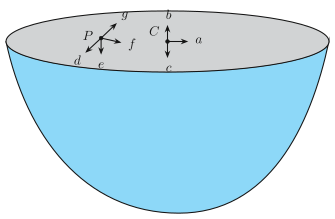
Q.A hemispherical shell of uniform mass density is oriented like a bowl, with its flat circular face horizontal and on top and its curved surface bulging downward. Let be an arbitrary point lying in the plane of the flat circular face (off the central axis). Choose the correct alternative for the direction of the gravitational intensity (gravitational field) at the point .
You're viewing a preview — the full solution, concept, methods & PYQ mapping are locked.
Start your 14-day free trial to unlock the full solution →Completing the bowl into a full spherical shell (by adding the mirror-image upper hemisphere) shows the field inside a complete uniform shell is zero, and mirror symmetry across the flat face forces the horizontal component of the bowl's own field at to vanish — leaving a field that is purely vertical, pointing downward into the bowl, perpendicular to the flat face.
The figure shows a hemispherical shell of uniform mass density, drawn in cross-section as a bowl shape. Its centre (the centre of the full sphere the hemisphere is half of) is marked C, sitting on the flat rim of the bowl. Three arrows radiate from C in different directions, labelled a (pointing right), b (pointing up), and c (pointing down) -- these are the candidate directions for the gravitational intensity a test mass would feel if placed exactly at C.
A second point, P, is marked at an arbitrary location inside the shell (not at the centre). Four more arrows radiate from P, labelled d, e, f, g, in different directions -- these are the candidate directions for the gravitational intensity at this off-centre point.
This figure grounds Exercises 7.10 and 7.11, which ask the student to reason out, from the shell's symmetry, which single labelled arrow correctly represents the true direction of the gravitational field at C and at P respectively.
Setting up
Complete the hemispherical bowl into a full spherical shell of the same radius and surface density by adding a mirror-image upper hemisphere (the same shape, reflected across the flat face). The point lies in the plane of the flat face, i.e. on the equatorial plane of this completed sphere — which is inside the completed shell.
Applying the shell theorem
For a complete uniform spherical shell, the gravitational field at every interior point is exactly zero (Newton's shell theorem). Writing and for the fields at due to the lower hemisphere (the actual bowl) and the (imagined) upper hemisphere:
Using mirror symmetry to pin the direction
Reflecting across the flat (equatorial) plane maps the upper hemisphere onto the lower one, and maps the point (which lies exactly in that plane) onto itself. Under this reflection, the horizontal (in-plane) component of a vector stays the same, while the vertical component reverses sign. Applying this to the two hemispheres' fields at : …
Unlock everything free for 14 days
- Full step-by-step solutions
- Concept-first explanations
- Methods, shortcuts & mistakes
- PYQ mapping + timed mock tests
Full access for 14 days. No credit card required.