Physics · Ch 3 — Motion in a Plane
Position and Displacement Vectors
Position and Displacement Vectors
Position and Displacement Vectors
In the study of motion in a plane, we need a way to describe where an object is and how its location changes. Two vectors serve this purpose: the position vector and the displacement vector.
The Position Vector
Consider a point in the - plane. To specify its location, we draw a vector from the origin of a chosen coordinate system to the point . This vector is called the position vector of , and is denoted by .
If the coordinates of are , then the position vector is written in component form as:
where and are unit vectors along the - and -axes, respectively.
The magnitude of the position vector is the distance of from the origin:
The direction of is given by the angle it makes with the positive -axis, measured anticlockwise:
The position vector depends on the choice of origin. If you shift the origin, the coordinates change, and so does . This is why position is always relative.
The Displacement Vector
Now suppose the object moves from an initial point to a final point . The displacement vector is defined as the vector that points from the initial position to the final position. It tells us how far and in what direction the object has moved, regardless of the path taken.
Let the position vectors of and be:
Then the displacement vector is:
In component form:
The magnitude of the displacement is the straight-line distance between and :
Displacement is not the same as distance travelled. Distance is the total length of the actual path; displacement is the straight-line separation between start and end points. For a curved path, distance is always greater than or equal to the magnitude of displacement.
Properties of Position and Displacement Vectors
The textbook lists three important properties that follow directly from the definitions.
›Proof
Property (I): The displacement vector is the difference of the final and initial position vectors.
This is the definition itself. If an object moves from to , the change in its position is . This vector is independent of the path taken — it depends only on the endpoints.
Property (II): The displacement vector is the same for all observers, provided they use the same origin.
…
Drawn by us to help you understand the concept clearly, and verified to make sure it's accurate. For exams, practice from your textbook's own diagram.
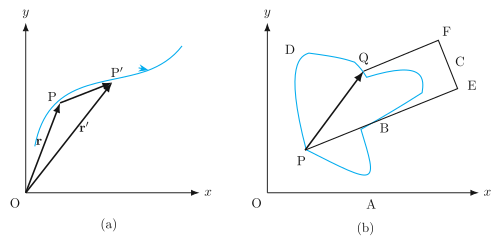
The figure is a two-panel diagram drawn on standard – axes. In panel (a), a curved path runs from a point near the origin out into the plane. Two points on that path are labelled and . From the origin , two arrows are drawn: one to (labelled ) and one to (labelled ). A third arrow connects directly to — this is the displacement vector . The curved path between and is the actual trajectory; the straight arrow is the displacement, which depends only on the start and end points, not on the path taken.
Panel (b) makes this path-independence explicit. Two fixed points are shown: near the bottom and near the top. A straight arrow runs from to — that is the displacement vector . Around it, three different curved routes are drawn, passing through intermediate points labelled . Each route is a different physical path from to , but the displacement arrow is the same for all of them.
The central idea is that displacement is a vector — it has both magnitude and direction, and it depends only on the initial and final positions, not on the actual path taken. This is what distinguishes displacement from distance (a scalar).
The textbook uses this figure to introduce the vector nature of displacement and to set up the definition of the displacement vector. If a particle moves from position to position , the displacement vector is
where and are the position vectors of the particle at the two instants. Each position vector is drawn from the origin to the particle's location. The subtraction is vector subtraction: is the vector that, when added to , gives .
…