Q.Explain, with the help of a diagram, the aggregate demand and aggregate supply method of determining the equilibrium level of national income.
🔒You're viewing a preview — the full solution, concept, methods & PYQ mapping are locked.
🔒 Start your 14-day free trial to unlock the full solution →Concept understanding — Aggregate Demand Equilibrium
Aggregate Demand Equilibrium: The Economy's Balancing Act
Think of a seesaw. On one side sits everything people, firms, and the government want to buy. On the other side sits everything firms produce. When the seesaw is perfectly level — when total spending exactly matches total output — the economy is in equilibrium. That's the core idea.
But why should you care? Because when the seesaw tilts, real things happen. If spending exceeds output, prices rise (inflation). If output exceeds spending, factories shut down and people lose jobs. Equilibrium is the sweet spot where neither happens.
The Precise Meaning
In macroeconomics, Aggregate Demand (AD) is the total planned spending on final goods and services in an economy during a given period. Aggregate Supply (AS) is the total output firms plan to produce.
Equilibrium occurs where:
AD=AS
At this point, what buyers intend to spend exactly equals what sellers intend to produce. No unwanted inventories pile up, and no shortages force prices up. The economy is "at rest."
Y=C+I+G+(X−M)
Where:
- Y = National Income (also equals Aggregate Supply)
- C = Household consumption expenditure
- I = Investment expenditure by firms
- G = Government spending on goods and services
- X = Exports
- M = Imports
- (X−M) = Net exports
This is the AD identity from your NCERT textbook. It tells you that total spending in the economy comes from four sources: households, firms, government, and foreigners (net of what we buy from them).
How Equilibrium Actually Works
Imagine a simple economy with only households and firms. Households earn income Y from firms. They spend part of it on consumption C and save the rest S. Firms produce output and also invest I (buying machines, building factories).
Equilibrium condition becomes:
Y=C+I
But households don't spend all their income. They save. So C=Y−S. Substituting:
Y=(Y−S)+I
Which simplifies to:
S=I
In equilibrium, planned savings must equal planned investment. This is the Keynesian cross condition. If people save more than firms invest, total spending falls short of output — inventories pile up, firms cut production, and income falls until savings and investment match again.
The 45° Line Diagram (Describe It)
Draw a graph with Aggregate Demand (AD) on the vertical axis and National Income (Y) on the horizontal axis.
- Draw a 45° line from the origin. Every point on this line represents AD=Y — the equilibrium condition.
- Draw the AD curve (which is C+I+G+(X−M)). It slopes upward because as income rises, consumption rises.
- Where the AD curve crosses the 45° line — that's the equilibrium point. …
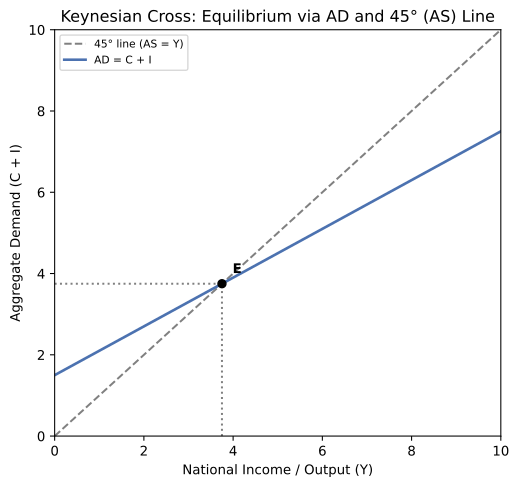
Equilibrium income is determined where Aggregate Demand equals Aggregate Supply (AD = AS); the AD curve crossing the 45° line gives this point on a diagram.
Aggregate Demand (AD) is the total planned expenditure in the economy on final goods and services; in a simple two-sector model, AD = C + I, where C is planned consumption expenditure (which rises with income, via the consumption function C = C̄ + cY) and I is planned (autonomous) investment expenditure.
Aggregate Supply (AS) in the Keynesian framework is simply the total output/income produced in the economy, Y — since whatever is produced must generate an equal amount of income, AS is drawn as a 45° line from the origin where every point represents AS = Y.
The diagram below shows this: the 45° line from the origin plots AS = Y (every point on it has aggregate supply equal to income); the AD line (= C + I) starts above the origin and rises with a flatter-than-45° slope (slope = MPC); point E, where the AD line cuts the 45° line, marks the equilibrium income Y*, read directly below E on the X-axis.
…
Showing the 12 most recent of 54 on this concept.
- CBSE 2026Set 58/1/11 markMCQQ.In an economy, when __________ is insufficient to achieve the level of output corresponding to the full employment, the difference is termed a deflationary gap. (Choose the correct option to fill in the blank) Options : (A) ex-ante Aggregate Demand (B) ex-post Aggregate Demand (C) ex-ante Aggregate Supply (D) ex-post Aggregate Supply
›Reveal solutionSolution
A deflationary gap occurs when planned (ex-ante) aggregate demand falls short of the level needed for full-employment output. The correct answer is (A) ex-ante Aggregate Demand.
Let’s first get the concept clear. In macroeconomics, the term “gap” refers to the difference between what the economy is actually producing and what it could produce if all resources (labour, capital) were fully employed. That full-employment level of output is also called potential output.
Now, what determines actual output in the short run? According to the Keynesian framework, it is aggregate demand that drives production. Firms produce only as much as they expect to sell. So if total planned spending in the economy — what buyers intend to buy — is less than the value of full-employment output, firms will not produce that full-employment output. They will produce less, leading to unemployment and idle capacity.
That shortfall in planned spending is the deflationary gap. The word “deflationary” signals that the pressure on prices is downward — because demand is too weak to absorb all that could be produced.
Now, why must it be ex-ante (planned) and not ex-post (actual)? Ex-post aggregate demand is always equal to actual output by definition (because what is produced is what is sold, once you account for inventory changes). So ex-post demand can never be “insufficient” — it always matches whatever output happens to be. The gap is about intentions not matching the full-employment target. That is why we use ex-ante concepts.
Deflationary gap = Full-employment output − Actual output
(where actual output is determined by ex-ante aggregate demand) …
- CBSE 2026Set 58/3/11 markMCQQ.Suppose in a hypothetical economy, Y = 50 + 0·8Y + 100, where Y = National Income. The value of Investment Multiplier (K) would be __________. (Choose the correct option to fill in the blank) Options : (A) 5 (B) 0·2 (C) 50 (D) 0·8
›Reveal solutionSolution
The given equation represents the equilibrium condition for national income. By identifying the Marginal Propensity to Consume (MPC) from this equation, we can calculate the Investment Multiplier using its standard formula. The value of the Investment Multiplier is 5.
In macroeconomics, the equilibrium level of national income (Y) is achieved when the aggregate demand (AD) in the economy equals the aggregate supply (AS), which is equivalent to the total output or national income. In a simple two-sector economy (households and firms), aggregate demand consists of consumption (C) and investment (I). Thus, the equilibrium condition is Y=C+I.
The given equation, Y=50+0.8Y+100, directly represents this equilibrium. Here, the term 50+0.8Y corresponds to the consumption function (C), and 100 represents autonomous investment (I).
The consumption function, C=a+bY, shows how consumption expenditure relates to national income. In this function:
- a is autonomous consumption (consumption that occurs even at zero income). Here, a=50.
- b is the Marginal Propensity to Consume (MPC), which indicates the proportion of an additional unit of income that is spent on consumption. Here, b=0.8.
The Investment Multiplier (K) is a crucial concept that explains how an initial change in autonomous investment leads to a much larger change in the equilibrium level of national income. It arises because an initial investment creates income, which is then partly consumed, leading to further income generation, and so on, in a continuous cycle. The size of this multiplier effect depends directly on the Marginal Propensity to Consume (MPC). A higher MPC means a larger portion of additional income is consumed, leading to a stronger multiplier effect. …
- CBSE 2026Set ANNUAL1 markQ.Fill in the blank: In two sector model, there are two sources of demand, the first is consumption and the second is ________.
›Reveal solutionSolution
The blank is filled by 'investment'.
The two-sector model includes only households and firms (no government or foreign sector). Here aggregate demand (AD) for goods and services comes from two sources: consumption expenditure (C) by households and investment expenditure (I) by firms, so AD = C + I. Since the first source given is consumpti …
- CBSE 2026Set ANNUAL1 markQ.Fill in the blank: The situation of excess demand leads to ________ in prices in the long run.
›Reveal solutionSolution
Excess demand leads to a rise in prices (inflation).
Excess demand is a situation where aggregate demand exceeds aggregate supply at the full-employment level. Since output cannot rise further (resources are already fully employed), the extra demand pulls the general price level up — causing demand-pull inflation. H …
- CBSE 2026Set ANNUAL1 markMCQQ.Write True or False: Higher interest rates inspires firms to higher investments.(a) True(b) False
›Reveal solutionSolution
False — higher interest rates reduce investment.
Investment depends inversely on the rate of interest, which is the cost of borrowing funds. A higher interest rate makes borrowing costlier and reduces the number of investment projects that are profitable, so firms invest less. Hence higher interest rates discourage (not inspire) investment, …
- CBSE 2025Set 58/4/11 markMCQQ.Read the following statements carefully : Statement 1 : The government may reduce the repo rate, to control deflationary gap prevailing in the economy. Statement 2 : The government may reduce the deflationary gap, by selling off government securities (G-Sec) in the open market. In the light of the given statements, choose the correct option from the following : (A) Statement 1 is true and Statement 2 is false. (B) Statement 1 is false and Statement 2 is true. (C) Both Statements 1 and 2 are true. (D) Both Statements 1 and 2 are false.
›Reveal solutionSolution
Statement 1 is true (lowering repo rate fights deflation by boosting credit and demand); Statement 2 is false (selling G-Sec drains liquidity and worsens deflation). The answer is (A).
A deflationary gap arises when aggregate demand falls short of aggregate supply at full employment—output capacity exists, but people and firms aren't spending enough to buy it all. Prices begin to fall, production contracts, and unemployment creeps up. The government's job, through monetary and fiscal policy, is to pump demand back into the economy. The two statements propose different tools; we need to judge whether each tool actually closes or widens the gap.
Statement 1 says the government may reduce the repo rate to control a deflationary gap. The repo rate is the rate at which the central bank (Reserve Bank of India) lends short-term funds to commercial banks. When the RBI cuts the repo rate, borrowing becomes cheaper for banks, and they in turn lower lending rates for businesses and households. Cheaper credit encourages investment and consumption—firms expand, consumers buy homes and durables, and aggregate demand rises. This is classic expansionary monetary policy, exactly the medicine needed when demand is deficient. Statement 1 is true.
Statement 2 claims the government may reduce the deflationary gap by selling government securities in the open market. Open Market Operations (OMO) are a central bank tool: selling G-Sec means the RBI offers bonds to banks and the public, who pay for them with cash. That cash moves from the economy into the RBI's vaults, shrinking the money supply and liquidity in the banking system. Banks have less to lend, credit becomes tighter, and spending falls—aggregate demand contracts further. This is contractionary monetary policy, used to fight inflation, not deflation. Selling securities would deepen the deflationary gap, not close it. To fight deflation, the RBI would buy G-Sec (injecting liquidity). Statement 2 is false. …
- CBSE 2025Set 58/4/11 markMCQQ.Under the Keynesian theory, ‘Reference Line’ is a straight line passing through the origin drawn at an angle of __________. (Choose the correct option to fill in the blank) (A) 25° (B) 40° (C) 45° (D) 70°
›Reveal solutionSolution
The 'Reference Line' in the simple Keynesian model represents all points where aggregate expenditure equals national income, forming a straight line through the origin at a 45-degree angle.
In the simple Keynesian model of income determination, we often use a diagram where national income (or output, Y) is plotted on the horizontal axis and aggregate expenditure (AE) is plotted on the vertical axis. The 'Reference Line', also known as the 'Aggregate Supply Curve' in this context, or the 'Income-Expenditure Equilibrium Line', is a crucial component of this diagram.
This line represents all possible points where the total output produced in the economy (national income, Y) is exactly equal to the total planned spending (aggregate expenditure, AE). In other words, it is the locus of points where Y=AE. This condition is fundamental for equilibrium in the Keynesian model, as it signifies that whatever is produced is exactly what is demanded, leaving no unplanned inventory changes.
The equilibrium condition in the simple Keynesian model is Y=AE. …
- CBSE 2025Set 58/4/11 markMCQQ.In a two-sector economy, the Aggregate Demand can be determined by adding __________ and __________. (Choose the correct option to fill in the blanks) (A) consumption, investments (B) investments, savings (C) consumption, savings (D) savings, exports
›Reveal solutionSolution
In a two-sector economy (households and firms only), Aggregate Demand equals consumption expenditure plus investment expenditure — the total spending on final goods and services.
The structure of a two-sector economy
A two-sector economy is the simplest macroeconomic model: it contains only households and firms, with no government and no foreign trade. Households supply factors of production (labor, capital, land) to firms and receive income in return. They then decide how to allocate that income between consumption and saving. Firms produce goods and services, paying out income to households and undertaking investment in capital goods.
The circular flow in this model has two key spending streams. Households spend on consumption goods — food, clothing, services, durables — which constitutes consumption expenditure (C). Firms spend on capital goods — machinery, buildings, inventories — which constitutes investment expenditure (I). These are the only two categories of final expenditure in a two-sector world.
What Aggregate Demand means
Aggregate Demand is the total planned expenditure on domestically produced final goods and services at a given income level. It answers the question: how much do all agents in the economy want to buy at current prices and income?
In the two-sector model, only households and firms are doing the buying. Households buy consumption goods, firms buy investment goods. There is no government purchasing goods and services (no G), and no foreign buyers purchasing exports (no X). So the components of Aggregate Demand collapse to just two:
AD=C+I
This is the fundamental identity for Aggregate Demand in a two-sector economy.
Why not savings?
A common confusion: since households split their income between consumption and saving (Y=C+S), why isn't saving a component of Aggregate Demand? …
- CBSE 2025Set 58/5/11 markMCQQ.Read the following statements carefully : Statement 1 : During deflationary gap, the Central Bank of a country may increase the repo rate. Statement 2 : The government can reduce the deflationary gap by purchasing Government Securities (G-Sec) in the open market. In the light of the given statements, choose the correct option from the following : (A) Statement 1 is true and Statement 2 is false. (B) Statement 1 is false and Statement 2 is true. (C) Both Statements 1 and 2 are true. (D) Both Statements 1 and 2 are false.
›Reveal solutionSolution
Both statements are false. During a deflationary gap the central bank should lower (not raise) the repo rate, and buying government securities in the open market is an Open Market Operation carried out by the central bank — not by the government. The correct option is (D).
Let's first get the economic context clear. A deflationary gap — also called a recessionary gap — occurs when the economy's actual output is below its potential output, meaning aggregate demand is too low. Unemployment rises, prices may fall or grow very slowly, and the economy is stuck in a low-activity rut. The textbook remedy is to expand aggregate demand, not contract it.
Now examine Statement 1: "During deflationary gap, the Central Bank of a country may increase the repo rate." The repo rate is the rate at which the central bank lends short-term funds to commercial banks. Raising it makes borrowing costlier for banks, who pass on higher interest rates to businesses and households — discouraging borrowing and spending. That is a contractionary monetary policy move, the opposite of what a deflationary gap requires. During a deflationary gap the central bank would reduce the repo rate to make credit cheaper and stimulate spending. So Statement 1 is false. …
- CBSE 2025Set 58/5/11 markMCQQ.Under the Keynesian theory, 'Reference Line' is a straight line passing through the origin drawn at an angle of ________. (Choose the correct option to fill in the blank) (A) 25° (B) 45° (C) 55° (D) 75°
›Reveal solutionSolution
In Keynesian theory, the 'Reference Line' (or 45-degree line) graphically represents all points where aggregate expenditure equals national income, which is the equilibrium condition. This line is drawn at an angle of 45°.
In Keynesian economics, particularly within the income-expenditure model (often called the Keynesian Cross model), the 'Reference Line' plays a crucial role in determining the equilibrium level of national income. This line is a graphical representation of the condition where aggregate expenditure (AE) is equal to national income (Y).
The model typically plots aggregate expenditure on the vertical axis and national income (or output) on the horizontal axis. For the economy to be in equilibrium, the total amount of goods and services produced (national income, Y) must be equal to the total amount of goods and services that people plan to spend (aggregate expenditure, AE). This fundamental equilibrium condition is Y=AE.
To visually represent this identity on a graph where both axes have the same scale, a straight line is drawn from the origin at an angle of 45 degrees. Every point on this 45-degree line indicates that the value on the horizontal axis (national income) is exactly equal to the value on the vertical axis (aggregate expenditure). For instance, if national income is 100,thenaggregateexpenditureisalso100 at that point on the 45-degree line. …
- CBSE 2025Set 58/5/11 markMCQQ.In a two-sector economy, Aggregate Supply can be determined by adding ________ and ________. (Choose the correct option to fill in the blanks) (A) consumption, investments (B) investments, savings (C) consumption, savings (D) savings, exports
›Reveal solutionSolution
In a two-sector economy, Aggregate Supply represents the total income generated, which households either consume or save. Therefore, Aggregate Supply is the sum of consumption and savings.
In economics, a two-sector economy is the simplest model, comprising only two economic agents: households and firms. Households provide factors of production (like labor and capital) to firms and, in return, receive income. Firms use these factors to produce goods and services, which they sell to households. There is no government sector (meaning no taxes or government spending) and no foreign sector (meaning no exports or imports).
Aggregate Supply (AS) refers to the total value of goods and services produced in an economy during a given period. From the perspective of income, Aggregate Supply is equivalent to the total national income (Y) generated in the economy. This income is then distributed to households.
In a two-sector economy, households have only two ways to use their income: they can either spend it on consumption (C) of goods and services produced by firms, or they can save (S) a portion of it. There are no taxes to pay, and no foreign goods to buy, so all income must either be consumed or saved.
This fundamental relationship can be expressed as:
Y=C+S
Since Aggregate Supply (AS) is equal to the total national income (Y), we can substitute Y with AS:
AS=C+S
This equation shows that the total output or income generated in the economy (Aggregate Supply) is composed of the total consumption expenditure by households and the total savings by households. …
- CBSE 2025Set ANNUAL1 markMCQQ.In Keynesian viewpoint the equilibrium level of income and employment in the economy will be established where (A) AD > AS (B) AS > AD (C) AD = AS (D) None of these
›Reveal solutionSolution
Keynesian equilibrium occurs where AD = AS, so the answer is (C).
In Keynes's theory the level of income and employment is determined by effective demand. Equilibrium is the output level at which aggregate demand (planned spending) exactly equals aggregate supply (planned output), i.e. AD = AS. If AD > AS (A) firms find stocks falling and expand output; if AS > AD (B) stocks pile up and firms cut output — so these are disequilibrium …
🎓Unlock everything free for 14 days
- ✓Full step-by-step solutions
- ✓Concept-first explanations
- ✓Methods, shortcuts & mistakes
- ✓PYQ mapping + timed mock tests
Full access for 14 days. No credit card required.