Economics · Ch 1 — Introduction to Macroeconomics
Emergence of Macroeconomics
Emergence of Macroeconomics
The story of macroeconomics begins with a crisis. Before the 1930s, the dominant school of thought — now called the classical tradition — held a simple and optimistic view: any labourer willing to work would find a job, and factories would always run at full capacity. The economy, it was believed, was self-correcting. If there was ever a temporary slump, market forces would quickly restore full employment.
Then came the Great Depression of 1929. For several years after, output and employment in Europe and North America collapsed by staggering amounts. The crisis spread to other countries as well. Demand for goods dried up, factories stood idle, and millions of workers were thrown out of jobs.
The numbers from the United States tell the story starkly. Between 1929 and 1933, the unemployment rate — defined as the number of people not working but looking for jobs, divided by the total number of people who are either working or looking for jobs — shot up from 3 per cent to 25 per cent. Over the same period, the country's aggregate output fell by about 33 per cent.
Drawn by us to help you understand the concept clearly, and verified to make sure it's accurate. For exams, practice from your textbook's own diagram.
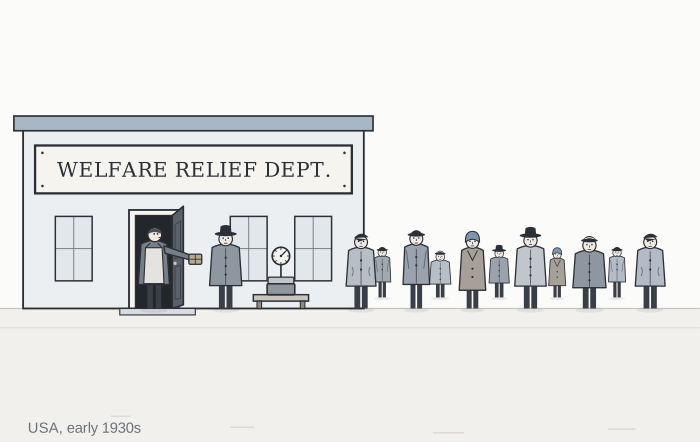
During the Great Depression, mass unemployment forced huge numbers of people to line up for government relief. Scenes like this — long queues outside a Welfare Relief Department — captured how the classical belief in a self-correcting, full-employment economy had broken down, and set the s …
These events shattered the classical assumption that prolonged, large-scale unemployment was impossible. Economists were forced to think about how the economy actually works in a new way. The fact that an economy could suffer long-lasting unemployment needed to be theorised and explained.
The breakthrough came in 1936, when the British economist John Maynard Keynes published his landmark book, The General Theory of Employment, Interest and Money. Keynes did not try to patch up the old classical framework. Instead, he took a fundamentally different approach: he examined the working of the economy in its entirety, looking at how different sectors — households, firms, the government — are interdependent. This holistic, economy-wide perspective is the essence of macroeconomics. With Keynes's book, macroeconomics was born as a separate branch of economics.
John Maynard Keynes
…