Economics · Ch 6 — Open Economy Macroeconomics
Current Account
Current Account
6.1.1 Current Account
The current account is one of the two main components of the balance of payments (the other being the capital account and financial account, under the new IMF classification). It records all transactions involving goods, services, and transfer payments between residents of a country and the rest of the world during a given period.
Components of the Current Account
The current account has three broad categories:
1. Trade in Goods (Visible Trade) — This includes exports and imports of physical goods. When a country sells goods abroad (exports), it earns foreign exchange — these are recorded as credit items. When it buys goods from abroad (imports), foreign exchange leaves the country — these are debit items.
2. Trade in Services (Invisible Trade) — Services trade is divided into two types:
- Factor income: Earnings from factors of production — labour (wages earned by residents working abroad), land (rent), and capital (interest, dividends, profits) — that flow across borders.
- Non-factor income: Earnings from the sale of service products such as shipping, banking, tourism, insurance, and software services.
3. Transfer Payments — These are receipts or payments that a country receives or gives "for free" — no goods or services are provided in return. They include:
- Gifts
- Remittances (money sent home by workers abroad)
- Grants (foreign aid)
Transfer payments can be made by governments (official grants) or by private citizens living abroad.
The textbook uses the term "invisibles" to collectively refer to services and transfer payments. In the balance of payments, invisibles are everything that is not a physical good.
The Logic of Exports and Imports
When a country buys foreign goods (imports), it is expenditure flowing out of the domestic economy — that spending becomes income for the foreign country. Imports therefore decrease the domestic demand for goods and services.
When a country sells goods abroad (exports), income flows into the domestic economy. Exports therefore add to the aggregate domestic demand for goods and services.
This is why exports are considered an injection into the circular flow of income, and imports are a leakage.
Balance on Current Account
The current account is said to be in balance when total receipts on current account equal total payments on current account.
- Current Account Surplus: Receipts > Payments. The nation is a net lender to the rest of the world — it is saving more than it invests domestically, and the excess flows abroad.
- Current Account Deficit: Receipts < Payments. The nation is a net borrower from the rest of the world — it invests more than it saves, and the shortfall is financed by foreign capital.
A current account deficit is not automatically "bad" nor a surplus automatically "good." A deficit may reflect strong domestic investment (borrowing for growth), while a surplus may reflect weak domestic demand. The context matters.
Two Components of the Current Account Balance
The balance on current account is the sum of two sub-balances:
1. Balance of Trade (BOT) — also called Trade Balance
This is the difference between the value of exports of goods and the value of imports of goods in a given period.
- Exports of goods are entered as credit items.
- Imports of goods are entered as debit items.
- Trade Surplus: Exports > Imports (positive BOT)
- Trade Deficit: Imports > Exports (negative BOT)
- Balanced Trade: Exports = Imports (BOT = 0)
2. Balance on Invisibles (Net Invisibles)
This is the difference between the value of exports of invisibles and the value of imports of invisibles in a given period. Invisibles include:
- Services (both factor and non-factor income)
- Transfers (gifts, remittances, grants)
- Flows of income (investment earnings)
Putting It Together
The overall current account balance is:
| Condition | Current Account Status |
|---|---|
| Receipts = Payments | Balanced |
| Receipts > Payments | Surplus (net lender) |
| Receipts < Payments | Deficit (net borrower) |
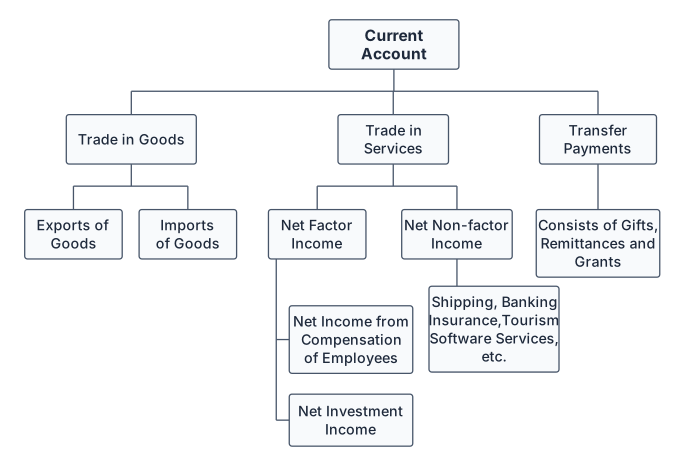
Drawn by us to help you understand the concept clearly, and verified to make sure it's accurate. For exams, practice from your textbook's own diagram.
The current account is built from three streams: trade in goods (exports and imports of goods), trade in services, and transfer payments (gifts, remittances and grants). Trade in services further separates net factor income — compensation of employees and investment income — from net non-factor income such as ship …
…