Computer Science · Ch 3 — Stack
Stack
Stack
A stack is a linear arrangement of elements where all additions and removals happen from the same end — the top. Think of a pile of plates in a kitchen or a stack of books on a table (Figure 3.1). To put another book or plate on such a pile, we always place (add to the pile) the object at the top only. Likewise, to remove a book or a plate from such a pile, we always remove (delete from the pile) the object from the top only. This is because in a large pile, it is inconvenient — and often impossible — to add or remove an object from in between or from the bottom.
Such an arrangement of elements in a linear order is called a stack. We add new elements or remove existing elements from the same end, commonly referred to as the top of the stack. It thus follows the Last-In-First-Out (LIFO) principle: the element which was inserted last (the most recent element) will be the first one to be taken out from the stack. …
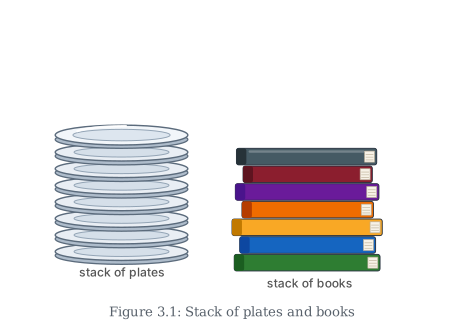
Drawn by us to help you understand the concept clearly, and verified to make sure it's accurate. For exams, practice from your textbook's own diagram.
These two real-life examples give you the intuition behind a stack before we look at any code. A pile of plates on a shelf and a pile of books on a table both work the same way: you can only add a new plate or book on TOP of the pile, and you can only ever remove the one that's currently on top. You cannot pull a plate out from the middle of the stack without first removing everything above it. …