Physical Education · Ch 6 — Test and Measurement in Sports
Back Stretch
Back Stretch
Back Stretch
- Purpose: to determine upper body flexibility.
- Objective: to touch or overlap the fingers of both hands behind the back.
- Equipment: an 18-inch ruler.
Procedure
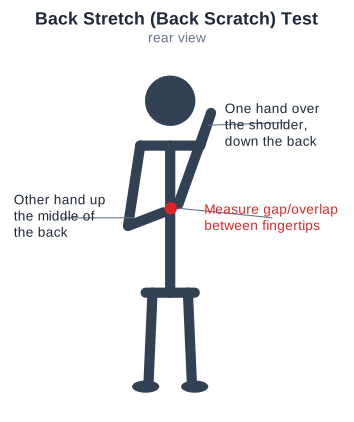
Standing, the participant places one hand over the shoulder and reaches down the back, while the other hand reaches up the middle of the back, trying to touch or overlap the two sets of fingers behind the back.
Drawn by us to help you understand the concept clearly, and verified to make sure it's accurate. For exams, practice from your textbook's own diagram.
A rear-view line drawing of a standing person performing the back stretch (back scratch) test. One hand reaches over the same-side shoulder and down the back, while the other hand reaches up the middle of the back from below, the two sets of fingers meeting behind the back. The gap or overla …
Scoring
The distance between the tips of the two middle fingers is measured. If the fingertips just touch, the score is zero. If they do not touch, the gap between them is measured as a negative score. If they overlap, the amount of overlap is measured as a positive score.
The heading in the textbook reads "Back Stretch", but the unit overview and the norms table call this the Back Scratch Test - both names refer to the same upper-body-flexibility test.
Why It Matters (Physiological Rationale)
This test measures the combined range of motion of both shoulder joints together with the flexibility of the muscles that cross them: one shoulder in overhead flexion with external rotation, the other in extension with internal rotation behind the back. Because it requires both shoulders to work through a large, opposite range at once, it is a sensitive indicator of overall shoulder and upper-back flexibility.
Benefits of Regular Testing
- Flags restricted shoulder mobility early, before it limits everyday reaching tasks or sporting movements such as an overhead throw or swimming stroke.
- Gives a simple, equipment-light way to track the effect of a shoulder-mobility or stretching programme over weeks or months.
- Testing both hand-positions, each hand taking a turn over the top, shows whether one side is tighter than the other, which is common and useful to know.
Common Mistakes & Precautions
- Measuring from the wrong landmark; the distance must always be taken between the tips of the two middle fingers, not the hands or wrists.
- Allowing the participant to lean or twist the trunk to close the gap artificially, rather than reaching with the shoulders alone.
- Forcing the stretch when there is shoulder pain, a history of dislocation, or a rotator-cuff injury; the test should be stopped immediately if it causes pain.
- Not testing both hand-arrangements and only reporting the better side as if it represented the whole body. …