Question of 96
Q.Describe, with the help of a diagram, the experiment of scientists Hershey and Chase to prove that 'DNA is the genetic material'. OR
(i) What is the genetic code?
(ii) Mention three characteristics of the genetic code.
(iii) Which is the initiation codon in the genetic code?
Tripura TbseHigher Secondary (+2 Stage) Examination 2026Subjective· 5mImportance★★★★★
0% · 0/96 Questions
You're viewing a preview — the full solution, concept, methods & PYQ mapping are locked.
Start your 14-day free trial to unlock the full solution →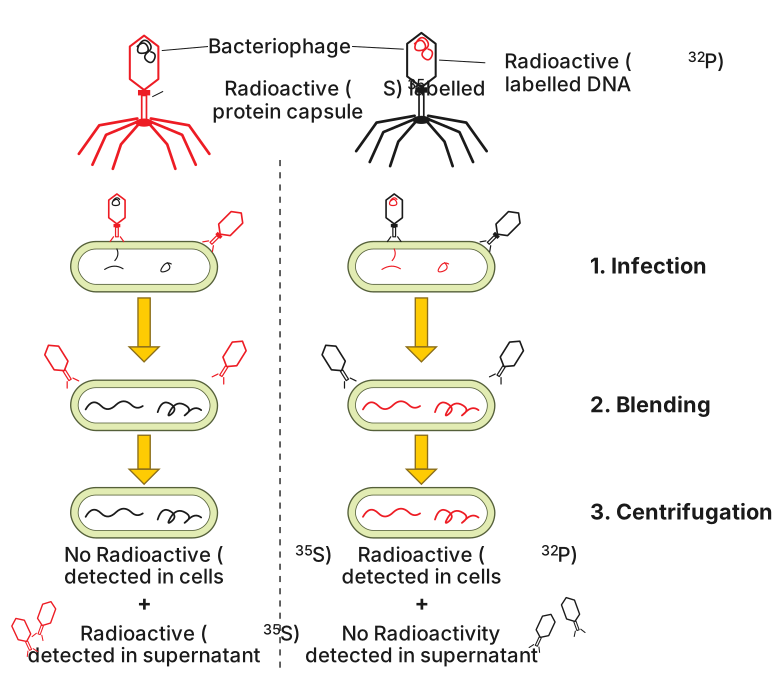
Alfred Hershey and Martha Chase (1952) used differentially radiolabelled bacteriophages to show that only the phage's DNA — never its protein coat — enters the host bacterium and carries the genetic instructions for making new phages, settling the DNA-vs-protein debate over the identity of genetic material.
Experimental design: Hershey and Chase worked with bacteriophage T2, a virus that infects the bacterium E. coli and consists only of a DNA core surrounded by a protein coat. They grew separate batches of phages in media containing either:
- Radioactive phosphorus (³²P), which gets incorporated only into DNA (since DNA, not protein, contains phosphorus), or
- Radioactive sulfur (³⁵S), which gets incorporated only into the protein coat (since protein, not DNA, contains sulfur-containing amino acids, whereas DNA lacks sulfur).
Procedure and result:
- The radiolabelled phages (either ³²P- or ³⁵S-labelled) were allowed to infect separate cultures of unlabelled E. coli bacteria.
- After allowing enough time for infection, the bacterial cultures were agitated in a blender to shake loose and separate the empty phage coats (ghosts) still attached to the outside of the bacterial cell wall from the bacterial cells themselves.
- The mixture was then centrifuged, separating the heavier bacterial cells (pellet) from the lighter phage particles/coats (supernatant).
- It was found that the ³²P radioactivity (DNA) was detected mainly in the pellet (inside the bacterial cells), while the ³⁵S radioactivity (protein) remained in the supernatant (outside, with the empty phage coats).
- Furthermore, the infected bacteria went on to produce new progeny phages containing ³²P, confirming that the injected DNA carried the full genetic information needed to produce new phage particles. …
Unlock everything free for 14 days
- Full step-by-step solutions
- Concept-first explanations
- Methods, shortcuts & mistakes
- PYQ mapping + timed mock tests
Full access for 14 days. No credit card required.