Question of 87
Q.(a) Why can formaldehyde not be prepared using the Rosenmund reduction reaction?
(b) Write a short note on the H.V.Z. (Hell-Volhard-Zelinsky) reaction.
(c) Among the following compounds, which has the lowest pKa value?
(d) Carry out the conversion: Ethanoic acid → Propanone
OR
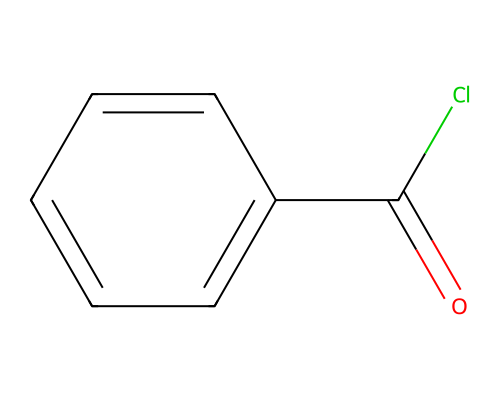
A light-yellow crystalline aromatic compound A, molecular formula C8H8O2, reacts with SOCl2 to give a fuming liquid B with a pungent smell, molecular formula C8H7ClO. Compound B, through Rosenmund reduction, gives compound C, molecular formula C8H8O. Compound C reduces Tollens' reagent, forms a 2,4-DNP derivative, and undergoes the Cannizzaro reaction. On strong oxidation, compound C gives 1,2-benzenedicarboxylic acid. Identify compounds A, B and C. Write the equations for the relevant reactions.
(b) Carry out the conversion: Benzaldehyde → Acetophenone
Tripura TbseHigher Secondary (+2 Stage) Examination 2026Subjective· 5mImportance★★★★★
0% · 0/87 Questions
You're viewing a preview — the full solution, concept, methods & PYQ mapping are locked.
Start your 14-day free trial to unlock the full solution →Rosenmund reduction needs a stable acyl chloride, and formyl chloride does not exist as a stable compound; among the three substituted benzoic acids, the -NO2 (strongest electron-withdrawing) one is most acidic (lowest pKa); acetic acid is converted to acetone via dry distillation of calcium acetate. (Answering the primary version of this OR question, per the solving contract.)
- In the Rosenmund reduction, an acyl chloride (RCOCl) is selectively hydrogenated over a poisoned Pd/BaSO4 catalyst to give the corresponding aldehyde (RCHO). To prepare formaldehyde (HCHO) this way, the starting acyl chloride would have to be formyl chloride (HCOCl, methanoyl chloride). However, HCOCl is an inherently unstable compound - it decomposes spontaneously into carbon monoxide (CO) and hydrogen chloride (HCl) as soon as it forms, and cannot be isolated or stored. Since there is no stable starting acid chloride available, formaldehyde cannot be prepared by the Rosenmund reduction.
- Hell-Volhard-Zelinsky (HVZ) reaction: A carboxylic acid possessing an alpha-hydrogen atom, when treated with chlorine or bromine in the presence of a small amount of red phosphorus, undergoes substitution of the alpha-hydrogen by the halogen to give an alpha-haloacid. The mechanism proceeds through enolisation of the acid (catalysed by the phosphorus halide formed in situ), followed by halogenation at the alpha-carbon. Example: CH3COOH + Br2 --(red P)--> CH3CHBrCOOH (alpha-bromoacetic acid) + HBr. …
Unlock everything free for 14 days
- Full step-by-step solutions
- Concept-first explanations
- Methods, shortcuts & mistakes
- PYQ mapping + timed mock tests
Full access for 14 days. No credit card required.