Q.The catalyst used in Rosenmund's reduction is:
🔒You're viewing a preview — the full solution, concept, methods & PYQ mapping are locked.
🔒 Start your 14-day free trial to unlock the full solution →Concept understanding — Rosenmund Reduction
Rosenmund Reduction: From Intuition to Precision
Imagine you have an acyl chloride — a highly reactive molecule with a chlorine atom attached to a carbonyl carbon. You want to turn it into an aldehyde, which has a hydrogen atom in place of that chlorine. The obvious idea is to add hydrogen gas (H2) in the presence of a metal catalyst. But here's the problem: if you use plain palladium or platinum, the reaction doesn't stop at the aldehyde. The catalyst is too aggressive — it keeps reducing the aldehyde further, all the way to a primary alcohol.
So you need a way to tame the catalyst. You want it to be just active enough to replace the chlorine with hydrogen, but not so active that it attacks the aldehyde group you just made. That's the core intuition behind the Rosenmund reduction.
The key insight: a poisoned catalyst is not a broken catalyst — it's a selective catalyst. The poison blocks the most reactive sites on the metal surface, leaving only milder sites that can still reduce the acyl chloride but cannot reduce the aldehyde.
The Precise Statement
Rosenmund reduction is the catalytic hydrogenation of an acyl chloride (RCOCl) over palladium metal supported on barium sulfate (BaSO4), where the catalyst is partially deactivated (poisoned) to stop the reaction at the aldehyde stage.
The general reaction:
RCOCl+H2Pd/BaSO4,poisonRCHO+HCl
The barium sulfate acts as a support, spreading the palladium into fine particles. But the real trick is the poison — typically a small amount of sulfur or a sulfur-containing compound (like thiourea or quinoline-sulfur). This poison binds to the most active sites on the palladium surface, preventing over-reduction.
RCOCl+H2Pd/BaSO4,quinoline-SRCHO+HCl
Why It Works — The Mechanism in Simple Terms
- Adsorption: The acyl chloride adsorbs onto the palladium surface. The C=O and C−Cl bonds both interact with the metal.
- Hydrogenolysis: Hydrogen gas dissociates on the metal surface into atomic hydrogen. These hydrogen atoms attack the C−Cl bond, replacing chlorine with hydrogen. This step is fast and happens even on the poisoned sites.
- Desorption: The aldehyde forms and desorbs from the catalyst surface. Because the most active sites are blocked, the aldehyde cannot re-adsorb and undergo further reduction to an alcohol.
A common mistake: thinking the poison stops the reaction. It doesn't — it slows down the unwanted second step. If you use too much poison, the first step also stops. If you use too little, you get alcohol. The art is in the precise amount of poison.
Why Barium Sulfate?
You might wonder: why BaSO4 specifically? It's not just any support. Barium sulfate is insoluble and chemically inert under the reaction conditions. It provides a large surface area for the palladium without interfering with the chemistry. More importantly, it doesn't adsorb the aldehyde product, so the aldehyde leaves the catalyst quickly — another factor that prevents over-reduction.
Exam-Relevant Points
| Aspect | Detail |
|---|---|
| Reactant | Acyl chloride (RCOCl) |
| Reagent | H2 gas |
| Catalyst | Pd supported on BaSO4, poisoned |
| Poison | Sulfur / quinoline-sulfur / thiourea |
| Product | Aldehyde (RCHO) |
| Byproduct | HCl gas |
| Limitation | Only works for acyl chlorides; not for other acid derivatives |
Stopping the hydrogenation of an acid chloride cleanly at the aldehyde stage, rather than over-reducing it to an alcohol, requires a catalyst that has been deliberately deactivated. …
Rosenmund reduction converts an acid chloride to an aldehyde using H2 over a poisoned Pd-BaSO4 catalyst.
Rosenmund's reduction is the controlled catalytic hydrogenation of an acyl (acid) chloride to an aldehyde:
R−COCl+H2Pd/BaSO4R−CHO+HCl
The catalyst used is palladium deposited on barium sulphate, and crucially it is 'poisoned' (partially deactivated) — usually with a small amount of sulphur or quinoline (Lindlar-type deactivation). This poisoning is essential because it prevents the catalyst from being active enough to further reduce the newly-formed aldehyde all the way down to a primary alcohol; the reaction is thereby halted cleanly at the aldehyde stage.
…
- CBSE 2026Set ANNUAL1 markMCQQ.The catalyst used in Rosenmund's reduction is:(a) Zn-Hg(b) Raney-Ni(c) Na in ether(d) Pd-BaSO4
›Reveal solutionSolution
Rosenmund reduction converts an acid chloride to an aldehyde using H2 over a poisoned Pd-BaSO4 catalyst.
Rosenmund's reduction is the controlled catalytic hydrogenation of an acyl (acid) chloride to an aldehyde:
R−COCl+H2Pd/BaSO4R−CHO+HCl
The catalyst used is palladium deposited on barium sulphate, and crucially it is 'poisoned' (partially deactivated) — usually with a small amount of sulphur or quinoline (Lindlar-type deactivation). This poisoning is essential because it prevents the catalyst from being active enough to further reduce the newly-formed aldehyde all the way down to a primary alcohol; the reaction is thereby halted cleanly at the aldehyde stage.
…
- CBSE 2026Set ANNUAL1 markQ.Name the reaction: C6H5-COCl (benzoyl chloride) is converted to C6H5-CHO (benzaldehyde) using H2 / Pd-BaSO4.
›Reveal solutionSolution
Selective reduction of an acid chloride to an aldehyde using H2 over a poisoned (partially deactivated) Pd–BaSO4 catalyst is called the Rosenmund reduction.
C6H5COClH2Pd−BaSO4 (poisoned with S/quinoline)C6H5CHO+HCl
…
- CBSE 2026Set ANNUAL1 markMCQQ.Acid chloride is hydrogenated over suspended palladium as catalyst on barium sulphate and form aldehydes. This reaction is called:(a) Stephen reaction(b) Carbyl amine reaction(c) Hunsdiecker reaction(d) Rosenmund reduction
›Reveal solutionSolution
Acid chloride + H2 over Pd/BaSO4 -> aldehyde: this is the Rosenmund reduction.
In the Rosenmund reduction, an acyl chloride is reduced to an aldehyde by hydrogen gas over a palladium catalyst supported on barium sulphate:
R-COCl + H2 --(Pd/BaSO4)--> R-CHO + HCl
…
- CBSE 2025Set ANNUAL1 markMCQQ.Which of the following method is not used to prepare Ketone?(a) Oxidation of Secondary alcohol(b) Catalytic dehydrogenation of secondary alcohol(c) Dry distillation of calcium salt of fatty acids(d) Rosenmund's reduction
›Reveal solutionSolution
Rosenmund reduction (acid chloride + H2, Pd/BaSO4 poisoned catalyst) stops at the aldehyde stage; it is a method for preparing aldehydes, not ketones.
- Oxidation of a secondary alcohol (with, e.g., PCC or acidified K2Cr2O7): gives a ketone — a valid ketone-preparation method.
- Catalytic dehydrogenation of a secondary alcohol (passing vapours over hot Cu): gives a ketone — a valid method.
- Dry distillation of the calcium salt of a fatty acid (Ca salt of a carboxylic acid, heated): gives a ketone (e.g., calcium acetate → acetone) — a valid method. …
- CBSE 2023Set ANNUAL1 markQ.Identify the product 'X' in the chemical reaction given below:
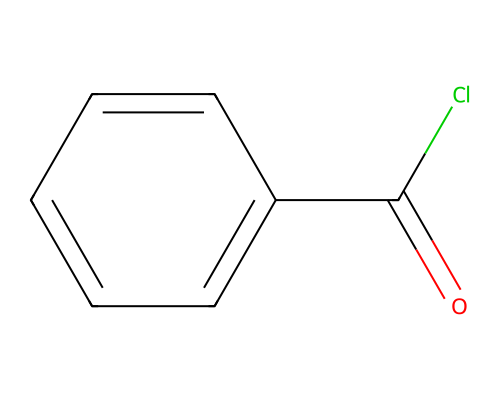 H2, Pd/BaSO4 X
›Reveal solutionSolution
Benzoyl chloride Benzoyl chloride is selectively reduced by H2 over a Pd/BaSO4 (poisoned/partially deactivated palladium) catalyst to give benzaldehyde — this is the Rosenmund reduction.
The scheme shows benzoyl chloride (C6H5–COCl) reacting with hydrogen gas in the presence of a palladium catalyst supported on barium sulphate (Pd/BaSO4), which is partially poisoned (deactivated) so that the reduction stops at the aldehyde stage instead of going further to the alcohol.
C6H5–COCl + H2 --(Pd/BaSO4)--> C6H5–CHO + HCl
…
- CBSE 2022Set E1 markMCQQ.The reaction, R-CO-Cl + H2 --Pd/BaSO4--> RCHO + HCl is called(a) Cannizzaro's reaction(b) Rosenmund reaction(c) Haloform reaction(d) Clemmensen reaction
›Reveal solutionSolution
Catalytic hydrogenation of an acyl chloride over poisoned palladium (Pd/BaSO4) is the Rosenmund reduction, giving an aldehyde.
R-CO-Cl + H2 --(Pd on BaSO4)--> R-CHO + HCl
…
- CBSE 2022Set TERM21 markQ.Complete the following rex: benzoyl chloride (benzene ring with -C(=O)Cl substituent) + H2/Pd-BaSO4 → ?
›Reveal solutionSolution
This is the Rosenmund reduction: an acid chloride is selectively reduced to an aldehyde using H2 over a poisoned Pd catalyst.
Acyl chlorides (acid chlorides) can be reduced to aldehydes by controlled hydrogenation over palladium supported on barium sulfate and partially poisoned with sulfur/quinoline. The poisoning is essential — it stops the catalyst from over-reducing the product all the way to the alcohol, so the reaction halts cleanly at the aldehyde stage.
…
- CBSE 2022Set ANNUAL1 markQ.Identify the products C and D from the following sequence of reactions: benzoic acid (C6H5COOH) PCl5CH2/Pd/BaSO4/SD
›Reveal solutionSolution
Benzoic acid is first converted to its acid chloride with PCl5, and that acid chloride is then selectively reduced back to the aldehyde stage by Rosenmund reduction (catalytic hydrogenation over a poisoned palladium catalyst).
Step 1 — reaction with PCl5: PCl5 replaces the −OH of the carboxylic acid with −Cl, converting the acid to its acyl (acid) chloride, along with POCl3 and HCl as by-products:
C6H5COOH+PCl5→C6H5COCl(=C)+POCl3+HCl
C is benzoyl chloride.
…
- CBSE 2021Set NC1 markMCQQ.In the reaction: benzoyl chloride (benzene ring--C(=O)--Cl) treated with Pd, H2 / BaSO4 gives X (a Rosenmund-reduction scheme). X is(a) propionaldehyde(b) benzaldehyde(c) acetone(d) acetophenone
›Reveal solutionSolution
Controlled catalytic hydrogenation of an acid chloride over a poisoned palladium catalyst (Rosenmund reduction) stops at the aldehyde stage, without over-reduction to the alcohol.
Benzoyl chloride, C6H5–COCl, when treated with hydrogen gas in the presence of palladium supported on barium sulphate (partially poisoned/deactivated, often with sulphur or quinoline, so that the catalyst is not active enough to reduce the aldehyde further to the alcohol), undergoes selective reduction of the acid chloride group to an aldehyde. This is the Rosenmund reduction:
…
- CBSE 2018Set ANNUAL1 markMCQQ.Acid chloride is reduced to aldehyde by which of the following?(a) Wurtz reaction(b) Rosenmound reduction(c) Fitting reaction(d) None of these
›Reveal solutionSolution
The Rosenmund reduction uses hydrogen gas over a specially 'poisoned' palladium catalyst to reduce an acid chloride only as far as the aldehyde, without over-reducing it to the alcohol.
An acid chloride (R-COCl) can, in principle, be hydrogenated all the way to a primary alcohol. To stop the reduction cleanly at the aldehyde stage, the reaction is run with H2 gas over palladium supported on barium sulphate, whose activity has been deliberately reduced ('poisoned') using sulphur or quinoline. This partial-deactivation prevents the aldehyde product from being further reduced:
…
- CBSE 2018Set ANNUAL1 markMCQQ.R-C(=O)-X --(H2, Pd/BaSO4, Δ)--> R-C(=O)-H + HX. This reaction is known as -(a) Stephen's reaction(b) Cannizzaro's reaction(c) Rosenmund's reaction(d) Hinsberg's reaction
›Reveal solutionSolution
Acid chloride → aldehyde over Pd/BaSO₄ = Rosenmund reduction.
Rosenmund reduction converts an acyl chloride to an aldehyde using H₂ over palladium supported on barium sulfate (the catalyst is 'poisoned' with BaSO₄/quinoline to stop over-re …
🎓Unlock everything free for 14 days
- ✓Full step-by-step solutions
- ✓Concept-first explanations
- ✓Methods, shortcuts & mistakes
- ✓PYQ mapping + timed mock tests
Full access for 14 days. No credit card required.