Chemistry · Ch 10 — Biomolecules
Fructose
Fructose
Fructose — a ketohexose
Fructose is the second important hexose sugar of the chapter, and it is a ketohexose rather than an aldohexose. It occurs naturally, alongside glucose, in fruits, honey and vegetables, and in its pure crystalline form it is used commercially as a sweetener. It is also generated whenever the disaccharide sucrose is hydrolysed — the hydrolysis of sucrose yields one molecule of glucose and one molecule of fructose.
Open-chain structure
Fructose shares the same molecular formula as glucose,
and, like glucose, has six carbons arranged in a straight chain. The key structural difference shows up at carbon 2: instead of the aldehyde group that glucose carries at C1, fructose carries a ketonic carbonyl group at C2. Its stereochemistry places it in the D-series, and the compound is laevorotatory, so it is correctly named D-(–)-fructose. The open-chain (Fischer-projection-style) skeleton runs:
- C1:
- C2: (the ketonic carbon)
- C3: pointing left (opposite convention to glucose's C3)
- C4: pointing right
- C5: pointing right
- C6:
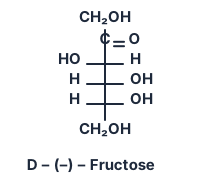
Drawn by us to help you understand the concept clearly, and verified to make sure it's accurate. For exams, practice from your textbook's own diagram.
Redrawn from the NCERT page with the structures, printed labels (CH2OH, HO, OH) and reagent placement exactly as the textbook prints them. Every element of this display was checked against the printed page during the sweep's blind-judge verification pass, so wha …
Because fructose is isomeric with glucose (same formula, different functional-group placement) yet still terminates in the same six-carbon polyhydroxy skeleton, strong reduction or hydrolysis of many of its derivatives converges on products comparable to those obtained from glucose.
Cyclic (furanose) structure
Fructose does not stay locked in its open-chain form in solution. It exists in two cyclic anomeric forms, formed when the group at C5 attacks the ketonic carbon (C2) and closes a ring. Because this closure produces a five-membered ring, the resulting structure is named a furanose, by analogy with the parent five-membered heterocycle furan (a ring built from four carbons and one oxygen atom).
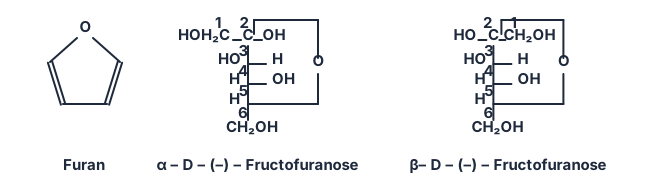
Drawn by us to help you understand the concept clearly, and verified to make sure it's accurate. For exams, practice from your textbook's own diagram.
Redrawn from the NCERT page with the structures, printed labels (HOH2C, OH, HO, CH2OH) and reagent placement exactly as the textbook prints them. Every element of this display was checked against the printed page during the sweep's blind-judge verification pass, so wh …
Glucose closes into a six-membered pyranose ring through its C5–OH attacking the C1 aldehyde. Fructose instead closes into a five-membered furanose ring through its C5–OH attacking the C2 ketone. The ring size and the anomeric carbon are different precisely because the parent open-chain carbonyl sits at a different position (C1 aldehyde vs C2 ketone).
Just as with glucose, ring closure at C2 creates a new stereocentre, so fructose too exists as a pair of anomers, distinguished by the orientation of the generated at that new stereocentre: …
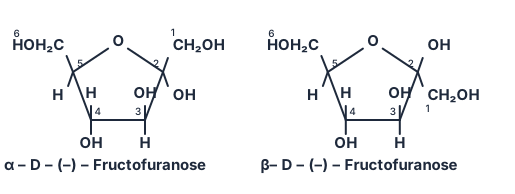
Drawn by us to help you understand the concept clearly, and verified to make sure it's accurate. For exams, practice from your textbook's own diagram.
Redrawn from the NCERT page with the structures and reagent placement exactly as the textbook prints them. Every element of this display was checked against the printed page during the sweep's blind-judge verification pass, so what you …