Chemistry · Ch 3 — Chemical Kinetics
Collision Theory of Chemical Reactions
Collision Theory of Chemical Reactions
Collision theory, put forward by Max Trautz and William Lewis around 1916–18, digs deeper than the Arrhenius equation into why a reaction proceeds at the rate it does. It borrows its picture of molecules from the kinetic theory of gases: reactant molecules are treated as hard spheres, constantly moving and colliding, and a reaction is imagined to occur only when two such spheres strike each other.
Collision frequency
The starting idea is simple — more collisions per second should mean a faster reaction. This rate of collisions is captured by a single quantity.
Collision frequency () — the number of collisions occurring per second, per unit volume, of the reaction mixture.
For a simple bimolecular elementary step
collision theory writes the rate as
where is the collision frequency of A and B, and is the Boltzmann factor — the fraction of those collisions in which the colliding pair together carries kinetic energy at least equal to the activation energy . Matched against the Arrhenius equation, this tells us that the pre-exponential factor is essentially a measure of how often molecules collide.
This expression works well for reactions between atoms or fairly simple molecules, but for reactions involving more complex molecules the predicted rate constants can be far off the observed ones. The reason is that colliding with enough energy is necessary but not, by itself, sufficient — not every energetic collision actually turns reactants into products.
Two conditions for an effective collision
Collision theory therefore tightens its criterion. A collision only counts as productive — an effective collision — when both of the following hold at once:
- The colliding molecules must carry kinetic energy equal to or above a certain minimum, called the threshold energy, so that the necessary bonds can break and new bonds can form.
- The molecules must collide in the correct spatial orientation, so that the reactive parts of each molecule actually meet.
Energy alone getting molecules to crash into one another is not enough — they also have to be pointed the right way when they do.
Why orientation matters
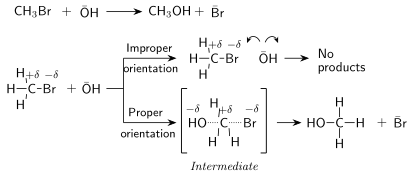
The reaction of bromomethane with hydroxide ion to give methanol,
illustrates this neatly (fig-3-12).
Drawn by us to help you understand the concept clearly, and verified to make sure it's accurate. For exams, practice from your textbook's own diagram.
What the Figure Shows
The figure starts from ONE shared reactant pair — a drawn bromomethane molecule (, with its / charge marks) plus a hydroxide ion () — which forks into two labelled arrows: the upper arm is labelled improper orientation and the lower arm proper orientation.
-
Improper orientation (upper arm): The approaches the bromine end of . Because bromine carries a partial negative charge () due to the polar bond, the negatively charged is repelled. The collision is ineffective: the molecules simply bounce apart, and no products are formed.
-
Proper orientation (lower arm): The attacks the carbon atom from the side opposite the bromine. Carbon carries a partial positive charge () because it is bonded to the more electronegative bromine. The figure shows a bracketed intermediate (the transition state) with partial bonds: and . This arrangement allows the to bond to carbon while the bond breaks, yielding and .
The Physical Idea
The figure illustrates that collision energy alone is not enough for a reaction to occur. Even if two molecules collide with sufficient kinetic energy (above the activation energy ), the reaction will fail unless the molecules are properly oriented relative to each other. In this example, the correct orientation is a backside attack on the carbon, which is the classic mechanism.
Key Formula Developed with This Figure
The textbook uses this concept to modify the Arrhenius equation. The rate constant for a bimolecular reaction is given by:
where:
- = probability or steric factor (accounts for proper orientation; )
- = collision frequency (number of collisions per second per unit volume between reactants A and B)
- = fraction of molecules with energy equal to or greater than the activation energy …
The hydroxide ion needs to approach and bond at the carbon atom, on the side opposite to the C–Br bond, for the old bond to break as the new one forms. If the two species collide with this proper orientation — the negative oxygen end of swinging in towards the carbon from the back side — an intermediate stage forms and the collision goes on to give methanol and bromide ion. But if instead collides on the wrong side of the molecule — an improper orientation, for instance approaching near the bromine or hydrogen atoms rather than lining up opposite the C–Br bond — the two species simply bounce apart unchanged, and no product is formed at all. So a "good" collision is not just forceful, it is also aimed correctly at the reactive site.
Building orientation into the rate expression
To account for this, collision theory introduces a second factor alongside energy.
Steric factor / probability factor () — a factor that reflects the probability that colliding molecules are oriented correctly for a reaction to occur.
Bringing into the earlier expression gives the more complete rate law of collision theory:
Here:
- — the steric (probability) factor, accounting for proper orientation
- — the collision frequency between reactants A and B
- — the activation energy of the reaction
- — the gas constant
- — the absolute temperature …