Chemistry · Ch 2 — Electrochemistry
Measurement of Electrode Potential
Measurement of Electrode Potential
Why a single electrode potential cannot be measured
The potential of an individual half-cell, by itself, cannot be measured. Only the difference between two half-cell potentials can be measured — and that difference is exactly the emf of the cell they form together. To get around this, one electrode's potential is arbitrarily fixed as a reference, and every other electrode's potential is then determined relative to it.
The Standard Hydrogen Electrode (SHE)
By international convention, the reference half-cell is the standard hydrogen electrode, represented as
It is assigned a potential of exactly zero volts at all temperatures, corresponding to the half-reaction
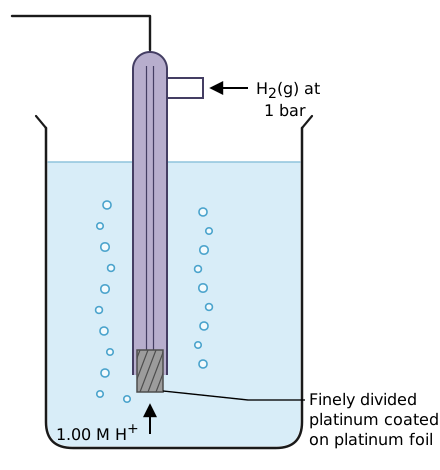
Construction. The SHE consists of a platinum electrode coated with platinum black, dipped in an acidic solution through which pure hydrogen gas is continuously bubbled. Both the oxidised and reduced forms of hydrogen are kept at unit concentration/activity: the hydrogen gas pressure is maintained at 1 bar and the hydrogen ion concentration in solution at 1 M.
Drawn by us to help you understand the concept clearly, and verified to make sure it's accurate. For exams, practice from your textbook's own diagram.
What the Figure Shows
The schematic of the Standard Hydrogen Electrode (SHE) depicts a glass beaker containing a 1.00 M H⁺ solution. A glass tube dips into the solution, through which hydrogen gas (H₂) at 1 bar is bubbled. At the bottom of the tube, a strip of finely divided platinum coated on platinum foil is immersed in the solution. Small circles around the platinum represent gas bubbles of H₂, indicating the gas–solution–electrode interface where the half-cell reaction occurs.
The Physical Idea
The SHE is the universal reference electrode for measuring electrode potentials. Its half-cell reaction is:
By convention, the standard electrode potential of SHE is exactly zero volts at all temperatures:
This allows any other half-cell to be measured relative to it. The figure illustrates the three-phase boundary (gas, solution, solid) essential for the reaction: H₂ gas adsorbs on the platinum surface, dissociates, and exchanges electrons with H⁺ ions in solution. The platinum is inert — it does not participate chemically but provides a surface for electron transfer.
Key Formulas Developed with This Figure
The textbook uses the SHE to define standard electrode potential () of a half-cell. For a cell constructed as:
the measured cell potential () equals the standard reduction potential of the right-hand electrode because SHE is on the left with :
Here:
- = standard reduction potential of the half-cell on the right (cathode)
- = standard reduction potential of the left half-cell (anode) = 0 V for SHE
For example, with copper:
And with zinc: …
Using the SHE to measure another half-cell's potential
To find the standard electrode potential of an unknown half-cell, it is combined with the SHE to form a complete cell, with the SHE acting as the anode (the reference) and the half-cell under test acting as the cathode. If the oxidised and reduced species of the test half-cell are also at unit concentration, the measured cell potential equals the standard electrode potential, , of that half-cell:
Since for the SHE,
Symbols: is the cell's standard emf; , are the standard electrode potentials of the right-hand (cathode) and left-hand (anode) half-cells.
For example, the measured emf of the cell
is , which is therefore the standard electrode potential of
Likewise, the measured emf of
is , the standard electrode potential of
Reading the sign of the standard electrode potential
- A positive (as for Cu/Cu) means the ion is reduced more easily than H; the reverse cannot happen under standard conditions, so H cannot oxidise the metal (e.g. copper does not dissolve in HCl; in nitric acid it is oxidised by the nitrate ion, not by H).
- A negative (as for Zn/Zn) means H ions can oxidise the metal — equivalently, the metal can reduce hydrogen ions.
Applying this convention to the Daniell cell, with zinc as the left (anode) electrode and copper as the right (cathode) electrode:
The overall reaction of the cell is the sum of these two electrode reactions, and the emf of the cell is:
Inert electrodes
Metals such as platinum or gold are sometimes used purely as inert electrodes — they take no part in the reaction themselves but supply a surface for the oxidation/reduction reaction and for conduction of electrons. For example:
- Hydrogen electrode: , with half-reaction
- Bromine electrode: , with half-reaction
What standard electrode potentials tell us
Standard electrode potentials, measured this way for many half-cells, carry a lot of chemical information:
- If a half-cell's standard electrode potential is greater than zero, its reduced form is more stable than hydrogen gas.
- If it is less than zero, hydrogen gas is more stable than the reduced form of that species. …