Worked Examples · Example 3.7
Q.The four arms of a Wheatstone bridge (Fig. 3.19) have the following resistances:
, , , and .
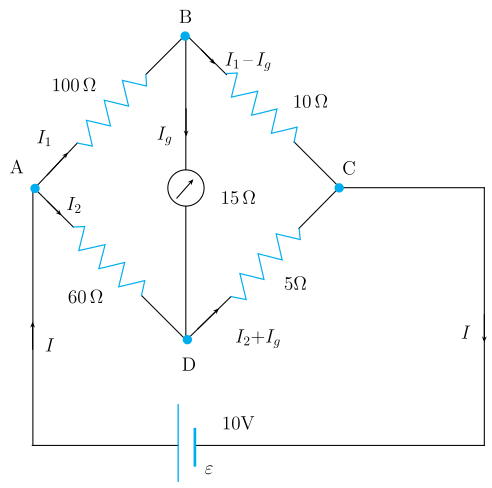
A galvanometer of resistance is connected across BD. Calculate the current through the galvanometer when a potential difference of is maintained across AC.
Tripura TbseTextbookSubjective· 3mImportance★★★★★
17% · 7/42 Questions
You're viewing a preview — the full solution, concept, methods & PYQ mapping are locked.
Start your 14-day free trial to unlock the full solution →The bridge is unbalanced (), so current flows through the galvanometer. Solving Kirchhoff's equations gives .
Check for balance. For a Wheatstone bridge at balance. Here but ; the ratios differ, so the bridge is unbalanced and a current flows through the galvanometer across .
Assign currents. Let flow and flow , with flowing through the galvanometer. By the junction rule the current in is and in is .
Kirchhoff's voltage law (three independent loops):
Loop :
Loop :
Loop with the source across :
Solve. From (3): . Substituting into (2) gives . Putting both into (1): …
Unlock everything free for 14 days
- Full step-by-step solutions
- Concept-first explanations
- Methods, shortcuts & mistakes
- PYQ mapping + timed mock tests
Full access for 14 days. No credit card required.