Physics · Ch 13 — Nuclei
Nuclear Binding Energy
Nuclear Binding Energy
The Mass of a Nucleus is Less Than the Sum of Its Parts
You might think that the mass of a nucleus is simply the sum of the masses of its individual protons and neutrons. After all, a nucleus is made of these particles. But careful measurements show something surprising: the measured mass of any stable nucleus is always less than the total mass of its separate, free nucleons.
Take the oxygen-16 nucleus () as an example. It contains 8 protons and 8 neutrons. Let's calculate what we would expect its mass to be, using the known masses of a free proton, neutron, and electron (since atomic masses include electrons).
Atomic masses include the mass of the electrons. To get the nuclear mass, we subtract the mass of the electrons from the atomic mass.
- Mass of 8 neutrons =
- Mass of 8 protons =
- Mass of 8 electrons =
The expected mass of the nucleus, if it were just a loose collection of its parts, would be the sum of the masses of its 8 neutrons and 8 protons:
But the actual atomic mass of from mass spectroscopy is . Subtracting the mass of the 8 electrons gives the experimental nuclear mass:
The difference is striking. The expected mass is , but the actual nuclear mass is only . The nucleus is lighter by:
This missing mass is not an error. It is a real, physical effect.
The Mass Defect
The difference between the total mass of the individual nucleons (protons and neutrons) and the actual mass of the nucleus is called the mass defect, denoted by .
For a nucleus with protons and neutrons, the mass defect is:
where is the mass of a proton, is the mass of a neutron, and is the mass of the nucleus.
A common mistake is to use the atomic mass directly in the formula. The formula above uses the nuclear mass. If you are given the atomic mass , you must subtract the mass of the electrons: . For most calculations, the electron mass is small, but for precision, it matters.
Where Does the Missing Mass Go? Einstein's Answer
The mass defect is not a loss of matter. It is a conversion of mass into energy. Einstein's famous equation, , tells us that mass and energy are two sides of the same coin. When the 8 protons and 8 neutrons come together to form the oxygen nucleus, they release a tremendous amount of energy. This released energy carries away some of the system's mass, which is why the final nucleus is lighter.
To reverse the process — to break the oxygen nucleus back into 8 separate protons and 8 neutrons — you would have to supply that same amount of energy. This energy is called the binding energy of the nucleus, .
The binding energy is directly related to the mass defect:
The Energy Equivalent of One Atomic Mass Unit
To work with these energies in practical units, it is useful to know the energy equivalent of 1 atomic mass unit (u).
Multiplying by :
To convert this to electronvolts (eV), we use :
This is a crucial conversion factor. It means that a mass defect of 1 u corresponds to a binding energy of 931.5 MeV.
For our oxygen-16 example, the mass defect is . Its binding energy is therefore:
This is the energy that would be released if you built an oxygen nucleus from scratch, and the energy you would need to supply to tear it apart.
Binding Energy Per Nucleon
The total binding energy tells you how tightly the whole nucleus is bound. But a more useful measure for comparing different nuclei is the binding energy per nucleon, . It is the average energy needed to remove a single nucleon from the nucleus.
where is the mass number (total number of nucleons).
For , per nucleon.
The Binding Energy Curve: What It Tells Us About the Nuclear Force
If you plot the binding energy per nucleon against the mass number for all stable nuclei, you get a famous curve (Figure 13.1 in the textbook). This curve is not just a graph; it is a fingerprint of the nuclear force itself. It reveals four key properties.
The binding energy per nucleon curve is the single most important graph in nuclear physics. It explains why stars shine, why nuclear power plants work, and why some elements are more stable than others.
Property (I): The Plateau for Middle-Mass Nuclei
For nuclei with mass numbers in the range , the binding energy per nucleon is roughly constant, around 8 MeV per nucleon. The curve peaks at about 8.75 MeV for (iron-56) and is still around 7.6 MeV for (uranium-238).
Why is it constant? This is a direct consequence of the short-range nature of the nuclear force. A given nucleon inside a large nucleus only feels the attractive force from its nearest neighbours — those within a few femtometers. Nucleons farther away have no influence. So, a nucleon deep inside the nucleus has a fixed number of neighbours, say , and its contribution to the binding energy is roughly a constant . The total binding energy is then approximately , which means , a constant.
This property is called the saturation of the nuclear force. The force does not accumulate with distance; it saturates. Each nucleon can only "bond" with a limited number of others.
Property (II): Lower Binding for Light Nuclei () …
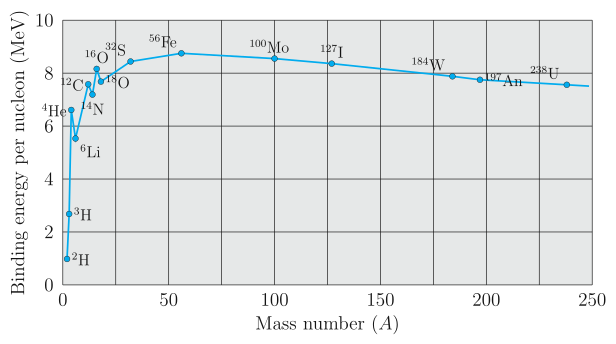
Drawn by us to help you understand the concept clearly, and verified to make sure it's accurate. For exams, practice from your textbook's own diagram.
The figure is a plot of binding energy per nucleon () against mass number (). The horizontal axis runs from to about , and the vertical axis runs from to about MeV. A single smooth curve rises steeply from the origin, then climbs to a broad maximum near (iron, ) at about MeV. After that, the curve falls very slowly, staying almost flat through the middle-mass region (where MeV), then declines gradually to about MeV at (uranium, ). Sharp local peaks are visible at the tightly-bound light nuclei , , and — the peak is followed by a dip.
The physical idea this figure teaches is that nuclei are most stable when their binding energy per nucleon is highest. The curve shows that middle-mass nuclei (around iron) are the most tightly bound, while both very light and very heavy nuclei are less tightly bound. This has two profound consequences:
- A very heavy nucleus (like ) has lower than two middle-mass nuclei (like each). If the heavy nucleus splits, the products are more tightly bound, and energy is released — this is nuclear fission.
- Two very light nuclei (like ) joining to form a heavier nucleus also increases , releasing energy — this is nuclear fusion, the energy source of the Sun.
The key formula the textbook develops with this figure is the mass defect and binding energy:
Here:
- is the mass defect — the difference between the total mass of the individual nucleons (protons and neutrons) and the actual mass of the nucleus.
- is the atomic number (number of protons), is the mass number (total nucleons), is the proton mass, is the neutron mass.
- is the total binding energy — the energy needed to separate the nucleus into its individual nucleons.
- is the binding energy per nucleon — the average energy per nucleon needed to separate the nucleus.
The textbook also gives the conversion: , so mass defects can be directly converted to energy in MeV.
The constancy of in the range is a direct consequence of the short-range nature of the nuclear force. A nucleon inside a large nucleus only interacts with its nearest neighbours (within the range of the force), not with all nucleons. This is called the saturation property of the nuclear force — adding more nucleons does not increase the binding energy per nucleon for interior nucleons, so stays roughly constant. …