Physics · Ch 9 — Ray Optics and Optical Instruments
Focal Length of Spherical Mirrors
Focal Length of Spherical Mirrors
Concept: What is Focal Length?
When a parallel beam of light (rays coming from a very distant object) falls on a spherical mirror, the behaviour depends on the mirror type:
- Concave mirror: The reflected rays actually meet (converge) at a single point on the principal axis.
- Convex mirror: The reflected rays appear to come from a single point behind the mirror (they diverge).
This point is called the principal focus of the mirror. The distance from the pole of the mirror to the focus is the focal length, denoted by .
The Paraxial Assumption
The analysis works only for paraxial rays — rays that:
- Strike the mirror very close to the pole .
- Make very small angles with the principal axis.
For such rays, we can use the small-angle approximation: (where is in radians).
Derivation:
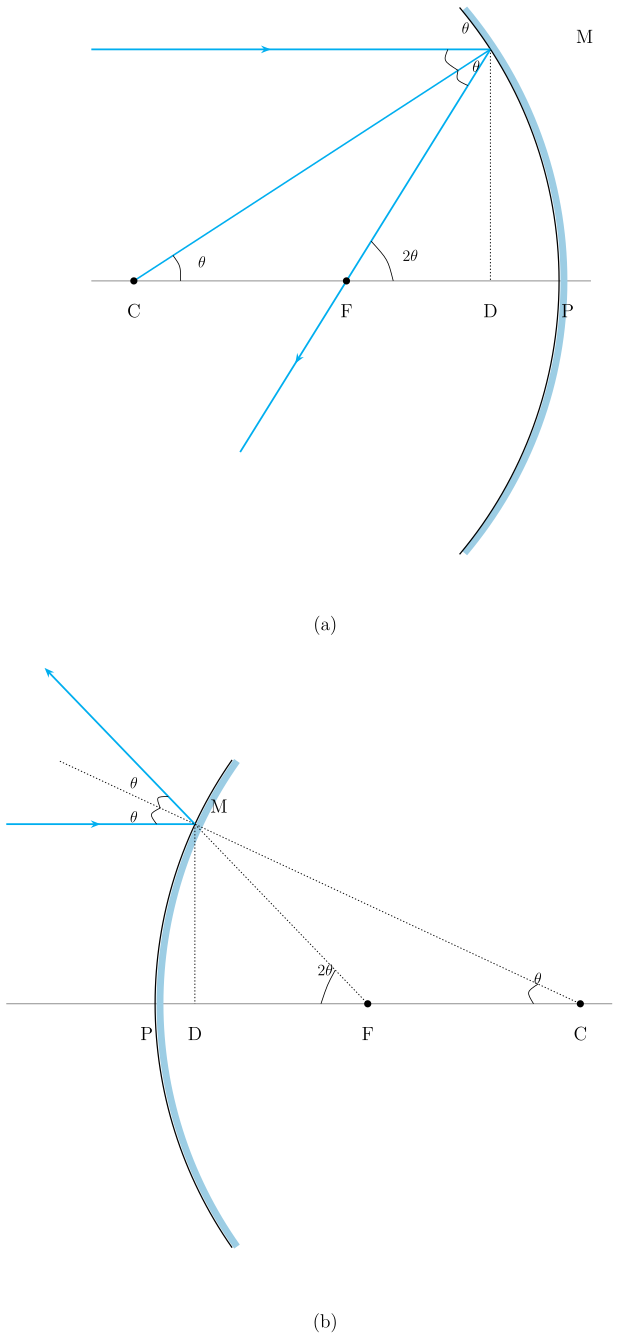
Consider a concave mirror with centre of curvature and radius of curvature . A ray parallel to the principal axis hits the mirror at point .
- Geometry of reflection: The line is the normal to the mirror at . The angle of incidence is . By the law of reflection, the reflected ray makes the same angle with the normal.
- Angle at focus: The reflected ray crosses the principal axis at . The angle between the reflected ray and the principal axis is .
- Using tangents: Drop a perpendicular from to the principal axis. From the two right triangles:
- In :
- In :
- Small-angle approximation: For paraxial rays, is very small, so and . Therefore:
Cancelling $MD$ (which is non-zero) gives: …
Drawn by us to help you understand the concept clearly, and verified to make sure it's accurate. For exams, practice from your textbook's own diagram.
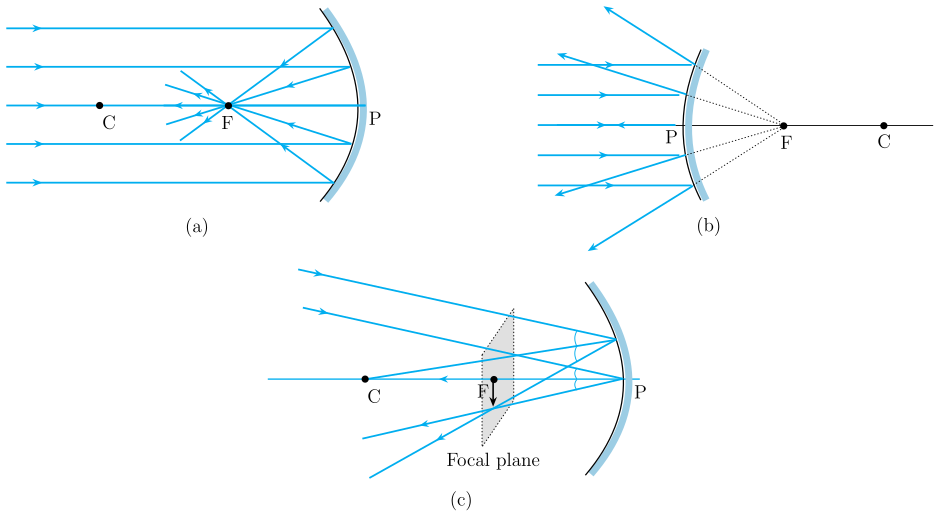
Figure 9.3 is a conceptual diagram that shows how spherical mirrors focus light. It has three panels, each illustrating a different case of paraxial ray reflection.
Panel (a): Concave mirror
The mirror is drawn as an arc that opens to the left, with its pole at the centre of the arc and its centre of curvature on the principal axis to the left of . A set of horizontal rays (parallel to the principal axis) comes from the left and strikes the mirror near . After reflection, these rays converge to a single point on the principal axis, between and . This point is the principal focus. The distance is the focal length .
Panel (b): Convex mirror
The mirror arc opens to the right. The same parallel beam from the left hits the convex surface. The reflected rays diverge; they never actually meet. However, if you extend the reflected rays backward (shown as dashed lines behind the mirror), those extensions all meet at a point on the principal axis behind the mirror. This is the virtual focus — it is not a real meeting point of light, but the point from which the reflected rays appear to come.
Panel (c): Oblique parallel beam
Here, the parallel beam is incident at a small angle to the principal axis. For both mirror types, the reflected rays converge (or appear to diverge) not at on the axis, but at a point in a plane through that is perpendicular to the principal axis. This plane is called the focal plane. This panel shows that the focus is not just a single point for on-axis rays; the entire focal plane is where parallel rays at any small angle are brought to a focus.
Physical idea
The figure teaches that for paraxial rays (rays close to the axis and making small angles), spherical mirrors produce a well-defined focus. The focal point is the image of an object at infinity. The focal plane extends this idea to off-axis parallel beams.
Key formula derived from this figure …
Drawn by us to help you understand the concept clearly, and verified to make sure it's accurate. For exams, practice from your textbook's own diagram.
The figure has two panels, (a) and (b), each showing the geometry of reflection for a single ray on a spherical mirror.
Panel (a): Concave mirror
The mirror is drawn as a concave arc. The principal axis is a horizontal line through the centre of curvature C and the pole P (the midpoint of the mirror). A ray parallel to the principal axis strikes the mirror at point M. The radius CM is drawn from C to M; this line is the normal to the mirror surface at the point of incidence. The reflected ray is drawn from M crossing the principal axis at the focus F. A perpendicular MD is dropped from M to the principal axis, meeting it at point D. Two angles are marked: (the angle between the radius CM and the principal axis) and (the angle between the reflected ray and the principal axis). The distances shown are CP = R (radius of curvature), FP = f (focal length), and CD and FD along the axis.
Panel (b): Convex mirror
The mirror is a convex arc. The same labels M, D, F, C, P, , and appear. The incident ray is again parallel to the principal axis and strikes the mirror at M. The radius CM is the normal. The reflected ray is drawn such that it appears to come from point F behind the mirror (on the principal axis, on the opposite side of the mirror from the incident ray). The geometry of angles is identical to the concave case, but the focus F is virtual.
Physical idea
The figure teaches that for a spherical mirror, a ray parallel to the principal axis reflects through (or appears to come from) a fixed point F on the axis, called the principal focus. The key relation derived is that the focal length is half the radius of curvature .
Key formula derived from the figure
Using the geometry of the right triangles MCD and MFD:
For paraxial rays (small ), and . Substituting gives: …