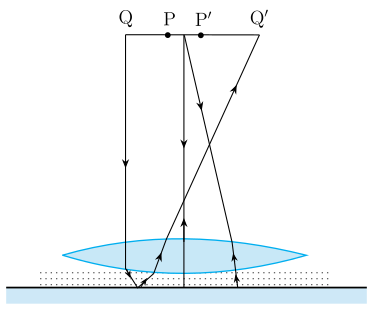
Q.Figure 9.30 shows an equiconvex lens (of refractive index ) in contact with a liquid layer on top of a plane mirror. A small needle with its tip on the principal axis is moved along the axis until its inverted image is found at the position of the needle. The distance of the needle from the lens is measured to be . The liquid is removed and the experiment is repeated. The new distance is measured to be . What is the refractive index of the liquid?
You're viewing a preview — the full solution, concept, methods & PYQ mapping are locked.
Start your 14-day free trial to unlock the full solution →Autocollimation makes each needle distance a focal length: glass lens , lens + liquid . These give a liquid lens and a liquid refractive index .
Principle — why the coincidence gives a focal length
With a plane mirror below the lens, rays that leave the needle, pass through the lens, reflect off the mirror, and return retrace their path only when they strike the mirror normally — that is, when they travel parallel between lens and mirror. This happens when the needle sits at the focus of the lens system, so the measured needle distance equals the focal length.
Step 1 — Focal lengths from the two measurements
- Glass lens + liquid layer together:
- Glass lens alone (liquid removed):
Step 2 — Radius of the equiconvex glass lens
With and surface radii and , the lens maker's formula gives
so .
Step 3 — Focal length of the liquid lens
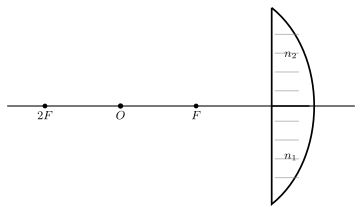
The liquid fills the gap between the convex glass lens and the plane mirror, forming a plano-concave lens in contact with the glass lens. For thin lenses in contact, …
Unlock everything free for 14 days
- Full step-by-step solutions
- Concept-first explanations
- Methods, shortcuts & mistakes
- PYQ mapping + timed mock tests
Full access for 14 days. No credit card required.