Q.(i) Using the angle of the prism and the angle of minimum deviation, derive an expression for the refractive index of the material of the prism.
You're viewing a preview — the full solution, concept, methods & PYQ mapping are locked.
Start your 14-day free trial to unlock the full solution →The prism formula relates refractive index to the prism angle and the minimum-deviation angle; for an equi-convex lens, the lens maker's formula with R1 = R, R2 = -R gives R = (n-1)·2f.
(i) Derivation of :
For a ray passing through a prism of refracting angle , if are the angles of incidence and emergence and the angles of refraction at the two faces, geometry gives:
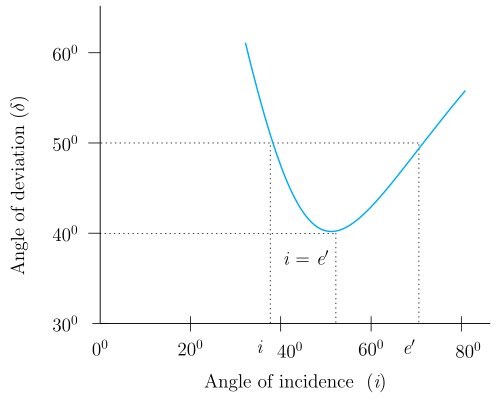
where is the angle of deviation.
As is varied, first decreases, reaches a minimum value , then increases. At minimum deviation, the ray inside the prism travels symmetrically (parallel to the base), so:
and
By Snell's law at the first face (going from air into the prism):
This is the required expression for the refractive index of the prism material.
(ii) Radius of curvature of the equi-convex lens:
By the lens maker's formula: …
Unlock everything free for 14 days
- Full step-by-step solutions
- Concept-first explanations
- Methods, shortcuts & mistakes
- PYQ mapping + timed mock tests
Full access for 14 days. No credit card required.