Q.Read the following passage carefully and answer the questions below: "In 1678, the Dutch physicist Christiaan Huygens proposed the wave theory of light. His wave theory is founded on the concept of the wavefront. Light travels in the form of waves. The wavefront is the locus traced by the source points of secondary wavelets vibrating in the same phase. Hence a wavefront may be defined as a surface of constant phase. The speed with which the wavefront spreads outward from the source is called the speed of the wave."
You're viewing a preview — the full solution, concept, methods & PYQ mapping are locked.
Start your 14-day free trial to unlock the full solution →These three answers restate Huygens' core ideas directly from the passage: light is a transverse EM wave, a point source gives spherical wavefronts, and wave propagation happens through secondary wavelets forming successive new wavefronts.
(i) According to the wave theory of light (later understood, with Maxwell's theory, as electromagnetic), light propagates as electromagnetic TRANSVERSE waves -- the oscillating E and B fields are perpendicular to the direction of travel. Answer: (b).
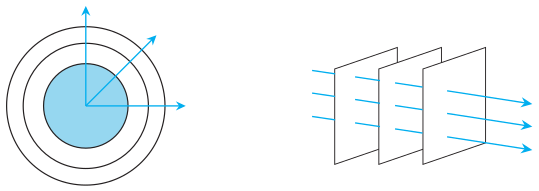
(ii) A point source emits light equally in all directions, so the locus of points at the same phase (same distance travelled) at any instant is a sphere centred on the source -- giving a spherical wavefront for a divergent beam from a point source (it looks locally planar only when the source is very far away). Answer: (b).
…
Unlock everything free for 14 days
- Full step-by-step solutions
- Concept-first explanations
- Methods, shortcuts & mistakes
- PYQ mapping + timed mock tests
Full access for 14 days. No credit card required.