Economics · Ch 12 — Human Capital Formation in India
Human Capital and Economic Growth
Human Capital and Economic Growth
The concept of physical capital is the starting point for thinking about human capital, and the two share some features while differing sharply in others.
Who contributes more to national income? A software professional, whose skill is high, generally adds more than an ordinary factory worker. Since the labour skill of an educated person exceeds that of an uneducated one, the educated person earns more and, because economic growth means a rise in a country's real national income, contributes more to that growth than an illiterate person does. Health works the same way: a healthy person who can supply labour steadily over a long period is also important for growth.
How human capital feeds growth. Education, health, on-the-job training, job-market information and migration all raise an individual's income-earning capacity. This enhanced productivity does more than lift labour productivity: it also stimulates innovation and builds the ability to absorb new technology. Education helps people understand social change and scientific advance, aiding invention and innovation, and an educated workforce adapts more readily to new technologies.
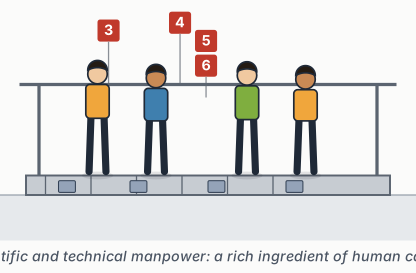
Drawn by us to help you understand the concept clearly, and verified to make sure it's accurate. For exams, practice from your textbook's own diagram.
Own-drawn recreation of NCERT Fig 4.3 …
The evidence is not clear-cut. Proving that a rise in human capital actually causes economic growth is difficult, largely because of measurement problems. Education measured by years of schooling, teacher-pupil ratios or enrolment rates may not capture its quality; health measured in money terms, life expectancy or mortality rates may not reflect the true health of a population. When developing and developed countries are compared using these indicators, the measures of human capital converge, but per capita real income does not, that is, human capital in developing countries grew faster, yet their per capita income did not keep pace.
Cause and effect run both ways. There is reason to think the link works in either direction: higher income helps build a higher level of human capital, and a higher level of human capital in turn raises income.
India's recognition of this. India acknowledged the importance of human capital long ago. The Seventh Five Year Plan stated that developing human resources must be given a key role in any development strategy, especially in a country with a large population, because a well-trained large population becomes an asset that accelerates growth and drives social change.
Simultaneous growth of the sectors. Even though a strict cause-and-effect relation is hard to establish, the data show that the education and health sectors have grown together over the decades, with each sector's growth probably reinforcing the others.
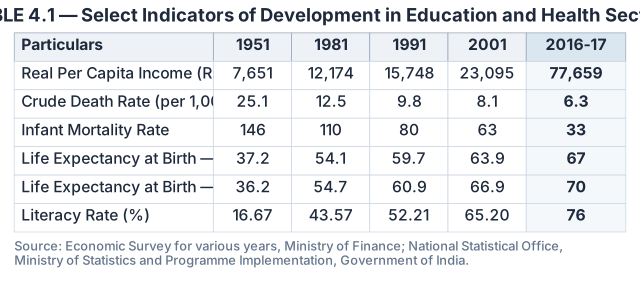
| Particulars | 1951 | 1981 | 1991 | 2001 | 2016-17 |
|---|---|---|---|---|---|
| Real per capita income (Rs) | 7,651 | 12,174 | 15,748 | 23,095 | 77,659 |
| Crude death rate (per 1,000) | 25.1 | 12.5 | 9.8 | 8.1 | 6.3 |
| Infant mortality rate | 146 | 110 | 80 | 63 | 33 |
| Life expectancy at birth, male (years) | 37.2 | 54.1 | 59.7 | 63.9 | 67 |
| Life expectancy at birth, female (years) | 36.2 | 54.7 | 60.9 | 66.9 | 70 |
| Literacy rate (per cent) | 16.67 | 43.57 | 52.21 | 65.20 | 76 |
A knowledge economy ahead. The National Education Policy 2020 notes that the world's knowledge landscape is changing fast. With advances such as big data, machine learning and artificial intelligence, many unskilled jobs may be taken over by machines, while demand rises for skilled workers in mathematics, computer science and data science, combined with abilities across the sciences, social sciences and humanities. Climate change, pollution and shrinking natural resources will call for new skills in fields like biology, chemistry, physics, agriculture and climate science; epidemics and pandemics will need collaborative research in disease management and vaccines; and demand for the humanities and arts will grow as India moves towards becoming a developed country and one of the world's three largest economies. This policy vision suggests how human capital formation can move India's economy onto a higher, knowledge-based growth path.
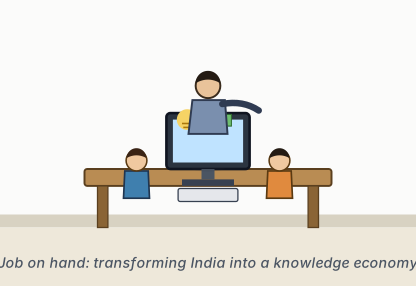
Drawn by us to help you understand the concept clearly, and verified to make sure it's accurate. For exams, practice from your textbook's own diagram.
Own-drawn recreation of NCERT Fig 4.4 …
…