Physical Education · Ch 10 — Training & Doping in Sports
Overload
Overload
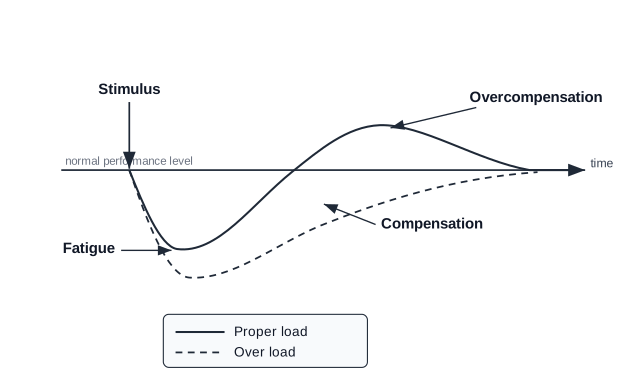
The normal development of an athlete's training state is disturbed when the physical and psychic daily load of life exceeds the loading capacity of the individual. Over-load administered over a long period leads to decreased performance capacity. Scientists see over-loading largely as a disturbance of normal nervous activity: performance depends not only on muscular and metabolic efficiency but, to a large extent, on the nervous system, and when that is disturbed, energy use and other body systems also suffer. An excessive load causes incomplete adaptation, so the athlete has trouble recovering; these recovery problems accumulate when loading is repeatedly too great or too closely spaced. A decline in performance despite hard training is one of the clearest signs of over-training. In short, over-load is a load that is excessive or badly managed, and it results in altered performance, injury and illness.
Drawn by us to help you understand the concept clearly, and verified to make sure it's accurate. For exams, practice from your textbook's own diagram.
A supercompensation graph of performance against time. From a baseline, a training Stimulus causes a dip to a Fatigue low point, then a rise through Compensation back to baseline and up to Overcompensation (a peak above baseline) before settling. A solid line marked 'Proper load' shows this healthy rise; a dashed line marked 'Over load' drops further below baseline and …
What counts as over-load depends on the quality the coach is trying to develop — for strength, raising the resistance; for strength endurance, more repetitions against resistance; for aerobic/heart endurance, a longer time at low-intensity steady work; for speed endurance, more high-quality repetitions per unit of time; for speed, performing a task faster; for elastic strength/power, more resistance without loss of speed; and for mobility, taking a joint beyond its present range.
Two types of over-loading
- Dominance of the excitation process — occurs when the training load is suddenly increased without adequate preparation.
- Dominance of the relaxation process — results when an overdose of load is administered continuously over a long period.
Causes of over-loading
The causes fall into four groups:
- Faulty training method — neglecting recovery; increasing load too rapidly so adaptation cannot occur; a high volume of load at maximum/sub-maximum intensity; forced technical training of complex movements without rest; excessive competition; or one-sided training.
- Life factors — insufficient night's rest; an irregular or over-luxurious daily routine; indulgence in alcohol and nicotine; bad living conditions; faulty use of leisure time; or conflict in the family or community.
- Social factors — excess of engagements; friction in the family; dissatisfaction in profession or studies; misunderstandings with colleagues; over-loading in work/studies; an unfriendly family attitude towards sport; or excessive entertainment.
- Health factors — the sportsperson may be suffering from fever, a bad stomach, an infectious disease, or injuries.
Symptoms of over-load
The symptoms appear in three groups, usually in this order:
- Psychological symptoms — increased excitability, a tendency to hysteria, becoming quarrelsome, less contact with the coach, increased sensitivity to criticism, depression, indifference, loss of confidence, and loss of motivation.
- Performance symptoms — increased technical errors, decreased concentration and differentiation ability, a fall in strength/speed/endurance, slow recovery, decreased competition readiness, a tendency to surrender in competition, and uncontrolled behaviour.
- Somatic-functional symptoms — loss of sleep, loss of appetite, loss of weight, disturbed digestion, frequent giddiness, and susceptibility to injury.