Biology · Ch 5 — Morphology of Flowering Plants
Corolla
Corolla
The corolla is composed of petals. Petals are usually brightly coloured to attract insects for pollination. Like the calyx, the corolla may also be gamopetalous (petals united) or polypetalous (petals free). The shape and colour of the corolla vary greatly among plants; it may be tubular, bell-shaped, funnel-shaped or wheel-shaped.
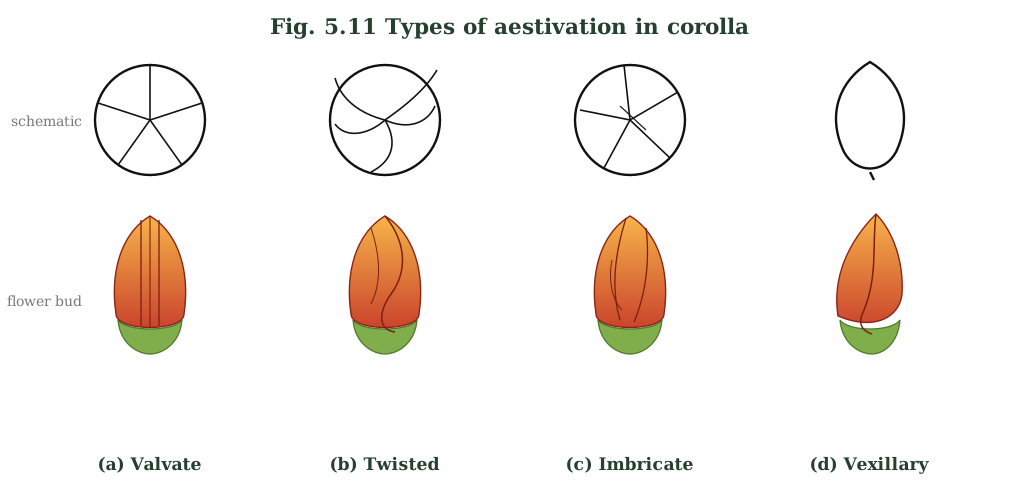
Aestivation: The mode of arrangement of sepals or petals in the floral bud with respect to the other members of the same whorl is known as aestivation. The main types of aestivation are:
- Valvate — when the sepals or petals in a whorl just touch one another at the margin, without overlapping, as in Calotropis.
- Twisted — when one margin of an appendage overlaps that of the next one, and so on, as in china rose, lady's finger and cotton.
- Imbricate — when the margins of the sepals or petals overlap one another but not in any particular direction, as in Cassia and gulmohur. …
Drawn by us to help you understand the concept clearly, and verified to make sure it's accurate. For exams, practice from your textbook's own diagram.
Aestivation is the way sepals or petals are arranged relative to one another in a flower bud, and the figure shows four patterns. In valvate aestivation the parts just meet at their edges without overlapping, as in Calotropis. In twisted aestivation each part overlaps the next in a regular, one-directional way so the whorl looks spirally arranged, as in china rose and lady's finger. In imbricate aestivation the parts overlap but not in any set direction, so the pattern is irregular, as in Cassia and gulmohur. In vexillary or papilionaceous aestivation, seen in the pea and bean family, …