Biology · Ch 11 — Photosynthesis in Higher Plants
Chemiosmotic Hypothesis
Chemiosmotic Hypothesis
Let us try to understand how ATP is actually synthesised in the chloroplast. The chemiosmotic hypothesis has been put forward to explain the mechanism. As in respiration, in photosynthesis too ATP synthesis is linked to the development of a proton gradient across a membrane — this time the membrane of the thylakoid. One important difference is that here the proton accumulation is towards the inside of the membrane, i.e., in the lumen, whereas in respiration protons accumulate in the intermembrane space of the mitochondria.
Three processes cause the proton gradient to develop:
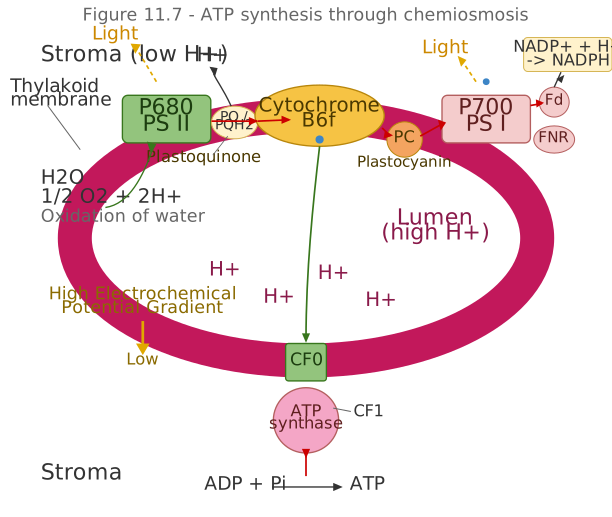
- Splitting of water takes place on the inner side of the membrane, so the protons (H+) produced accumulate within the lumen of the thylakoids.
- As electrons move through the photosystems, the primary electron acceptor, located towards the outer side of the membrane, transfers its electron not to an electron carrier but to an H carrier. This molecule removes a proton from the stroma while transporting the electron, and releases that proton into the lumen side when it passes the electron to the carrier on the inner side.
- The NADP reductase enzyme is located on the stroma side. Reduction of NADP+ to NADPH + H+ uses protons, and these protons too are removed from the stroma.
The combined effect is that protons in the stroma decrease while protons in the lumen accumulate, creating a proton gradient across the thylakoid membrane and a measurable decrease in pH in the lumen.
The gradient matters because its breakdown drives ATP synthesis. Protons move back across the membrane to the stroma through the transmembrane channel of the CF0 part of the ATP synthase. The ATP synthase enzyme has two parts:
- CF0 is embedded in the thylakoid membrane and forms a transmembrane channel that carries out facilitated diffusion of protons across the membrane.
- CF1 protrudes on the outer surface of the thylakoid membrane, on the side that faces the stroma. …
Drawn by us to help you understand the concept clearly, and verified to make sure it's accurate. For exams, practice from your textbook's own diagram.
This figure shows how the thylakoid membrane builds a proton gradient that powers ATP synthesis. On the stroma side (low H+), light drives electrons from P680 of PS II, through plastoquinone, the cytochrome b6f complex and plastocyanin, to P700 of PS I, and finally through Fd and FNR to make NADPH. Splitting of water on the inner face releases O2, H+ and electrons into the lumen. As electrons move, protons are pumped into the lumen, so the lumen becomes rich in H+ (low pH) while the stroma becomes depleted. This high electrochemical gradient drives proton …