Biology · Ch 12 — Respiration in Plants
Tricarboxylic Acid Cycle
Tricarboxylic Acid Cycle
The TCA cycle starts with the condensation of the acetyl group (from acetyl CoA) with oxaloacetic acid (OAA) and water to yield citric acid. The reaction is catalysed by the enzyme citrate synthase, and a molecule of CoA is released. Citrate is then isomerised to isocitrate. This is followed by two successive steps of decarboxylation, leading to the formation of alpha-ketoglutaric acid and then succinyl-CoA.
In the remaining steps of the citric acid cycle, succinyl-CoA is oxidised to OAA, allowing the cycle to continue:
- During the conversion of succinyl-CoA to succinic acid, a molecule of GTP is synthesised. This is a substrate-level phosphorylation. In a coupled reaction GTP is converted to GDP with the simultaneous synthesis of ATP from ADP.
- There are three points in the cycle where NAD+ is reduced to NADH + H+, and one point where FAD+ is reduced to FADH2.
The continued oxidation of acetyl CoA via the TCA cycle requires the continued replenishment of oxaloacetic acid, the first member of the cycle. In addition it also requires the regeneration of NAD+ and FAD+ from NADH and FADH2 respectively. The summary equation for this phase may be written as: Pyruvic acid + 4 NAD+ + FAD+ + 2 H2O + ADP + Pi gives 3 CO2 + 4 NADH + 4 H+ + FADH2 + ATP (in the mitochondrial matrix). …
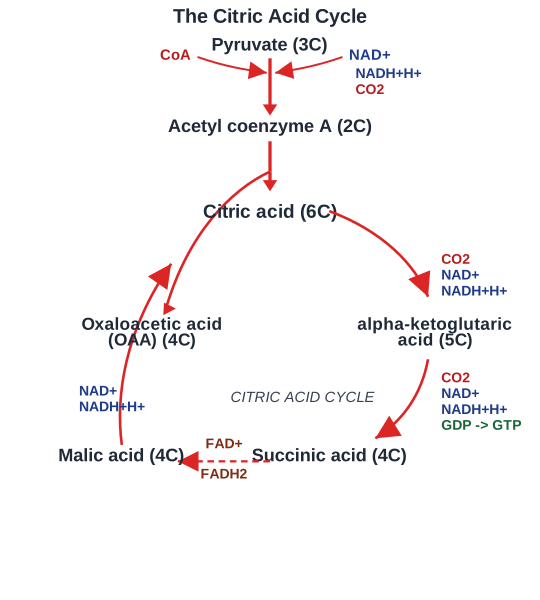
Drawn by us to help you understand the concept clearly, and verified to make sure it's accurate. For exams, practice from your textbook's own diagram.
This figure presents Krebs' cycle, operating in the mitochondrial matrix. Pyruvate (3C) is first oxidatively decarboxylated to acetyl coenzyme A (2C), releasing CO2 and reducing NAD+ to NADH + H+. Acetyl CoA condenses with oxaloacetic acid (4C) to form citric acid (6C). The cycle proceeds through alpha-ketoglutaric acid (5C) and succinic acid (4C), losing two molecules of CO2 at the decarboxylation steps, then through malic acid (4C) back to oxaloacetic acid. Around the cycle, NAD+ is reduced to NADH + H+ at three points and FAD+ to FADH2 at one point, and a molecule of GTP is f …