Chemistry · Ch 9 — Hydrocarbons
Directive Influence of a Functional Group in Monosubstituted Benzene
Directive Influence of a Functional Group in Monosubstituted Benzene
Directive Influence of a Functional Group in Monosubstituted Benzene
When a benzene ring already carries one substituent (a functional group), the position where a second substituent enters is not random. The existing group exerts a directive influence — it determines whether the incoming group goes to the ortho, meta, or para position. This is one of the most practically important ideas in aromatic chemistry because it lets you predict the product of a reaction.
The directing effect depends entirely on the nature of the group already attached. Groups are classified into two broad categories: ortho-para directing (also called activating groups, though not all are activating) and meta directing (also called deactivating groups, though again not all are deactivating).
The directing effect is a property of the substituent, not of the incoming reagent. The same reagent will give different products depending on which group is already on the ring.
Why Does a Group Direct to Specific Positions?
The explanation lies in the electron density distribution of the benzene ring after the first substituent is attached. A substituent can either donate electrons to the ring (increasing electron density) or withdraw electrons from the ring (decreasing electron density). The positions ortho and para to the substituent are affected more strongly than the meta position.
For an electron-donating group, the ortho and para positions become relatively electron-rich (more negative). An electrophile (which seeks electrons) will therefore attack these positions preferentially. For an electron-withdrawing group, the ortho and para positions become relatively electron-deficient (less negative, or even positive). The meta position, being less affected, becomes the most favourable site for electrophilic attack.
This is a kinetic effect — the rate of attack at different positions differs because the stability of the intermediate carbocation (the arenium ion) varies depending on where the electrophile attaches.
Classification of Directing Groups
The textbook presents this classification through a series of properties. Each property is a generalisation supported by experimental observation.
Property (I): Ortho-Para Directing Groups
Groups that direct the incoming substituent to the ortho and para positions are called ortho-para directing groups. These are typically groups that have a lone pair of electrons on the atom directly attached to the benzene ring, or are alkyl groups.
Examples: , , , , , , .
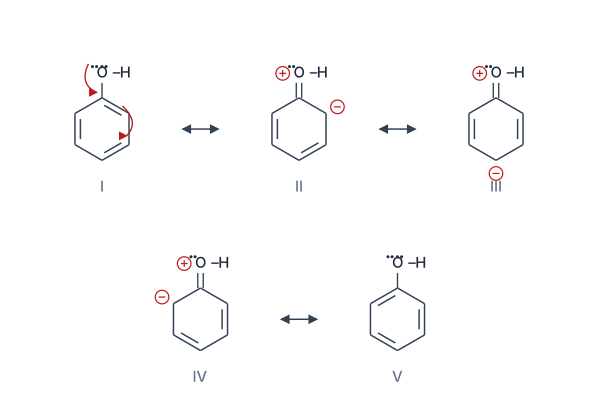
Resonance structures I–V of phenol: the –OH oxygen's lone pair is donated into the ring (curved arrows), and in structures II–IV the resulting negative charge lands on the two ortho carbons and the para carbon. Electron density is therefore highest at ortho and para — which is why –OH is …
Halogens (, , ) are a special case. They are ortho-para directing but they deactivate the ring (make it less reactive than benzene itself). This is because they withdraw electrons inductively (through the sigma bond) but donate electrons through resonance (lone pairs). The resonance effect wins the directing battle, but the inductive effect wins the reactivity battle.
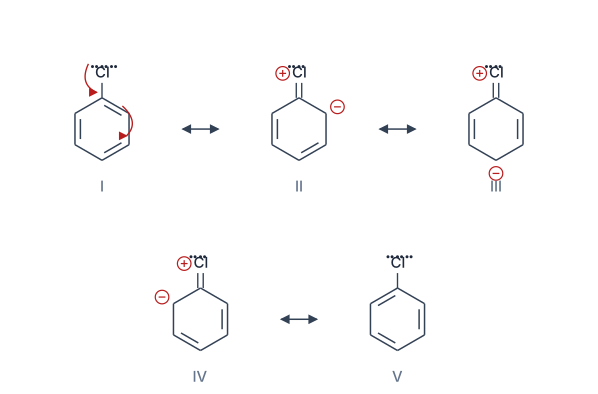
Resonance structures I–V of chlorobenzene: chlorine's lone pairs delocalise into the ring exactly as phenol's oxygen does, raising electron density at ortho and para positions — so halogens direct ortho/para. But chlorine's strong inductive withdrawal lowers the ring's overall electron density, so the ring is deactivated: h …
Property (II): Meta Directing Groups
Groups that direct the incoming substituent to the meta position are called meta directing groups. These are groups that are strongly electron-withdrawing.
Examples: , , , , , .
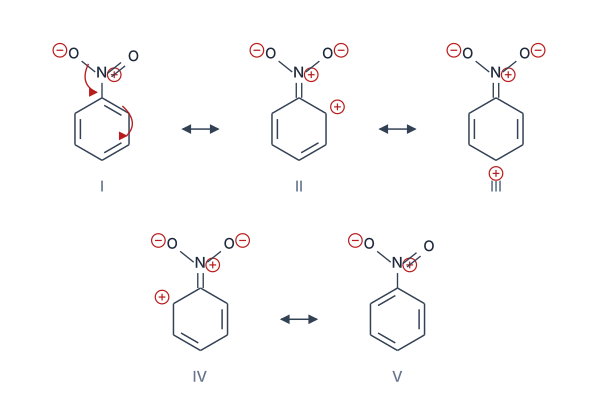
Resonance structures I–V of nitrobenzene: the electron-withdrawing group pulls density out of the ring, and in structures II–IV the resulting POSITIVE charge sits on the ortho and para carbons. The meta position is left comparatively electron-rich, so the electrophile attacks there — the …
A quick way to remember: if the atom attached to the ring has a positive charge, a double bond to a more electronegative atom, or is part of a strongly electron-withdrawing functional group, it is almost certainly meta directing.
The Complete Derivation: Why Ortho-Para vs. Meta?
The textbook proves these directing effects by examining the stability of the intermediate carbocation (arenium ion) formed when an electrophile attacks each possible position. We will do the same.
Consider a monosubstituted benzene with a substituent . An electrophile can attack at three distinct positions: ortho (position 2 or 6), meta (position 3 or 5), or para (position 4).
›Proof
Proof for an ortho-para directing group (e.g., )
When attacks the ortho position, the positive charge in the arenium ion can be delocalised onto the carbon bearing the group. The oxygen's lone pair can then donate into the ring, stabilising the positive charge. The resonance structures include one where the positive charge is directly on the oxygen (which is very stable because oxygen is electronegative and can accommodate the charge).
When attacks the para position, a similar stabilisation occurs — the positive charge can be delocalised onto the carbon bearing , and the oxygen's lone pair again stabilises it.
When attacks the meta position, the positive charge cannot be delocalised onto the carbon bearing . The resonance structures never place the positive charge on that carbon. Therefore, the oxygen's lone pair cannot help stabilise the intermediate.
Result: The ortho and para intermediates are more stable (lower energy) than the meta intermediate. The reaction therefore proceeds faster at ortho and para positions.
Proof for a meta directing group (e.g., )
When attacks the ortho position, one resonance structure places the positive charge directly on the carbon bearing the group. The nitro group is strongly electron-withdrawing — it pulls electron density away, making this structure destabilised (high energy). The positive charge is adjacent to an already electron-deficient centre.
When attacks the para position, the same problem occurs — one resonance structure places the positive charge on the carbon bearing , again destabilising the intermediate.
When attacks the meta position, none of the resonance structures place the positive charge on the carbon bearing . The destabilising effect of the nitro group is avoided.
Result: The meta intermediate is the most stable (least destabilised) of the three. The reaction therefore proceeds preferentially at the meta position.
The directing rule:
The Complete List of Common Directing Groups
The textbook provides a working list. Here it is in full, with the direction and the activation/deactivation effect noted.
| Substituent | Directing Effect | Activating or Deactivating | Notes |
|---|---|---|---|
| Ortho-Para | Strongly activating | Lone pair on oxygen donates strongly | |
| Ortho-Para | Strongly activating | Lone pair on nitrogen donates strongly | |
| Ortho-Para | Activating | Lone pair on oxygen donates | |
| Ortho-Para | Weakly activating | Hyperconjugation and inductive effect | |
| Ortho-Para | Deactivating | Inductive withdrawal > resonance donation for reactivity, but resonance wins for direction | |
| Ortho-Para | Deactivating | Same as chlorine | |
| Ortho-Para | Deactivating | Same as chlorine | |
| Meta | Strongly deactivating | Strong electron withdrawal | |
| Meta | Deactivating | Electron withdrawal | |
| Meta | Deactivating | Electron withdrawal | |
| Meta | Deactivating | Electron withdrawal | |
| Meta | Deactivating | Electron withdrawal | |
| Meta | Deactivating | Strong inductive withdrawal |