Chemistry · Ch 9 — Hydrocarbons
Structure of Double Bond
Structure of Double Bond
The Carbon-Carbon Double Bond: A Sigma-Pi Picture
The carbon-carbon double bond is not simply two identical bonds stacked on top of each other. It is a hybrid structure built from two very different types of bonds: one strong sigma () bond and one weaker pi () bond. Understanding this difference is the key to understanding why alkenes react the way they do.
Each carbon in the double bond is hybridised. This means one orbital and two orbitals mix to form three equivalent hybrid orbitals, which lie in a plane at angles. The remaining unhybridised orbital (the orbital) sticks out perpendicular to this plane.
The sigma bond forms first. It comes from the head-on overlap of one hybrid orbital from each carbon. This overlap is direct, along the internuclear axis, and is therefore strong. Its bond enthalpy is about .
Drawn by us to help you understand the concept clearly, and verified to make sure it's accurate. For exams, practice from your textbook's own diagram.
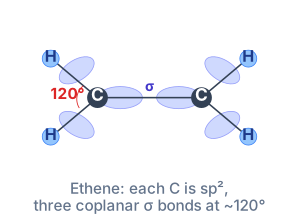
Fig. 9.4 is a schematic orbital diagram of ethene (C₂H₄) that shows only the σ-bond framework — the skeleton of the molecule formed by head-on orbital overlaps. The figure deliberately omits the π bond (which is shown separately in Fig. 9.5) so you can focus on the geometry and hybridisation of the sigma bonds.
Each carbon atom in ethene is hybridised. This means one orbital mixes with two orbitals to produce three equivalent hybrid orbitals that lie in a plane, pointing toward the vertices of an equilateral triangle — separated by . The remaining unhybridised orbital on each carbon sticks out perpendicular to this plane (it will form the π bond later).
In the figure, you see the three hybrid orbitals on each carbon. Two of them overlap head-on with the orbitals of two hydrogen atoms, forming two C–H σ bonds. The third orbital on each carbon overlaps head-on with the corresponding orbital of the other carbon, forming the C–C σ bond. All six atoms — two carbons and four hydrogens — lie in the same plane. The bond angles are close to , and the C–C σ bond length is about (the same as a typical single bond in ethane).
The key physical idea the figure teaches is that the σ bond is strong and localised along the internuclear axis. Because it is formed by direct, head-on overlap, it has high electron density between the nuclei and a bond enthalpy of about for the C–C σ component. The planar geometry is a direct consequence of hybridisation: the three σ bonds around each carbon repel each other to maximise separation, giving the angles.
The σ-bond framework alone does not account for the full double bond. The C=C double bond is shorter () and stronger (total bond enthalpy ) than a single bond because of the additional π bond. The σ bond contributes roughly ; the π bond contributes about .
The textbook develops the following central relationship from this figure:
where (from head-on – overlap) and (from sideways – overlap). The sum, , is the bond enthalpy of the double bond.
The figure also reinforces that the π bond is weaker than the σ bond because sideways overlap is less effective than head-on overlap. This weakness is why alkenes are reactive toward electrophiles: the π electrons are loosely held and easily attacked. …
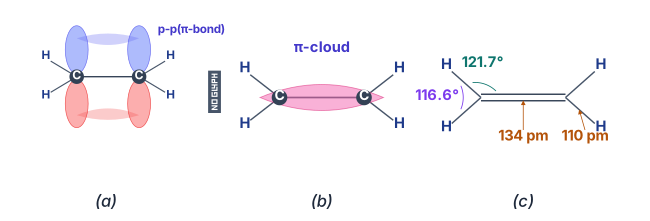
The pi bond is a different story. It forms from the lateral or sideways overlap of the two unhybridised orbitals. These orbitals are parallel to each other, so their overlap occurs above and below the plane of the sigma bond, not directly between the nuclei. This sideways overlap is much less effective than head-on overlap, making the pi bond significantly weaker. Its bond enthalpy is about .
Drawn by us to help you understand the concept clearly, and verified to make sure it's accurate. For exams, practice from your textbook's own diagram.
The figure shows two carbon atoms, each with three hybrid orbitals lying in a plane at angles. On each carbon, one unhybridised orbital sticks out perpendicular to that plane — one lobe above and one below. The two orbitals, one from each carbon, are parallel to each other and aligned so that their lobes overlap sideways, both above and below the plane of the molecule. This sideways overlap creates the bond.
The key physical idea is that a bond is not concentrated along the internuclear axis. Instead, its electron density is distributed in two regions — one above and one below the molecular plane — with a node (zero electron density) exactly in the plane, right along the line joining the two carbon nuclei. This is why the bond is weaker than a bond: sideways overlap is less effective than head-on overlap. The electrons in a bond are also more exposed and more mobile, which is why alkenes are attacked by reagents that seek electrons (electrophiles).
The bond has a nodal plane that contains the bond and both carbon nuclei. Electron density is zero in that plane.
The textbook uses this figure to explain the bond enthalpy data for the double bond. The total bond enthalpy of the C=C double bond in ethene is . This is the sum of the bond enthalpy (about ) and the bond enthalpy (about ). For comparison, a single C–C bond in ethane has a bond enthalpy of only .
The bond alone is weaker than a single bond, but the double bond as a whole is stronger than a single bond. The bond length of the double bond () is also shorter than that of a single bond (), because the sideways overlap pulls the two carbons closer together. …
The total bond enthalpy of the double bond is the sum of its sigma and pi components: . This is greater than the single C–C sigma bond in ethane (), but it is not twice as strong. The pi bond adds only about of extra stability, which is less than the strength of a full sigma bond.
Consequences of the Pi Bond
The presence of this weaker, more exposed pi bond has two immediate consequences.
1. Shorter Bond Length. The double bond is shorter than a single bond. The carbon-carbon double bond length is , while a typical C–C single bond (as in ethane) is . The extra electron density from the pi bond pulls the two carbon nuclei closer together.
2. A Source of Mobile Electrons. The pi electrons are not tightly held between the nuclei. They are delocalised above and below the plane of the molecule, making them relatively loosely held and mobile. This means the double bond is an electron-rich region.
Because the pi bond is a source of loosely held mobile electrons, alkenes are easily attacked by reagents that are in search of electrons. Such reagents are called electrophilic reagents (electron-loving). This is the fundamental reason why alkenes undergo electrophilic addition reactions.