Chemistry · Ch 5 — Thermodynamics
ΔU Measurements
ΔU Measurements
ΔU Measurements
For chemical reactions, the heat absorbed or evolved at constant volume, , is measured using a bomb calorimeter.
Construction and Principle:
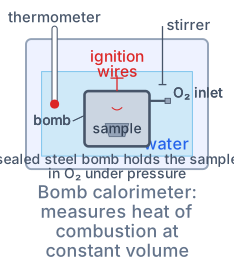
The core of the apparatus is a strong, sealed steel vessel called the "bomb." This bomb is placed inside a larger, insulated container filled with a known mass of water. The entire assembly (bomb + water + container) is the calorimeter. The reaction mixture (e.g., a combustible substance and excess pure oxygen) is placed inside the bomb. The reaction is initiated electrically.
Because the bomb is sealed, its volume cannot change. Therefore, the reaction occurs at constant volume. Under these conditions, no pressure-volume work is done (). From the first law of thermodynamics:
Therefore, the heat measured at constant volume is equal to the change in internal energy of the reaction.
The Measurement Process:
The heat released (or absorbed) by the reaction changes the temperature of the entire calorimeter assembly. The temperature change () is measured precisely. The total heat capacity of the calorimeter () is known (it is determined in a separate calibration experiment). The heat gained by the calorimeter is .
Since the calorimeter is perfectly insulated (adiabatic), the heat lost by the reaction system is exactly equal to the heat gained by the calorimeter, but with the opposite sign.
…
Drawn by us to help you understand the concept clearly, and verified to make sure it's accurate. For exams, practice from your textbook's own diagram.
The bomb calorimeter is a constant-volume device used to measure the heat released or absorbed during a combustion reaction. The figure shows a cross-section of the apparatus: a thick-walled steel container called the bomb sits submerged in a water bath. Inside the bomb, a small crucible holds the sample. Two firing leads connect to an ignition wire that touches the sample, and an oxygen inlet valve allows pure oxygen to be pumped in under high pressure. The bomb is sealed tight, so the reaction occurs at constant volume.
Outside the bomb, the water bath is equipped with a stirrer (to keep the water temperature uniform) and a thermometer (to measure temperature changes with high precision). The entire assembly is insulated from the surroundings — typically by an outer jacket of water or air — so that no heat escapes. When the sample is ignited electrically, it burns in the oxygen atmosphere. The heat released warms the bomb, which in turn warms the surrounding water. By measuring the rise in water temperature, and knowing the heat capacity of the calorimeter (the bomb + water + stirrer + thermometer), we can calculate the total heat evolved.
Because the reaction happens at constant volume, the heat measured equals the change in internal energy, , not the enthalpy change . The first law for a constant-volume process (no work) gives .
The key formula the textbook develops from this figure is:
Here:
- is the heat exchanged at constant volume (in joules or kilojoules).
- is the heat capacity of the calorimeter — the total heat required to raise the temperature of the entire assembly (bomb + water + stirrer + thermometer) by 1 K. It is determined beforehand by burning a standard substance (like benzoic acid) with a known heat of combustion.
- is the measured temperature change of the water bath (final minus initial).
For a combustion reaction, the heat released is negative (exothermic), so and . If you need the enthalpy change , you can convert using , where is the change in the number of moles of gas during the reaction. …