Mathematics · Ch 6 — Permutations and Combinations
Fundamental Principle of Counting
Fundamental Principle of Counting
6.2 Fundamental Principle of Counting
The Core Idea: Why Multiplication, Not Addition
Consider a simple wardrobe problem. Mohan has 3 pants and 2 shirts. How many different pant-shirt combinations can he wear?
You could pick any of the 3 pants. For each pant you choose, there are 2 possible shirts. So the total number of outfits is .
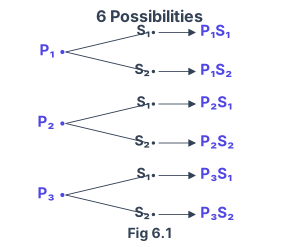
Why multiply and not add? Because the choices happen in sequence — first choose a pant, then choose a shirt — and every choice of pant pairs with every choice of shirt. If you named the pants and the shirts , the six possibilities are:
This is the essence of the multiplication principle.
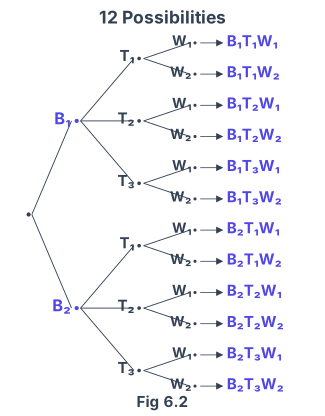
Now take a slightly bigger problem. Sabnam has 2 school bags, 3 tiffin boxes, and 2 water bottles. She needs to carry one of each. First choose a bag: 2 ways. For each bag, choose a tiffin box: 3 ways. That gives bag-tiffin pairs. For each such pair, choose a water bottle: 2 ways. Total: ways.
The order of choosing matters only in the sense that we fix a sequence. We could choose the water bottle first, then the bag, then the tiffin box — the product would still be . The multiplication principle works for any chosen order, as long as we count the number of ways at each step correctly.
The Multiplication Principle (Fundamental Principle of Counting)
This principle extends to any finite number of events. For three events:
…
Drawn by us to help you understand the concept clearly, and verified to make sure it's accurate. For exams, practice from your textbook's own diagram.
Fig. 6.1 is a tree diagram that visualises the multiplication principle — the core idea of this chapter. The tree is drawn left to right, with three pant nodes () stacked vertically on the left. From each pant node, two branches spread out to shirt nodes (). Every shirt node then has a horizontal arrow pointing to an outcome label: , , , , , . There are exactly six leaves, one for each possible pair.
The physical idea is simple but powerful: when you have a sequence of choices, the total number of combinations is the product of the number of options at each step. Here, choosing a pant (3 ways) and then a shirt (2 ways) gives distinct outfits. The tree makes this visible — each path from left to right is one complete choice, and the number of leaves equals the product.
This is the fundamental principle of counting (also called the multiplication principle): if one event can happen in ways and, after that, another event can happen in ways, then the two events together can happen in ways. The tree shows exactly why: for each of the 3 pants, there are 2 shirts, so you count — but that's just . …
Drawn by us to help you understand the concept clearly, and verified to make sure it's accurate. For exams, practice from your textbook's own diagram.
Fig. 6.2 is a tree diagram that visualises the multiplication principle in action. At the far left is a single starting point — the root. From it, two branches spread out, each labelled with a school bag: and . These are the two choices for the first event (choosing a bag). From each bag node, three further branches go to tiffin boxes , , — that’s the second event, with 3 choices. And from each tiffin node, two final branches lead to water bottles and , the third event with 2 choices.
Every path from the root to a leaf traces one complete combination: bag, then tiffin, then bottle. The leaves themselves are labelled with the full triple, like or . There are 12 leaves in total — one for each distinct way Sabnam can carry one bag, one tiffin box, and one water bottle. The horizontal arrows from each leaf to its outcome label make it clear that each leaf corresponds to a specific, finished choice.
The physical idea is simple but powerful: when you make a sequence of choices, the total number of possible outcomes is the product of the number of options at each step. The tree makes this visible — the number of leaves equals . You can see that for every bag, there are 3 tiffin choices, and for every bag–tiffin pair, there are 2 bottle choices. The tree’s branching structure is the multiplication principle drawn out.
…