Q.Let be the set of real numbers. Define the real function by and sketch the graph of this function.
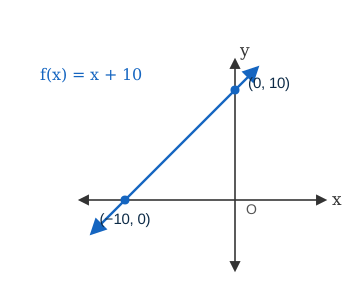
A linear function with slope and -intercept produces a straight line through and , rising at to the horizontal.
Understanding Linear Functions
The function is a linear function, the simplest non-constant type you'll encounter. Every linear function has the form , where is the slope (how steeply the line rises or falls) and is the -intercept (where the line crosses the vertical axis).
Here and . A slope of means that for every unit you move right, the function value increases by exactly one unit—the line rises at a angle. The -intercept of tells us the line passes through the point .
Because this is a polynomial of degree one, its graph is a straight line extending infinitely in both directions. No curves, no bends—just a single, unchanging direction.
Constructing the Graph
To sketch any line, you need only two points (though a third serves as a useful check).
- Find the -intercept. Set :
Plot the point .
- Find the -intercept. Set and solve for :
Plot the point .
- Check with a third point (optional but reassuring). Choose :
Plot .
- Draw the line. Connect the points with a straight edge, extending the line in both directions with arrows to indicate it continues indefinitely.
For any line , the intercepts are immediate: -intercept at and -intercept at (provided ).
Key Features
| Feature | Value |
|---|---|
| Slope | |
| -intercept | |
| -intercept | |
| Domain | |
| Range | |
| Increasing/Decreasing | Strictly increasing |
The function is one-to-one (injective) and onto (surjective) from to , so it has an inverse: .
The Sketch
Plotting the three points found above — , , and — and drawing a straight edge through them gives a line that crosses the -axis at , crosses the -axis at , and continues rising steadily to the right at a constant slope, with arrows on both ends showing it extends infinitely in both directions.
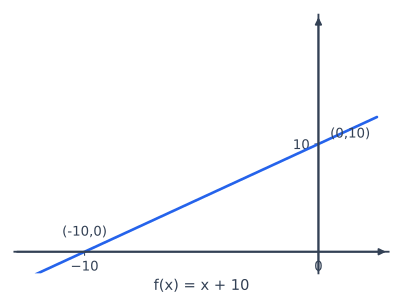
The graph of is a straight line with slope , passing through and , extending infinitely in both directions.
Unlock everything free for 14 days
- Full step-by-step solutions
- Concept-first explanations
- Methods, shortcuts & mistakes
- PYQ mapping + timed mock tests
Full access for 14 days. No credit card required.