Physics · Ch 14 — Waves
The Principle of Superposition of Waves
The Principle of Superposition of Waves
The Principle of Superposition of Waves
When two or more waves travel through the same medium at the same time, the displacement of any particle of the medium is the vector sum of the displacements that the individual waves would produce independently. This is the principle of superposition of waves.
It is the single most important idea in wave physics. Without it, we could not explain interference, beats, or standing waves. The principle holds for all linear wave equations — which means it works for waves on strings, sound waves in air, and light waves in vacuum, as long as the amplitudes are not so large that the medium behaves nonlinearly.
The principle works because the wave equation is linear: if and are solutions, then is also a solution. This linearity is what makes superposition possible.
Mathematically, if two waves produce displacements and at the same point, the resultant displacement is
This is a vector sum — if the displacements are along different directions, you must add them as vectors. In most textbook problems, the waves are polarised in the same plane (e.g., both transverse on a string), so the addition reduces to simple algebraic addition with appropriate signs.
Superposition of Two Sinusoidal Waves Travelling in the Same Direction
Consider two waves of the same frequency and wavelength, travelling along the direction. Let them have the same angular frequency and the same wave number , but different amplitudes and , and different initial phases and :
By the superposition principle, the resultant wave is
Because the two waves have different amplitudes, we combine them with the phasor method. Writing and , the sum is itself a sine wave of the same frequency and wavelength:
where the resultant amplitude and phase are given by
and
This is the standard result for the superposition of two sinusoidal waves of the same frequency and wavelength.
The phase difference determines everything.
Special Cases
Case 1: Constructive Interference
When (i.e., ), the waves are in phase. Then
The amplitudes add directly. The resultant wave has the maximum possible amplitude.
Case 2: Destructive Interference
When (i.e., ), the waves are out of phase. Then
The amplitudes subtract. If , the resultant amplitude is zero — complete cancellation.
Do not confuse phase difference with path difference. For waves from two sources, a path difference corresponds to a phase difference only if the sources are in phase. If the sources themselves have an initial phase difference, that must be added.
Superposition of Two Sinusoidal Waves Travelling in Opposite Directions
Now consider two waves of the same amplitude, frequency, and wavelength, but travelling in opposite directions:
The first travels to the right, the second to the left. Their superposition gives
Use the identity :
So
This is not a travelling wave. It is a standing wave (or stationary wave). Every particle of the medium oscillates with the same frequency , but the amplitude depends on position.
A standing wave does not transfer energy. The energy is stored in the oscillations and does not propagate.
The points where are called nodes — they never move. The points where are antinodes — they oscillate with maximum amplitude .
Properties of Standing Waves
The textbook lists the following properties. Each is derived from the equation .
Property 1: The amplitude of oscillation varies sinusoidally with position.
At a fixed , the particle executes simple harmonic motion of amplitude . This amplitude is zero at nodes and maximum at antinodes.
Property 2: Nodes and antinodes are equally spaced.
Nodes occur when , i.e., , or , where .
Antinodes occur when , i.e., , or .
The distance between successive nodes (or successive antinodes) is . The distance between a node and the next antinode is .
Property 3: All particles between two successive nodes oscillate in phase.
Between and , has the same sign. Therefore, the factor does not change sign, so all particles in that segment reach their maximum displacement at the same time. Particles on opposite sides of a node oscillate in opposite phase (their displacements are opposite at any instant).
Property 4: The wave does not travel — it is stationary. …
Drawn by us to help you understand the concept clearly, and verified to make sure it's accurate. For exams, practice from your textbook's own diagram.
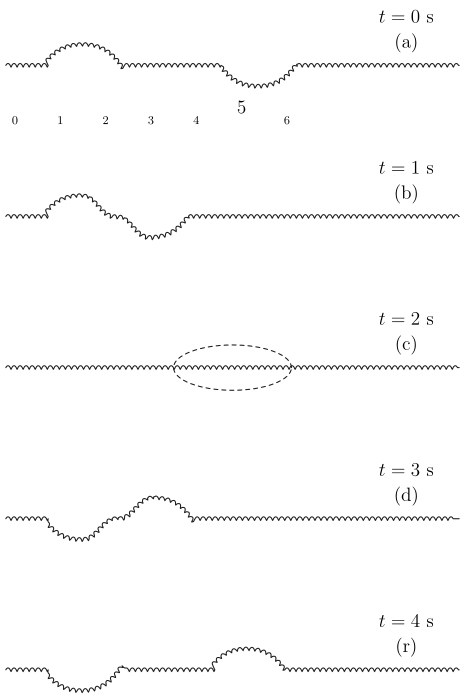
The figure shows five snapshots of a string taken at one-second intervals, from s to s. Each snapshot is a separate horizontal panel stacked vertically, with time increasing upward. The horizontal axis in each panel is position along the string, marked from 0 to 6 units (the scale is shown only under the bottom panel). The vertical axis in each panel is the displacement of the string from its equilibrium (the flat, undisturbed line).
At s, two pulses are far apart on the string. One is an upward pulse (positive displacement) located near the left end; the other is a downward pulse (negative displacement) of the same shape and size, located near the right end. They are moving toward each other. By s, the pulses have moved closer, their leading edges beginning to overlap. At s, the pulses are exactly on top of each other. Because one pulse is upward and the other is downward, and they have equal magnitudes, their displacements add to zero at every point along the string — the snapshot at s shows a perfectly flat line. After s, the pulses continue moving past each other. At s, they have partially separated: the upward pulse is now on the right side and the downward pulse on the left side. At s, the pulses have fully emerged on swapped sides — the upward pulse is at the right end and the downward pulse at the left end, each with the same shape they started with.
The physical idea is the principle of superposition: when two or more waves overlap in the same medium, the net displacement at any point is the algebraic sum of the individual displacements. The figure demonstrates this for two pulses of equal amplitude but opposite sign. During overlap, they cancel exactly — a phenomenon called destructive interference. After they pass through each other, each pulse continues unchanged, as if the other had never been there. This is not a collision of objects; it is the linear addition of disturbances.
The key formula the textbook develops from this figure is the superposition principle itself. For two waves and traveling on the same string, the resultant displacement is:
Here, is the net displacement of the string at position and time . and are the displacements that would be produced by each wave alone. The formula holds for any linear medium — one where the restoring force is proportional to displacement (Hooke's law), which is true for small-amplitude waves on a string.
The superposition principle applies only when the waves are linear — that is, when the wave equation is linear. For very large amplitudes, or in nonlinear media, waves do not simply add. In all standard Class 11 problems, you assume linearity. …
Drawn by us to help you understand the concept clearly, and verified to make sure it's accurate. For exams, practice from your textbook's own diagram.
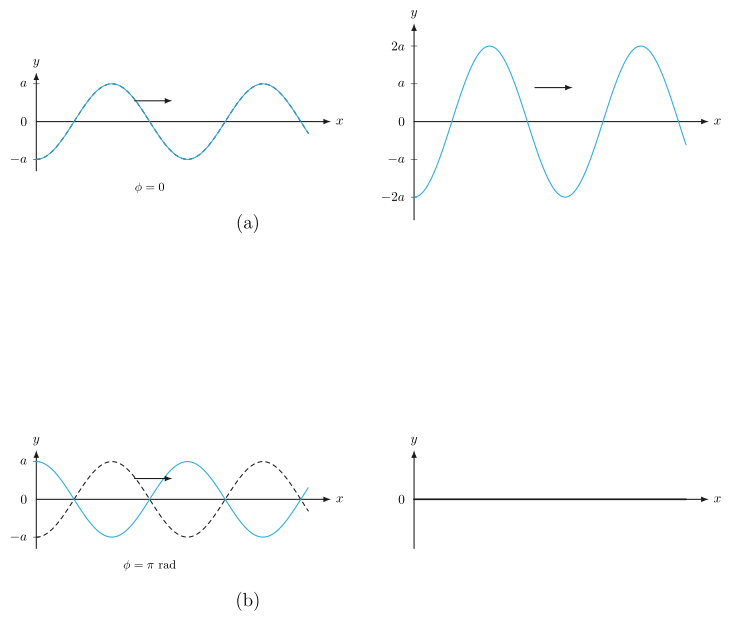
Fig. 14.10 is a superposition diagram built from two rows, (a) and (b). Each row shows three curves drawn on the same set of – axes: the -axis is the position along the wave (the direction of propagation, marked by a rightward arrow), and the -axis is the displacement of the medium. The three curves in each row are the two individual waves (drawn as thin lines, each of amplitude ) and their sum (drawn as a thicker line). The figure’s purpose is to show how the phase difference between two identical harmonic waves determines the amplitude of the resultant wave.
In row (a), the two waves are exactly in phase — their crests and troughs line up perfectly. The phase difference is . At every point , the displacements of the two waves are equal and have the same sign, so they add constructively. The resultant wave (the thick curve) has the same wavelength and shape as the individual waves, but its amplitude is — twice that of either original wave. The peaks are twice as high, the troughs twice as deep.
In row (b), the two waves are exactly out of phase — a crest of one coincides with a trough of the other. The phase difference is (or ). At every point , the displacements are equal in magnitude but opposite in sign, so they cancel exactly. The resultant wave is a flat line along the -axis: its amplitude is zero. This is perfect destructive interference.
The figure teaches the core idea of superposition: when two waves overlap, the net displacement at any point is the algebraic sum of the individual displacements. The outcome depends critically on the phase difference .
The textbook develops the general formula for the superposition of two harmonic waves of equal amplitude , angular frequency , wave number , and a phase difference :
Using the trigonometric identity , the resultant displacement is:
Here:
- is the amplitude of each individual wave.
- is the phase difference between the two waves.
- is the phase of the first wave; the resultant wave has a phase shift of .
- The factor is the resultant amplitude . …