Q.Two identical ball bearings, labelled 2 and 3, are in contact with each other and rest on a smooth (frictionless) table. A third identical ball bearing, labelled 1, of the same mass moves along the line of centres and strikes them head-on with speed . Assuming the collision is elastic, which of the listed outcomes is a physically possible result after the collision?
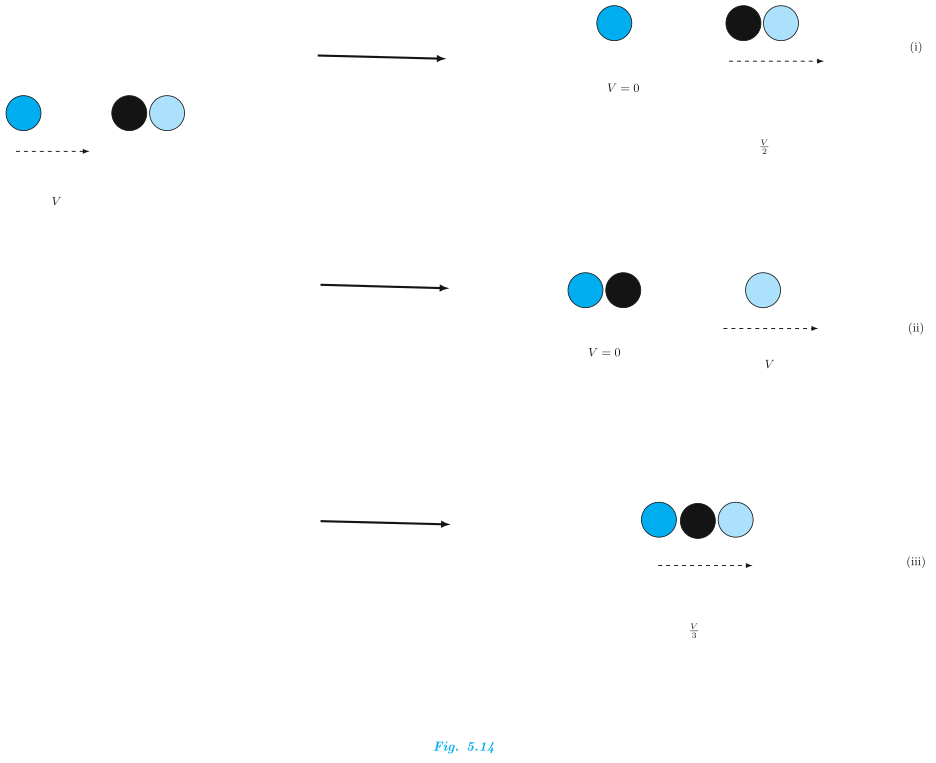
(B) Balls 1 and 2 both come to rest and ball 3 moves off with speed .
(C) All three balls move off together with a common speed .
You're viewing a preview — the full solution, concept, methods & PYQ mapping are locked.
Start your 14-day free trial to unlock the full solution →An elastic collision must conserve BOTH momentum and kinetic energy. All three outcomes conserve the momentum , but only the one where balls 1 and 2 stop and ball 3 leaves with speed also conserves kinetic energy. So option B is the only possible result.
Concept and conditions
Let each ball have mass . Before impact only ball 1 moves, so
An elastic collision requires both
Testing each outcome
Option A -- 1 stops, 2 and 3 move with : momentum (ok), but -- kinetic energy is halved, so this is not elastic.
Option B -- 1 and 2 stop, 3 moves with : momentum (ok), and (ok) -- both conserved, so this is possible.
Option C -- all three move with : momentum (ok), but -- energy is lost, so not elastic. …
Unlock everything free for 14 days
- Full step-by-step solutions
- Concept-first explanations
- Methods, shortcuts & mistakes
- PYQ mapping + timed mock tests
Full access for 14 days. No credit card required.