Q.Explain any two steps of control process.
🔒You're viewing a preview — the full solution, concept, methods & PYQ mapping are locked.
🔒 Start your 14-day free trial to unlock the full solution →Concept understanding — Performance Measurement Standards
Performance Measurement Standards — First Principles
Imagine you're training for a 100-metre sprint. You time yourself every day. One day you run it in 12 seconds, the next in 11.8, then 11.5. You're getting faster — but how much faster? And is 11.5 seconds good?
To answer that, you need a standard — a fixed reference point. Maybe the national record is 10.2 seconds. Maybe your personal best last month was 12.1 seconds. These are standards: they let you compare your performance against something meaningful.
Now replace "sprint" with "a mutual fund" or "a stock portfolio." The same logic applies. You need a benchmark to judge whether the investment is doing well or poorly.
The Intuition
A Performance Measurement Standard is simply a yardstick. It answers the question: "Compared to what?"
Without a standard, a 15% return sounds fantastic. But if the overall market returned 20% in the same period, that 15% is actually a failure — you lost ground relative to the market. Conversely, a 5% return sounds terrible, but if the market fell 10%, you've outperformed.
The standard gives context. It separates absolute performance (raw numbers) from relative performance (how you did versus a benchmark).
The Precise Statement
Performance Measurement Standard: A predetermined benchmark (index, peer group, or absolute target) used to evaluate the return and risk of an investment portfolio or fund manager over a specific period.
In finance and investing, the most common standards are:
| Standard Type | Example | What It Tells You |
|---|---|---|
| Market Index | Nifty 50, S&P 500, BSE Sensex | How the portfolio performed relative to the broad market |
| Peer Group Average | Average return of all large-cap mutual funds | How the fund performed relative to similar funds |
| Absolute Target | 8% annual return, or inflation + 3% | Whether the fund met a fixed goal (often used for pension funds) |
| Risk-Adjusted Standard | Sharpe ratio, Treynor ratio | How much return the fund generated per unit of risk taken |
Why This Matters (Exam-Ready)
A performance measurement standard is not the same as a performance measure. The standard is the benchmark; the measure is the calculation (e.g., return percentage). You need both: a measure without a standard is meaningless.
Common exam trap: Students confuse "performance measurement" (calculating returns) with "performance measurement standards" (the benchmark used for comparison). They are related but distinct.
A Concrete Example
Suppose Fund A returned 12% last year. The Nifty 50 returned 10%. The average large-cap fund returned 11%.
- Absolute standard: 12% > 0% → good
- Market index standard: 12% > 10% → outperformed the market
- Peer group standard: 12% > 11% → beat the average peer
Now suppose Fund B returned 8% last year. The Nifty fell 5%. The average peer returned 6%. …
The control process includes several steps; two of them are setting performance standards and measuring actual performance against those standards. …
Two steps of the control process are setting performance standards and measuring actual performance.
Controlling is a step-by-step process. Two of its steps are:
- Setting Performance Standards — The manager first lays down the standards — the criteria or targets against which performance is to be measured. Standards should be as measurable as possible (e.g., units produced, cost, time) but may be qualitative (e.g., goodwill, morale). …
Showing the 12 most recent of 15 on this concept.
- CBSE 2026Set ANNUAL1 markMCQQ.Reducing the workers’ absenteeism in a firm by 20% is an example of ________. (A) Deviation (B) Corrective action (C) Qualitative standard (D) Quantitative standard
›Reveal solutionSolution
"Reduce absenteeism by 20%" is a standard expressed in numbers, i.e. a quantitative standard — one of the two broad types of standards set in the controlling process.
Step in the controlling process this relates to: Setting performance standards is the first step of the control process; standards act as the criteria against which actual performance is later measured.
Qualitative vs quantitative standards
Type Meaning Example Qualitative standard Standards that are difficult to express in numbers (judged subjectively) Improving employee morale, enhancing goodwill Quantitative standard Standards expressed in measurable, numerical terms Reducing absenteeism by 20%, increasing sales by Rs 5 lakh, cutting production cost by 10% … - CBSE 2026Set ANNUAL1 markMCQQ.When mismatch between plan and actual performance is due to overstating or understating of plan then it is called(a) strategic control(b) operational control(c) Both(a) and(b)(d) None of the above
›Reveal solutionSolution
A mismatch between plan and actual performance caused by an inaccurate plan (over/understated) is addressed through strategic control.
In controlling, it's useful to distinguish:
- Operational control — focuses on monitoring day-to-day operational tasks and processes against short-term standards (e.g., daily production targets, budgets) to ensure they are executed as planned.
- Strategic control — monitors whether the organisation's broader strategies/plans themselves (goals, forecasts, assumptions about markets, demand etc.) are valid and on track; it questions whether the plan/premise itself was realistic.
If a mismatch between plan and actual results happens because execution was poor (e.g., machines broke down, workers underperformed), that is an operational control issue. But if the mismatch is because the plan/target was itself set wrong — overstated (too ambitious/unrealistic) or understated (too conservative) — the root problem is in the planning/strategy stage, which strategic control is meant to catch and correct, by revisiting the assumptions behind the plan.
…
- CBSE 2026Set ANNUAL1 markMCQQ.Which step in the controlling process focuses on key result areas which are critical to the success of an organisation ?(a) Setting performance standards(b) Measurement of actual performance(c) Comparing actual performance with standards(d) Analysing deviations
›Reveal solutionSolution
The step is Setting performance standards.
The controlling process has four steps:
- Setting performance standards — benchmarks against which actual performance will be compared; good practice converts broad objectives into specific Key Result Areas (KRAs), i.e., the areas most critical to the organisation's success, so that control effort is focused where it matters most.
- Measurement of actual performance — objectively and reliably recording what was actually achieved.
- Comparing actual performance with standards — finding the deviation, if any. …
- CBSE 2025Set MARCH1 markQ.Complete the series : (Identify the missing steps(a) and(b) in the controlling process cycle shown in the diagram.) 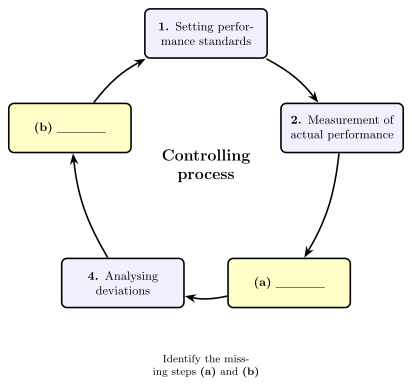
›Reveal solutionSolution
The controlling process has five steps. Since the exact diagram is not provided here, the standard steps are given honestly: the two most commonly-blanked steps (a) and (b) are Comparing actual performance with the standards and Taking corrective action.
Note on the figure: the original question refers to a diagram of the controlling cycle that is not supplied to us, so rather than invent a specific figure we answer with the standard controlling process taught in Kerala Plus Two Business Studies. The five steps, in order, are:
- Setting performance standards — deciding the benchmarks against which performance is judged.
- Measurement of actual performance — measuring performance in an objective and reliable manner.
- Comparing actual performance with standards — finding the deviation between actual and standard.
- Analysing deviations — using critical point control and management by exception to focus on significant deviations and find their causes. …
- CBSE 2025Set MARCH1 markMCQQ.The first step in controlling process is __________.(a) Measurement of actual performance(b) Setting Performance Standards(c) Analysing deviations(d) Taking corrective actions
›Reveal solutionSolution
The correct answer is (b) Setting Performance Standards — the first step of the controlling process.
…
- CBSE 2025Set ANNUAL1 markMCQQ.The first step of control process is - A) Corrective action B) Measure of actual performance C) Analysing deviations D) Establishment of performance standard
›Reveal solutionSolution
The control process begins with establishing performance standards.
The controlling function follows the sequence: (1) setting performance standards, (2) measuring actual performance, (3) comparing actual with standards and analysing deviations, and (4) taking corrective action. Standards are the benchmark against which everything else is judged, so they must be fixed first.
…
- CBSE 2025Set ANNUAL1 markQ.Answer in one word/sentence: The first step of controlling process is -
›Reveal solutionSolution
The first step of controlling is setting standards.
The controlling process starts by setting performance standards — the targets or benchmarks (quantitative or qualitative) against which actual performance will later be compared. Only after standards are set can performance be measur …
- CBSE 2025Set ANNUAL1 markQ.With whom actual performance is compared in controlling function?
›Reveal solutionSolution
Actual performance is compared against predetermined standards — the targets or benchmarks fixed in advance, usually during the planning process.
Controlling is the management function of ensuring that activities in an organisation are performed as per the plans. Its first and most basic step is setting performance standards — these may be quantitative (sales targets, production units, cost figures, profit margins) or qualitative (customer satisfaction, employee morale). Once work is carried out, the manager measures the actual performance achieved and compares it against these predetermined standards. Any gap between the two is a "deviation," which the manager then analyses for its cause and significance, and corrects through appropriate action.
…
- CBSE 2024Set MARCH1 markMCQQ.The last step in controlling function is :(a) Taking corrective action(b) Taking disciplinary action(c) Assessing the standards of performance(d) Assessing the business environment
›Reveal solutionSolution
The correct option is (a) Taking corrective action. The controlling function runs through: setting standards → measuring actual performance → comparing performance with standards → analysing deviations → taking corrective action, so corrective action is the last step.
In the Kerala Plus Two (DHSE) Controlling chapter, the steps in the controlling process are:
- Setting performance standards.
- Measurement of actual performance.
- Comparison of actual performance with standards.
- Analysing deviations (and applying management by exception / critical point control). …
- CBSE 2024Set ANNUAL1 markMCQQ.Which standard is associated with production?(a) Flow of cash(b) Volume of sales(c) Labour turnover(d) Quantity and quality
›Reveal solutionSolution
The standard associated with production is quantity and quality of output.
Setting performance standards is the first step of the controlling process, and standards are set in terms that are relevant to the function being measured. For production, the natural standards are the quantity of goods to be produced in a period and the quality level they must meet. The other options given relate to different functions: flow of cash is a standard for the finance function, volume of sales is a standard for the marketing f …
- CBSE 2023Set ANNUAL1 markMCQQ.Control is related to (A) Result (B) Function (C) Effort (D) None of these
›Reveal solutionSolution
The correct option is (A) Result, because controlling measures and evaluates actual results against predetermined standards.
Controlling is the function that checks whether actual performance matches the planned standards. It measures the results achieved, compares them with the standards set during planning, and takes corrective action on any deviation. Since the whole exercise centres on evaluating outcomes, control is said to be related to results.
…
- CBSE 2023Set ANNUAL1 markQ.Answer in one word/sentence: What is the first step of controlling?
›Reveal solutionSolution
The first step of controlling is setting standards.
The controlling process starts by setting performance standards — the targets or benchmarks (quantitative or qualitative) against which actual performance will later be compared. Only after standards are set can performance be measur …
🎓Unlock everything free for 14 days
- ✓Full step-by-step solutions
- ✓Concept-first explanations
- ✓Methods, shortcuts & mistakes
- ✓PYQ mapping + timed mock tests
Full access for 14 days. No credit card required.