Business Studies · Ch 2 — Principles of Management
Fayol’s Principles of Management
Fayol’s Principles of Management
Henri Fayol (1841–1925) was a French mining engineer and management theorist. While F.W. Taylor focused on improving the efficiency of workers on the shop floor, Fayol turned his attention to the work of managers themselves. He was the first to identify the functions of management — planning, organising, commanding, coordinating and controlling — and argued that managerial efficiency was just as important as worker efficiency. Based largely on his own experience as a managing director, he developed a set of 14 principles of management, published in his 1917 book Administration industrielle et générale (translated into English in 1949 as General and Industrial Management). These principles are considered a foundational part of classical management theory, and for this contribution Fayol is known as the ‘Father of General Management’.
Fayol believed that the number of useful management principles is potentially limitless. The 14 he proposed are discussed below.
The 14 Principles of Management
1. Division of Work
Work is divided into small tasks or jobs, each performed by a trained specialist. This leads to specialisation. Fayol stated: “The intent of division of work is to produce more and better work for the same effort. Specialisation is the most efficient way to use human effort.” In practice, a company has separate departments for finance, marketing, production and human resources, each staffed by specialists. This principle applies to all kinds of work — technical as well as managerial — and can be observed in any organisation, from a hospital to a government office.
2. Authority and Responsibility
Authority is the right to give orders and obtain obedience. Responsibility is the corollary of authority — meaning that whoever has authority must also be held accountable for its use. Fayol distinguished two types of authority: official authority (the authority to command, derived from one’s position) and personal authority (the authority of the individual manager). Authority is both formal and informal. There must be a balance between authority and responsibility; a manager should have enough authority to carry out her responsibility, and the organisation must build safeguards against abuse of power.
A sales manager is responsible for clinching a deal worth Rs 50 crore net margin. She finds that offering a 60-day credit period would seal the deal, but the company has only given her the authority to offer 40 days. This is an imbalance between authority and responsibility.
3. Discipline
Discipline means obedience to organisational rules and the terms of the employment agreement. Fayol said that discipline requires good superiors at all levels, clear and fair agreements, and the judicious application of penalties when rules are broken. For example, if workers and management have agreed that workers will put in extra hours without extra pay to revive a loss-making company, and management has promised to raise wages once the mission is accomplished, then discipline means both sides honour their commitments without prejudice.
4. Unity of Command
Every employee should receive orders from and be responsible to only one superior. If an employee gets orders from two superiors at the same time, the principle of unity of command is violated. Fayol gave great importance to this principle, warning that if it is violated, “authority is undermined, discipline is in jeopardy, order disturbed and stability threatened.” Dual subordination must be avoided to prevent confusion about tasks.
Suppose a salesperson is told by the marketing manager to offer a 10% discount to clinch a deal, but the finance department tells her not to offer more than 5%. This violates unity of command. Coordination between departments is needed to prevent such situations.
5. Unity of Direction
All units of an organisation should be moving towards the same objectives through coordinated and focused efforts. Each group of activities having the same objective must have one head and one plan. This ensures unity of action and coordination. For example, if a company manufactures both motorcycles and cars, it should have two separate divisions, each with its own in-charge, plans and resources. The working of the two divisions should not overlap.
Unity of command is about an individual employee reporting to one boss. Unity of direction is about the entire organisation having one plan and one head for each set of activities with the same objective. Unity of command affects individual employees; unity of direction affects the whole organisation.
6. Subordination of Individual Interest to General Interest
The interests of the organisation as a whole should take priority over the interests of any one individual employee. Every worker has personal interests (e.g., wanting maximum salary for minimum work), and the company has its own objectives (e.g., getting maximum output at competitive cost). In any conflict, the larger interests of the group — including owners, shareholders, creditors, customers and society — must prevail over the interest of any one person or small group. A manager can ensure this by her own exemplary behaviour, never misusing her powers for personal or family benefit at the cost of the company.
7. Remuneration of Employees
The overall pay and compensation should be fair to both employees and the organisation. Employees should be paid fair wages that give them at least a reasonable standard of living, but the amount should also be within the paying capacity of the company. Remuneration should be just and equitable. This ensures a congenial atmosphere and good relations between workers and management.
8. Centralisation and Decentralisation
Centralisation means the concentration of decision-making authority in the hands of a few people at the top. Decentralisation means the dispersal of that authority among more than one person or level. Fayol said there is a need to balance subordinate involvement (through decentralisation) with managers’ retention of final authority (through centralisation). The degree of centralisation depends on the circumstances of the company. In general, large organisations have more decentralisation than small ones.
In India, panchayats have been given more powers to decide and spend funds granted by the government for village welfare. This is an example of decentralisation at the national level.
9. Scalar Chain
The formal lines of authority from the highest to the lowest ranks in an organisation are called the scalar chain. According to Fayol, organisations should have a chain of authority and communication that runs from top to bottom, and it should be followed by managers and subordinates. In normal circumstances, communication should travel up and down this chain. However, if there is an emergency, employees at the same level can communicate directly using a ‘gang plank’ — a shorter route that avoids delay.
In the scalar chain A–B–C–D–E–F (one line) and A–L–M–N–O–P (another line), if E wants to communicate with O, the formal route is E–D–C–B–A–L–M–N–O. But in an emergency, E can contact O directly via the gang plank. In practice, a worker cannot directly contact the CEO without going through all formal levels — foreman, superintendent, manager, director — unless there is an emergency.
10. Order
People and materials must be in suitable places at the appropriate time for maximum efficiency. The principle is: “A place for everything (and everyone), and everything (and everyone) in its (or her/his) place.” This means orderliness. If every tool, material and person has a fixed place and is present there when needed, there will be no hindrance in business activities, leading to increased productivity and efficiency.
11. Equity …
Henri Fayol (1841–1925) was a French management theorist whose theories deal with the organisation of production in the context of a competitive enterprise that has to control its production costs. He worked for a mining company, ultimately acting as its managing director from 1888 to 1918. Fayol was the first to identify the functions of management — in his version, to Plan, Organise, Command, Coordinate and Control. According to Fayol, all activities of an industrial undertaking could be divided into Technical, Commercial, Financial, Security, Accounting and Managerial. He also suggested that the qualities a manager must possess are Physical, Moral, Education, Knowledge and Experience, and he believed that the number of management principles that might help to improve an organisation's operation is potentially limitless. Based largely on his own experience, he developed his concept of administration; the 14 principles of management he propounded were set out in detail in his 1917 book 'Administration industrielle et générale', published in English as 'General and Industrial Management' in 1949 and widely considered a foundational work in classical management theory.
- Life time: 1841 to 1925
- Profession: Mining engineer and management theorist (French national)
- Positions held: Managing Director of the mining company 'Compagnie de Commentry-Fourchambeau-Decazeville' from 1888 to 1918 …
| Basis | Unity of Command | Unity of Direction |
|---|---|---|
| 1. Meaning | One subordinate should receive orders from and should be responsible to only one superior. | Each group of activities having the same objective must have one head and one plan. |
| 2. Aim | It prevents dual subordination. | It prevents overlapping of activities. |
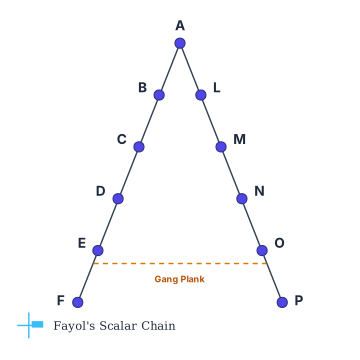
What the Diagram Shows
A single head, A, sits at the apex of two separate lines of authority running down to the lowest rank. One line runs A-B-C-D-E-F; the other runs A-L-M-N-O-P. A dashed horizontal line, the Gang Plank, joins E directly to O — two people at the same level of authority, but on two different lines.
What It Teaches
It illustrates Fayol's principle of Scalar Chain — the formal line of authority and communication that runs from the highest rank to the lowest, and which managers and subordinates are expected to follow. In the normal course of formal communication, this chain must not be violated: if E needs to reach O, the message should formally travel the full route E-D-C-B-A-L-M-N-O, exactly as it would in practice when a worker's concern must pass up through foreman, superintendent, manager and director rather than go straight to the CEO. But Fayol also recognised that rigidly following the chain can delay urgent action, so he allowed a shortcut: in an emergency, E can contact O directly through the Gang Plank, a shorter route provided so that time-critical communication is never held up by the …

Drawn by us to help you understand the concept clearly, and verified to make sure it's accurate. For exams, practice from your textbook's own diagram.
What the Figure Shows
Our own schematic shows two trainee employees handing a report — titled "Report Options & Opportunities for Growth" — to a senior manager, with a monitor behind them displaying a rising trend line.
What It Teaches
It illustrates Fayol's principle of Initiative — the thirteenth of his fourteen principles of management. Fayol held that workers should be encouraged to develop and carry out their own plans for improvement: initiative means taking the first step with self-motivation, thinking out and executing a plan, and it is one of the traits of an intelligent person. Initiative should be encouraged — though Fayol was careful to add that it does not mean going against a company's established practices merely for the sake of being different. In practice, this means a good company runs an employee suggestion system, through which initiative and suggestions that lead to a substantial reduction in cost or time are actively rewarded …
| Sl. No. | Name of Principle | THEN | NOW |
|---|---|---|---|
| 1 | Division of Work | Specialisation in workers' Job design | Generalisation in workers' Job design |
| 2 | Authority & Responsibility | Managers are empowered | Employees are empowered |
| 3 | Discipline | Formalised Controls | Informal, Peer pressure controls |
| 4 | Unity of Command | Subordinates report to only one boss | Subordinates report to multiple bosses |
| 5 | Unity of Direction | Functions have only one plan and one boss | Functions have multiple plans and multiple bosses |
| 6 | Subordination of individual interest to common good | Employees are committed to the organisation | Organisation is committed to the employees and vice versa |
| 7 | Remuneration of personnel | Reasonable Pay reward system | Performance based reward system |
| 8 | Centralisation | Trickle down decision making | Task relevant ad hoc decision making |
| 9 | Scalar Chain | Hierarchical, formalised communication channel | Less formalised, flatter communication structure |
| 10 | Order | Internal information system for control purposes | Internal information system for coordination purposes |
| 11 | Equity | Commitment obtained through kindness | Commitment obtained through a sense of ownership |
| 12 | Stability of tenure of personnel | Train employees and encourage them to remain | On-going employee training and development |
| 13 | Initiative | Managers conceive and implement new ideas | Workers conceive and implement new ideas |