Imagine you have only 4 hours to study after school. You can spend them all on Physics, all on Economics, or split them between the two. If you study only Physics, you might master 4 chapters. If only Economics, you could finish 6 chapters. But if you split your time, you get some of both — maybe 3 Physics chapters and 3 Economics chapters.
That trade-off is the core idea behind the Production Possibility Frontier (PPF).
What the PPF actually is
The PPF is a curve that shows all the maximum combinations of two goods (or services) an economy can produce when it uses all its resources fully and efficiently, given the current technology.
Think of a country that produces only two things: wheat and cloth. It has a fixed amount of land, labour, and machines. If it puts everything into wheat, it gets, say, 100 tonnes of wheat and zero cloth. If it puts everything into cloth, it gets 50 metres of cloth and zero wheat. In between, there are many possible combinations — 80 tonnes of wheat and 20 metres of cloth, or 50 tonnes of wheat and 35 metres of cloth, and so on.
Plot these points on a graph: wheat on the x-axis, cloth on the y-axis. The curve that connects them is the PPF.
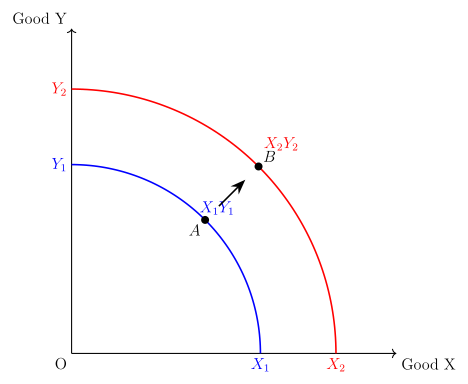
The PPF is always drawn as a downward-sloping curve that is concave to the origin (bowed outward). The downward slope is obvious — to get more of one good, you must give up some of the other. The outward bow shape comes from the law of increasing opportunity cost, which we'll see in a moment.
The key ideas the PPF teaches
1. Scarcity and choice
The PPF is a picture of scarcity. You cannot have everything — the economy cannot produce a point outside the curve (like 100 tonnes of wheat and 50 metres of cloth) because resources are limited. Every point on the curve is efficient; every point inside the curve (like 40 tonnes of wheat and 10 metres of cloth) means resources are lying idle or being used wastefully.
2. Opportunity cost
Moving from one point on the PPF to another means producing more of one good and less of the other. The amount of the good you give up is the opportunity cost of getting more of the other good.
Here's where the shape matters. Because resources are not equally suited to producing both goods, the opportunity cost increases as you produce more of one good. Early on, you shift land that is great for wheat into cloth production — you lose only a little wheat for a lot of cloth. But as you keep shifting, you start pulling land that is excellent for wheat but terrible for cloth. Now you lose a lot of wheat for just a little extra cloth. This is the law of increasing opportunity cost, and it is why the PPF is bowed outward (concave to the origin).
Marginal Opportunity Cost (MOC) = Units of good gainedUnits of good given up
For example, if moving from combination A to B means losing 10 tonnes of wheat to gain 5 metres of cloth, the MOC of 1 metre of cloth is 510=2 tonnes of wheat.
3. Efficiency and inefficiency
- Points on the PPF: The economy is using all resources fully and efficiently. You cannot produce more of one good without producing less of the other.
- Points inside the PPF: Resources are underutilised — maybe there is unemployment, or factories are running below capacity. You can produce more of both goods without sacrificing anything.
- Points outside the PPF: Unattainable with current resources and technology.
4. Economic growth
If the economy gets more resources (more labour, more capital) or better technology, the entire PPF shifts outward. Now combinations that were previously impossible become possible. This is what we call economic growth.
Why the PPF matters (NCERT's emphasis)
The NCERT textbook uses the PPF to introduce three fundamental economic problems:
- What to produce? — Which point on the PPF should we choose?
- How to produce? — Which production method (labour-intensive or capital-intensive) keeps us on the PPF? …