Biology · Ch 8 — Microbes in Human Welfare
Microbes in Sewage Treatment
Microbes in Sewage Treatment
Microbes are the backbone of modern sewage treatment. Without them, the process of breaking down the enormous organic waste load in domestic wastewater would be impossibly slow and expensive. Sewage — the liquid waste from homes, hospitals, and offices — contains a huge amount of organic matter (proteins, carbohydrates, fats) along with suspended solids and pathogens. The goal of treatment is to reduce this organic load to a safe level before the water is released into rivers or the sea.
The entire treatment process is divided into two main stages: primary treatment and secondary treatment. Primary treatment is purely physical — it involves filtration and sedimentation to remove solid debris and settleable solids. The water that comes out of primary treatment still contains a high amount of dissolved organic matter. That is where microbes take over.
Secondary treatment is the biological heart of the process. The primary-treated effluent is pumped into large aeration tanks where it is constantly stirred and mixed with air. This creates an ideal environment for aerobic microbes — mainly bacteria and fungi — to grow rapidly. These microbes consume the dissolved organic matter as their food, breaking it down into carbon dioxide, water, and other simple substances. As they feed, they multiply, forming flocs — fluffy, mesh-like masses of bacteria and fungi held together by slimy secretions. These flocs are the workhorses of the system.
After several hours of aeration, the mixture (now called the effluent) is passed into a settling tank. Here, the microbial flocs settle to the bottom as a sludge, while the clear supernatant water above is ready for further treatment or discharge. This clear water is now low in organic content and can be released into natural water bodies.
The settled sludge is not discarded. A portion of it is pumped back into the aeration tank to maintain a healthy population of microbes. The rest is sent to an anaerobic sludge digester. Inside this sealed tank, in the complete absence of oxygen, a different set of anaerobic bacteria digests the sludge. These bacteria break down the organic matter further, producing a mixture of gases — mainly methane, hydrogen sulphide, and carbon dioxide. This gas mixture is called biogas. Biogas is a valuable fuel that can be used to generate electricity or run heating systems for the treatment plant itself.
The biogas produced in the digester is a renewable energy source. Many modern sewage treatment plants are energy self-sufficient because of this methane generation.
The digested sludge that remains after biogas production is rich in nutrients. It is dried and can be used as an organic fertiliser or soil conditioner. This completes the cycle — waste is converted into clean water, energy, and fertiliser, all driven by microbial activity.
- Primary treatment: Physical removal of solids (filtration, sedimentation).
- Secondary treatment: Biological oxidation of dissolved organic matter by aerobic microbes in aeration tanks.
- Flocs: Aggregates of bacteria and fungi that form during aeration; they settle in the settling tank. …
Drawn by us to help you understand the concept clearly, and verified to make sure it's accurate. For exams, practice from your textbook's own diagram.
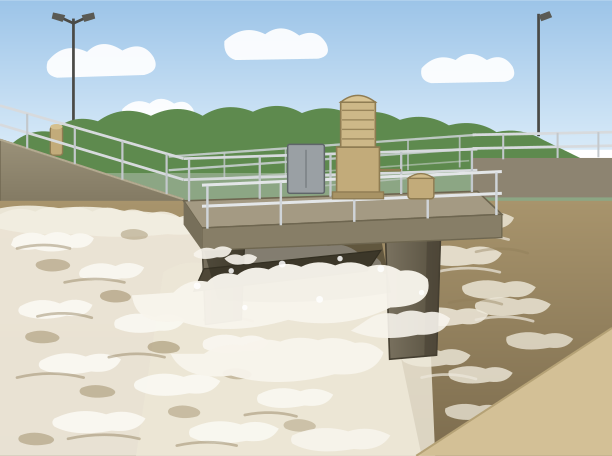
The real NCERT photograph for Figure 8.6 shows a single physical aeration tank at a sewage treatment plant: a raised concrete walkway with a metal railing spans a tank of visibly frothy, churning water, with a mechanical housing (the aerator/agitator motor) mounted on the walkway. It is a plain photograph -- there are no arrows, labels, or annotations for "primary effluent", "flocs", "settling tank", or "activated sludge" printed on the image itself.
What the photograph illustrates, per the section's own text: the primary effluent is pumped into a tank like this one and is constantly agitated and aerated -- mechanically stirred and supplied with air -- so that aerobic microbes can grow vigorously. These microbes form flocs (masses of bacteria together with fungal filaments) that consume the dissolved organic matter in the effluent, which is what reduces its BOD (biochemical oxygen demand). The effluent leaving a tank like this one is passed on to a separate settling tank, where the flocs settle out as activated sludge; part of that sludge is recycled back into the aeration tank as inoculum, and the rest goes to anaerobic sludge digesters. …
Drawn by us to help you understand the concept clearly, and verified to make sure it's accurate. For exams, practice from your textbook's own diagram.
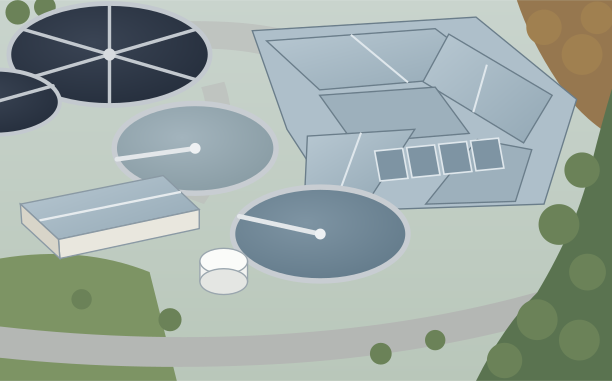
The real NCERT aerial photograph of a sewage treatment plant shows several large circular tanks — the settling tanks (primary treatment) and aeration tanks (secondary treatment) — but it also clearly shows a rectangular building or shed alongside the tanks, plus trees and vegetation bordering the site. It is not simply open ground with tanks and nothing else.
The circular tank shape allows continuous, efficient settling of solids and uniform mixing of air and microbes; channels connect the tanks in sequence, carrying wastewater from one treatment stage to the next. The photograph illustrates that sewage treatment is a sequential, multi-step process handling enormous volumes of wastewater from an entire city — run alongside ordinary site infrastructure (buildings, landscaping), not in isolation from it. …