Biology · Ch 5 — Molecular Basis of Inheritance
Replication
Replication
The moment Watson and Crick proposed the double helix, they also saw how it could copy itself. In their own words from 1953: “It has not escaped our notice that the specific pairing we have postulated immediately suggests a possible copying mechanism for the genetic material.” That single insight laid the foundation for understanding DNA replication.
The logic is simple and elegant. The two strands of DNA are complementary — wherever one strand has an adenine, the other has a thymine; wherever one has a guanine, the other has a cytosine. If the two strands separate, each can serve as a template (a mould) for building a new partner strand. Free nucleotides in the nucleus will line up opposite their complementary bases on the exposed template strand, and enzymes will link them together into a continuous chain.
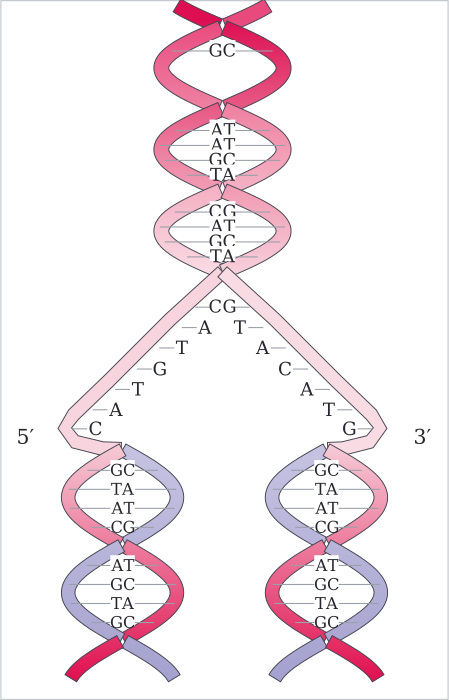
When replication finishes, each of the two resulting DNA molecules contains one old strand (from the original parent molecule) and one brand-new strand. Because each daughter molecule conserves one parental strand, this mechanism is called semiconservative replication. The name captures the key idea: half of the original DNA is conserved in each copy. …
Drawn by us to help you understand the concept clearly, and verified to make sure it's accurate. For exams, practice from your textbook's own diagram.
The figure shows a simple, two‑panel diagram that illustrates the core idea Watson and Crick proposed in 1953. On the left is a single DNA double helix, drawn as two antiparallel strands twisted together. The two strands are labelled Parental strands — they are the original, pre‑existing DNA. The figure uses a clear visual convention: one parental strand is shown as a solid line, the other as a dashed line (or sometimes in two different colours), to distinguish them from the new material that will appear.
An arrow points from this intact double helix to the right‑hand panel, which depicts the replication process. Here the two parental strands have separated lengthwise, like a zipper opening. Each separated parental strand now serves as a template. Along each template, a new complementary strand is being synthesised. The new strands are drawn with a different line style (often dotted or a lighter shade) and are labelled Newly synthesised strands. The figure makes it clear that the new strand on one side is built in the opposite direction to the new strand on the other, reflecting the antiparallel nature of DNA.
At the bottom of the right panel, two complete daughter DNA molecules are shown. Each daughter molecule consists of one parental strand (the original solid/dashed line) and one newly synthesised strand (the dotted/lighter line). This is the key visual message: after replication, neither daughter molecule is entirely old nor entirely new — each is a hybrid. The figure therefore directly illustrates the term semiconservative: half of the original DNA is conserved in each daughter molecule.
No enzymes, replication forks, Okazaki fragments, or other molecular machinery are shown. The figure is deliberately schematic, focusing only on the strand‑separation and template‑copying principle. The labels are minimal: “Parental strands”, “Newly synthesised strands”, and sometimes an arrow or bracket indicating the direction of synthesis. The entire layout is a before‑and‑after comparison: one helix on the left, two helices on the right, with the separation and copying step in between. …